



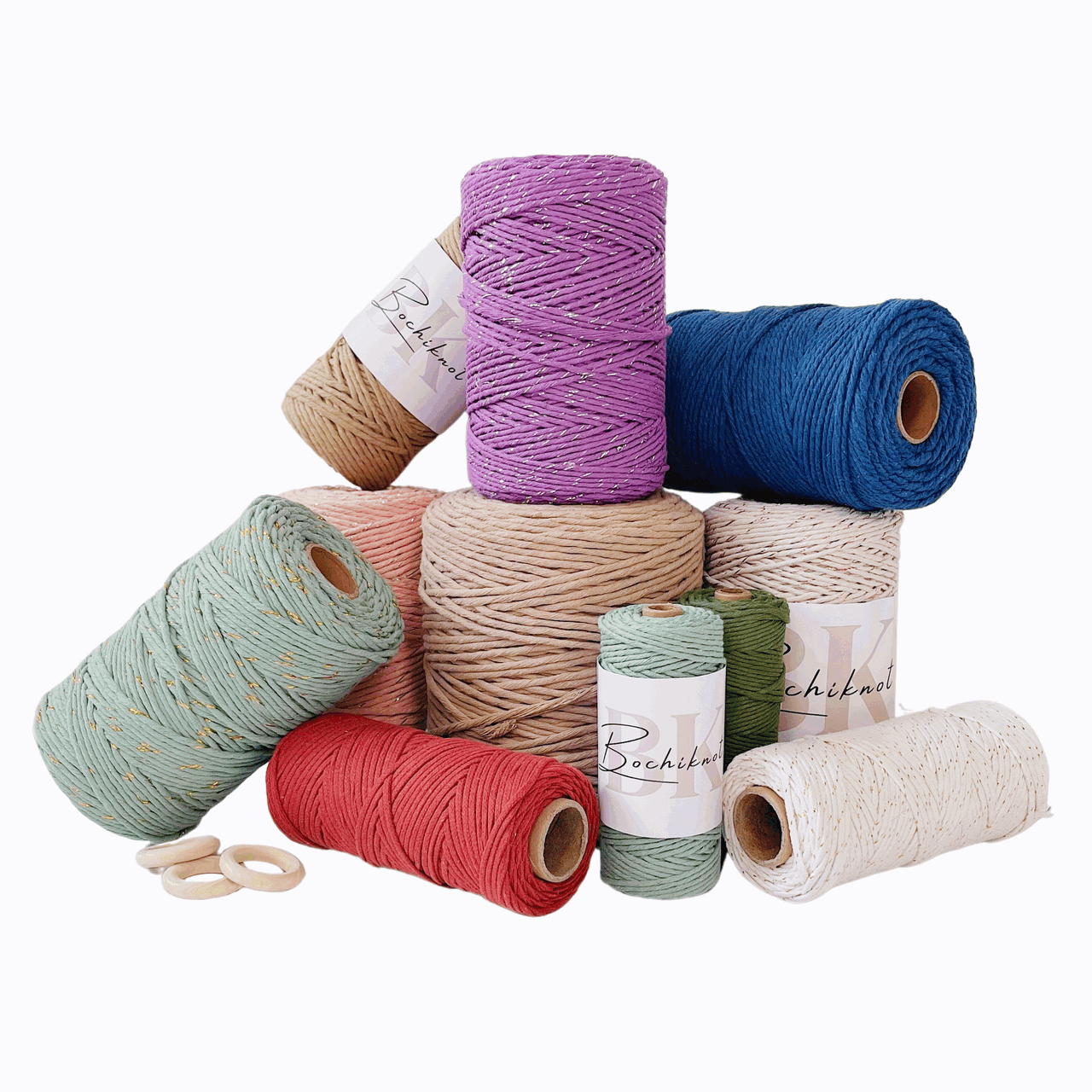
How to Choose the Best Macramé Cord: Types, Materials & Sizes

Updated 2026 · 20 min read

Updated April 2026 · 20 min read
Trusted by 100,000+ on YouTube · 100,000+ on Instagram · 40,000+ Facebook community · 20,000+ on Pinterest · 10,000+ email subscribers
Quick Answer:
- Best beginner cord: 3mm single-strand natural cotton — soft, forgiving, great fringe
- Best for plant hangers & bags: 3-ply or braided cotton for structure and strength
- Best premium cord: Lush bamboo-rayon or Egyptian Giza — silkier, smoother, noticeably higher-quality finish
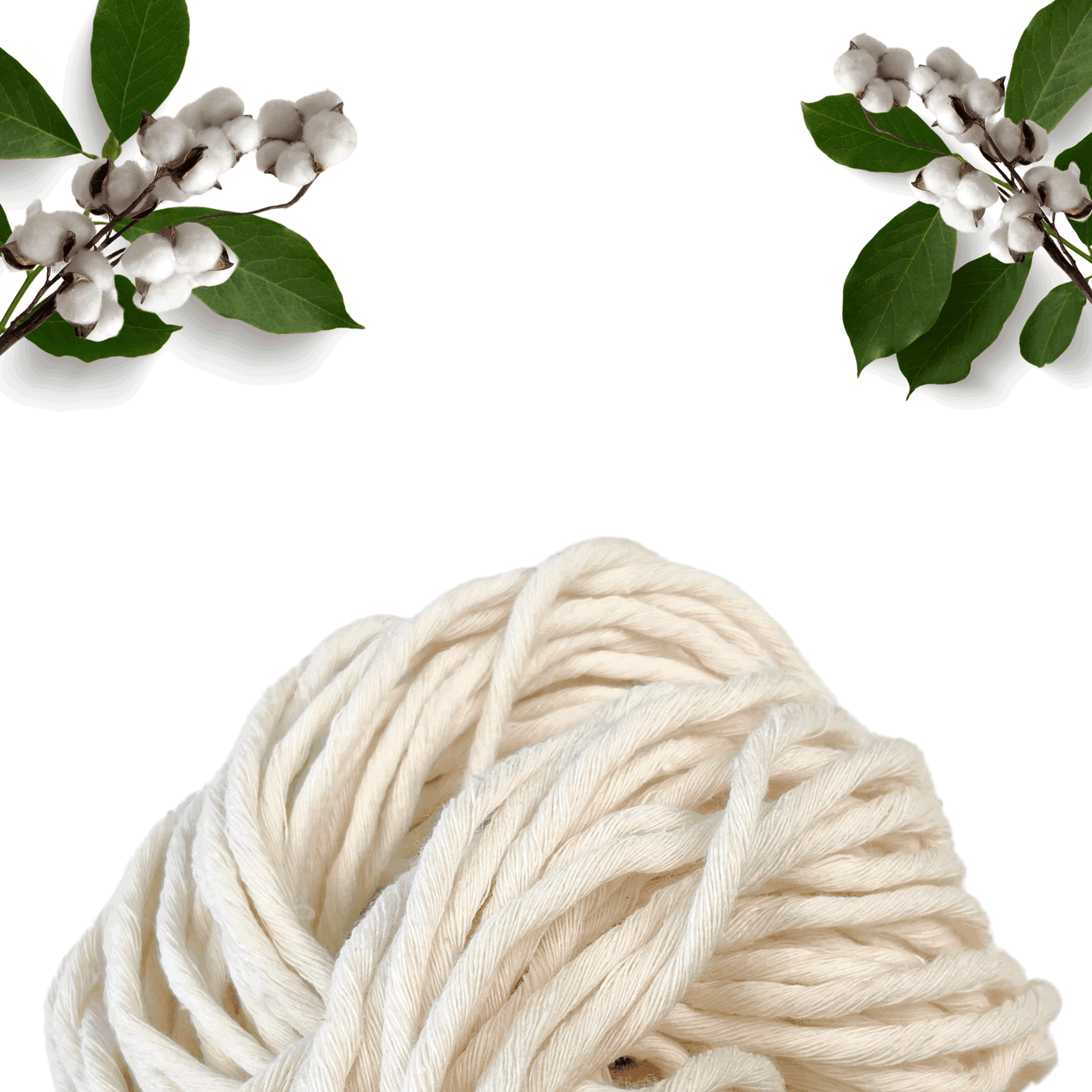
- Best eco cord: Recycled cotton — same performance, lower environmental footprint
- Not sure yet? Jump to the Cord Decision Guide →
You found a macramé tutorial you love. You order some cord. You start knotting — and something feels wrong. The fringe won't brush out properly. The knots look loose and uneven. The finished piece looks nothing like the tutorial photo. The cord is the problem.
Choosing the wrong macramé cord is the single most common reason beginner projects don't turn out as expected — and it's entirely avoidable once you understand the differences. The right cord for a boho wall hanging is not the right cord for a plant hanger. The right cord for a premium gift piece is not the same cord you'd use for a market bag. Material, construction, and thickness all matter.
This is the only guide you need. By the end, you'll know exactly which cord to choose for any project — and you'll never waste money on the wrong supplies again.
Prefer to watch? This guide is also available as a full video tutorial on our YouTube channel — 100,000+ subscribers.
In This Guide
- Part 1: Cord construction types (single-strand, 3-ply, braided)
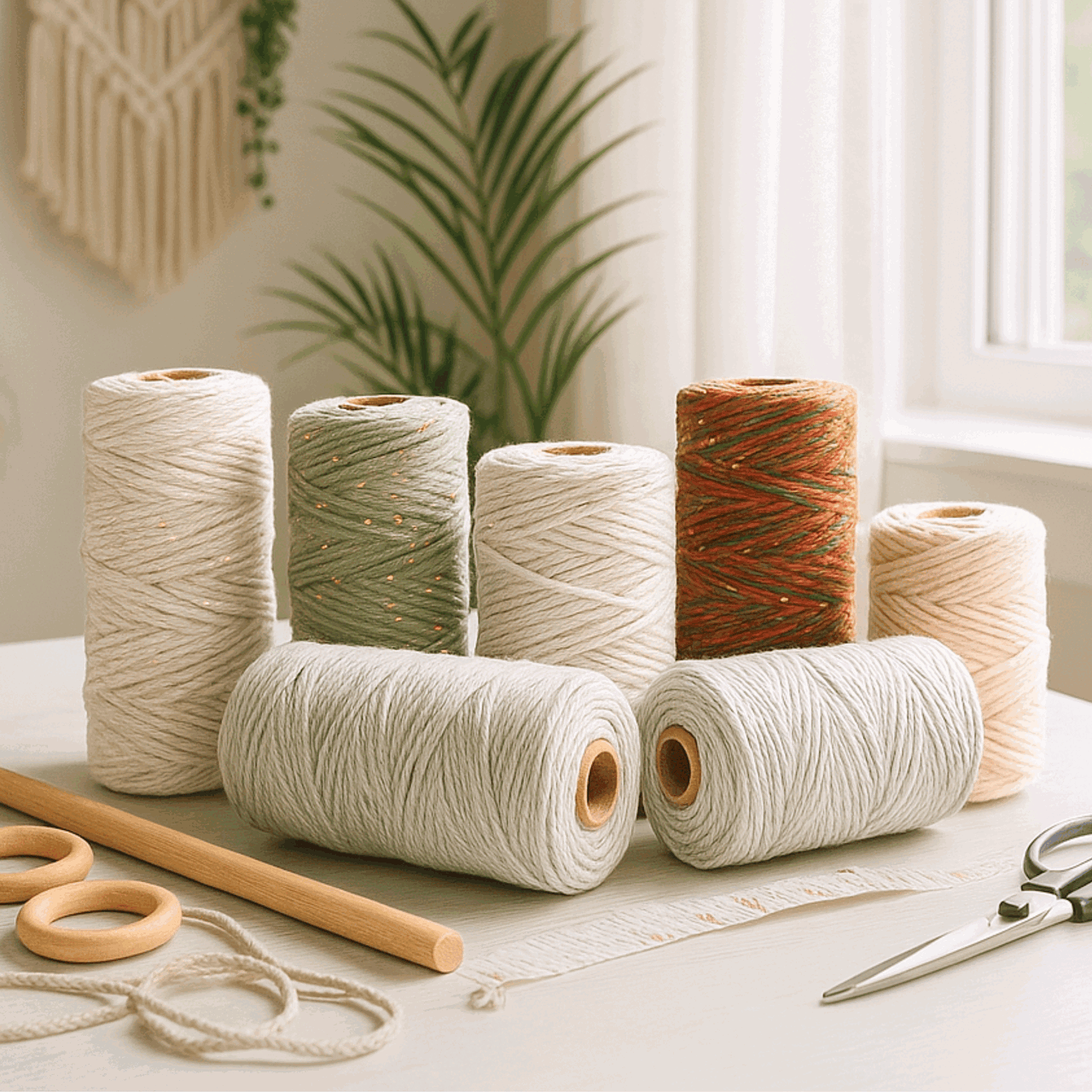
- Part 2: Cord materials — cotton, bamboo, recycled, metallic & more
- Premium cord comparison: recycled vs Giza vs bamboo
- Other cord types: wax, hemp & satin
- Part 3: Cord sizes — 1–2mm, 3–5mm, and 6mm+
- How much cord do I need?
- Common cord-buying mistakes
- Cord colour — natural vs pre-dyed
- Cord care & washing
- What to look for when buying cord online
- Cord decision guide (find yours fast)
- Frequently asked questions
Part 1: Cord Construction Types — Single-Strand, 3-Ply & Braided
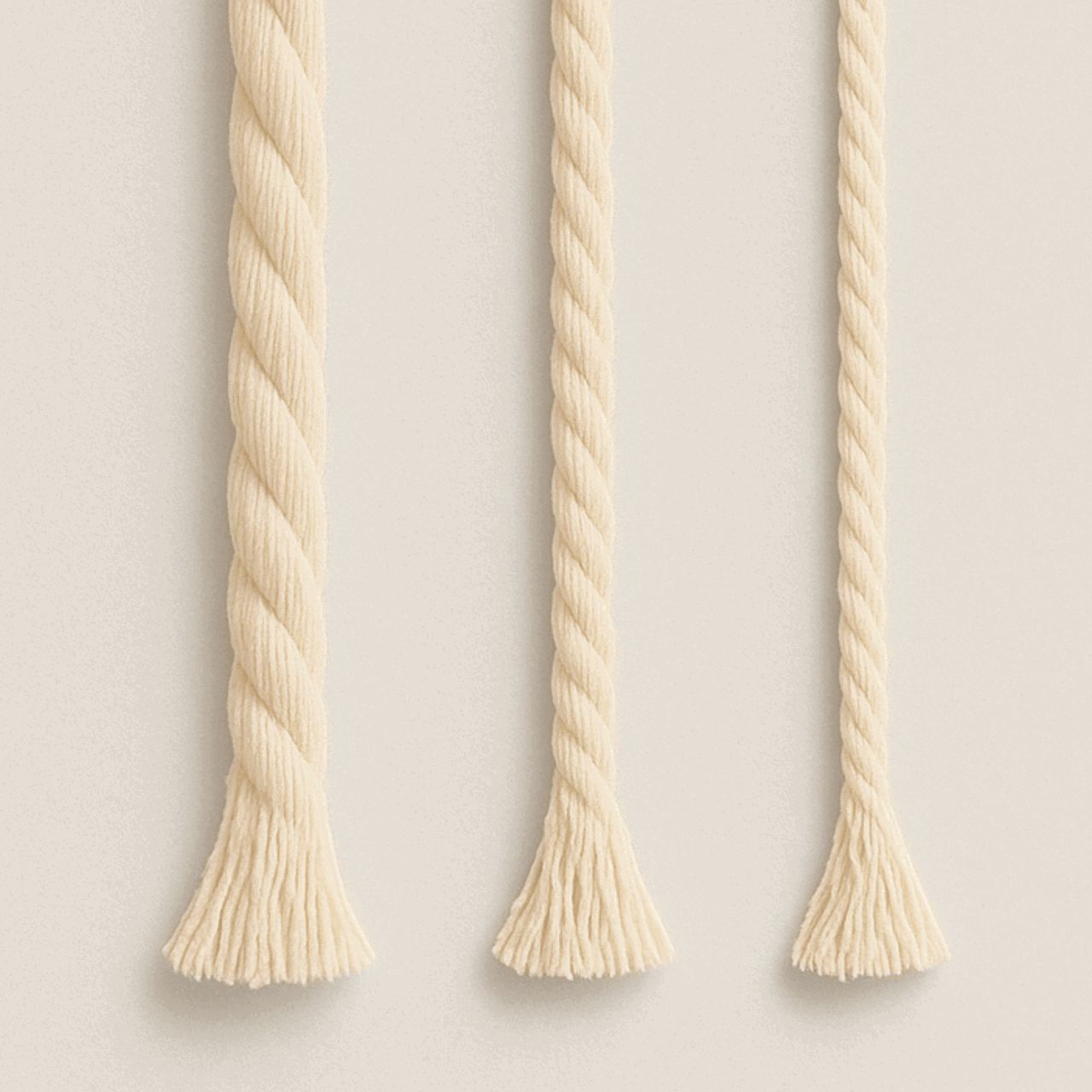
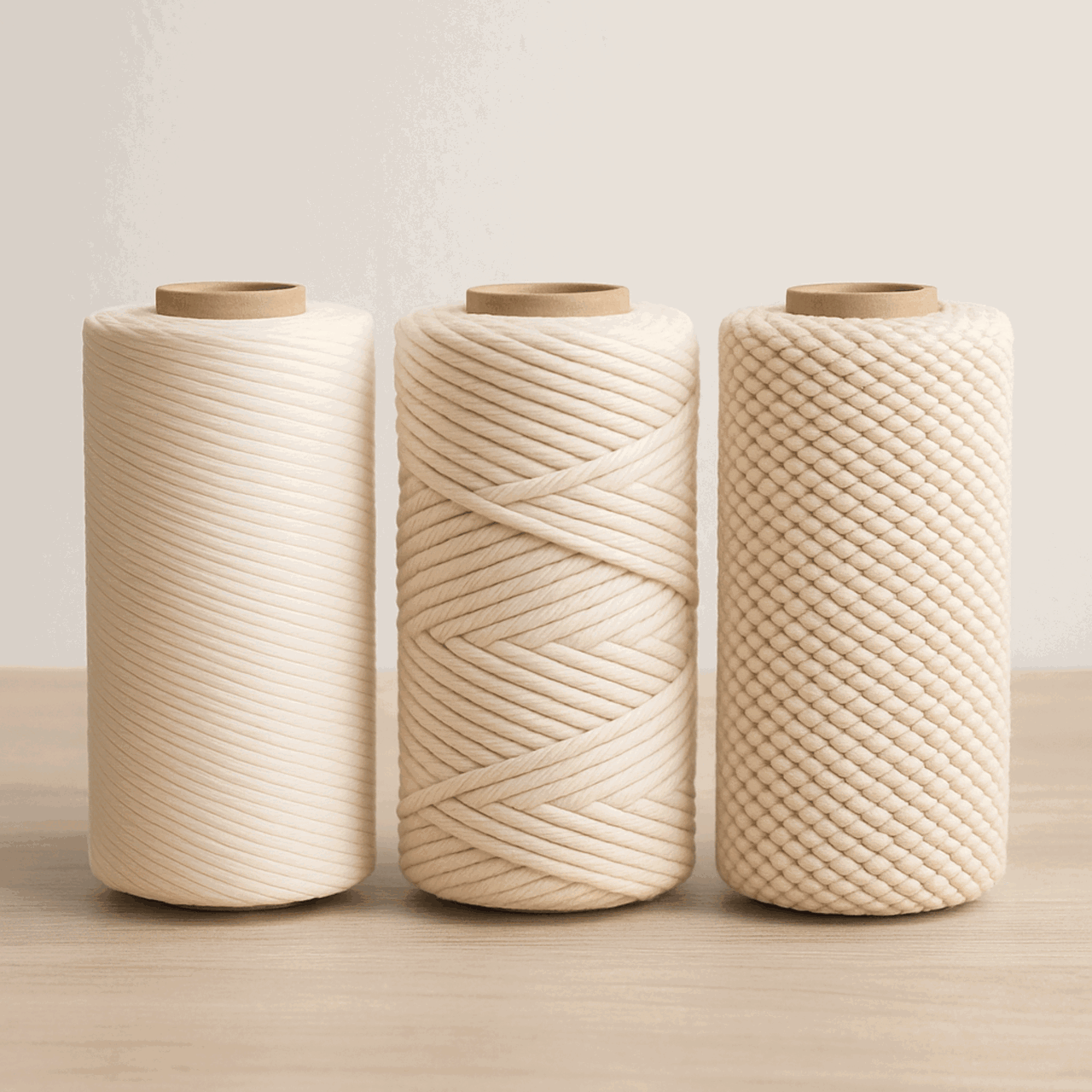
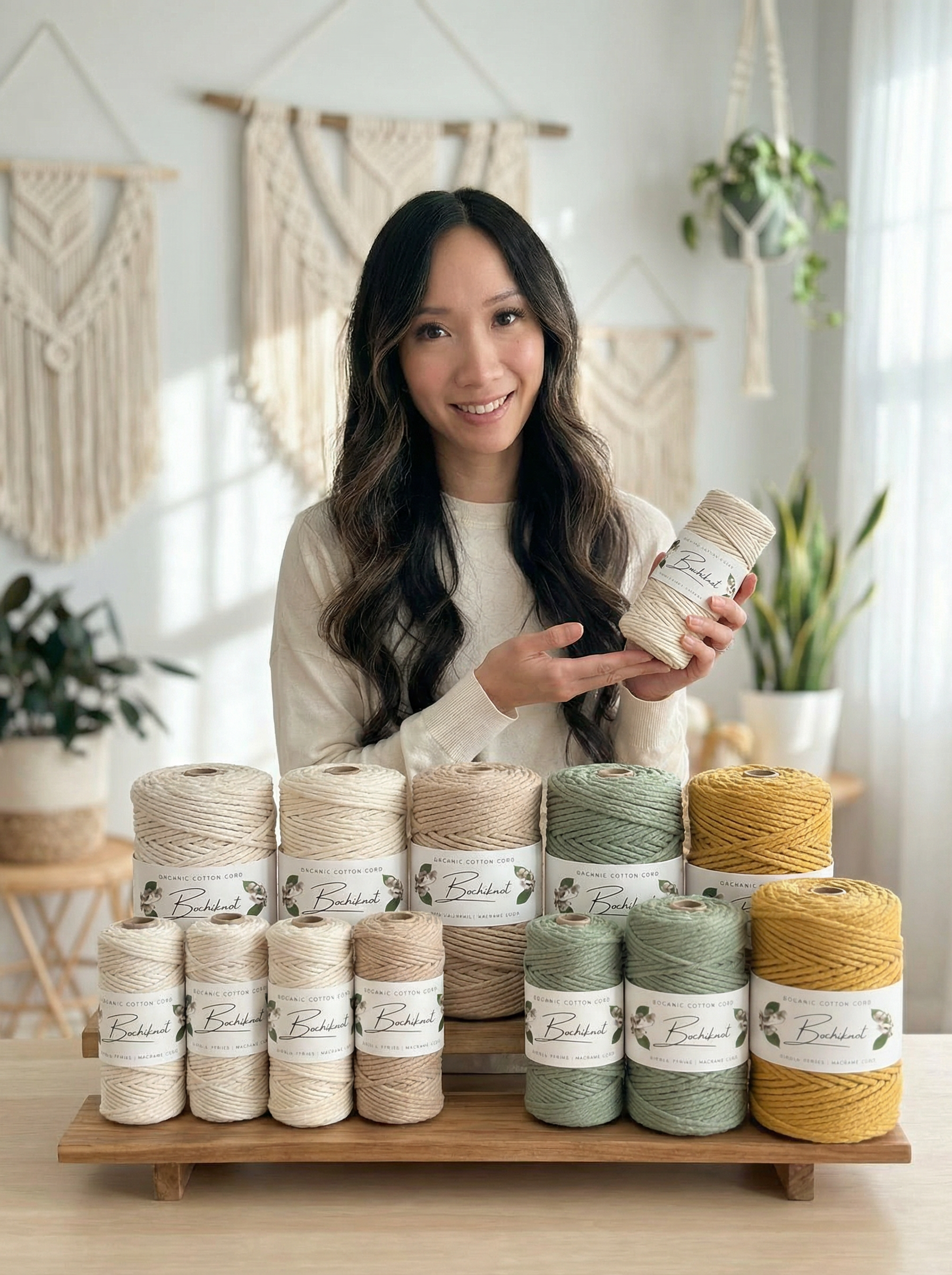
Before we talk about materials, you need to understand construction — how a cord is physically built. The same cotton fibre can be twisted into a single-strand cord, plied into a 3-ply rope, or woven into a braided cord. Each behaves completely differently when you knot it.

Single-Strand Twisted Cord
Single-strand cord is made of many individual fibres loosely twisted together into one continuous rope. It's the most popular cord type in macramé — and for good reason.
- Texture: Soft, slightly fuzzy, with visible twist direction along the rope
- Knotting feel: Easy to grip, very forgiving of tension variation — ideal for beginners
- Fringe: Unravels beautifully into fluffy, cloud-like fringe when you unbraid the twist and brush it out
- Knot definition: Good — creates that signature boho texture
Best for: Wall hangings, feather decorations, anything with fringe, beginner projects
→ Shop single-strand cord
Pro tip: If you want that fluffy, full fringe finish, single-strand is the only cord that brushes into it properly. Use a stiff fringe brush to comb unravelled ends outward, then trim to shape.
3-Ply Rope Cord
3-ply cord is made from three individual strands, each already twisted, then wound together in the opposite direction. The counter-twist locks the structure in place, creating a firm, durable rope.
- Texture: Structured, substantial, rope-like feel with visible three-strand twist
- Knotting feel: Firmer than single-strand — knots feel more deliberate and hold their shape well
- Fringe: Can be unravelled into fringe, but it's more work — each of the three strands separates into smaller sections
- Knot definition: Very clean, well-defined — knots sit neatly without looking loose
Best for: Plant hangers, market bags, outdoor pieces, projects that need to hold weight or maintain structure
→ Shop 3-ply cord
Braided Cord
Braided cord is made with fibres interlocked in a diagonal weave pattern rather than twisted. The result is a smooth, firm surface that behaves very differently from twisted cords.
- Texture: Smooth, almost slick surface — minimal fuzziness, very clean appearance
- Knotting feel: Less stretch than twisted cord — knots stay exactly where you place them
- Fringe: Does not unravel into fringe — the interlocked weave holds together
- Knot definition: Very sharp, precise edges — great for structured, geometric patterns
Best for: Macramé bags, accessories, projects where you want very clean, precise knot edges
→ Shop braided cord
| Construction | Texture | Fringe-Friendly? | Best For |
|---|---|---|---|
| Single-Strand | Soft, slightly fuzzy | Yes ✓ (best for fringe) | Wall hangings, feathers, beginner projects |
| 3-Ply Rope | Firm, structured, rope-like | Moderate | Plant hangers, bags, weight-bearing pieces |
| Braided | Smooth, firm, clean surface | No ✗ | Bags, accessories, geometric precision work |
Part 2: Cord Materials — Which Fibre Is Right for You?
Construction tells you how the cord is built. Material tells you what it's made of. Different fibres behave differently in your hands, look different in finished pieces, and suit different project types and aesthetics.
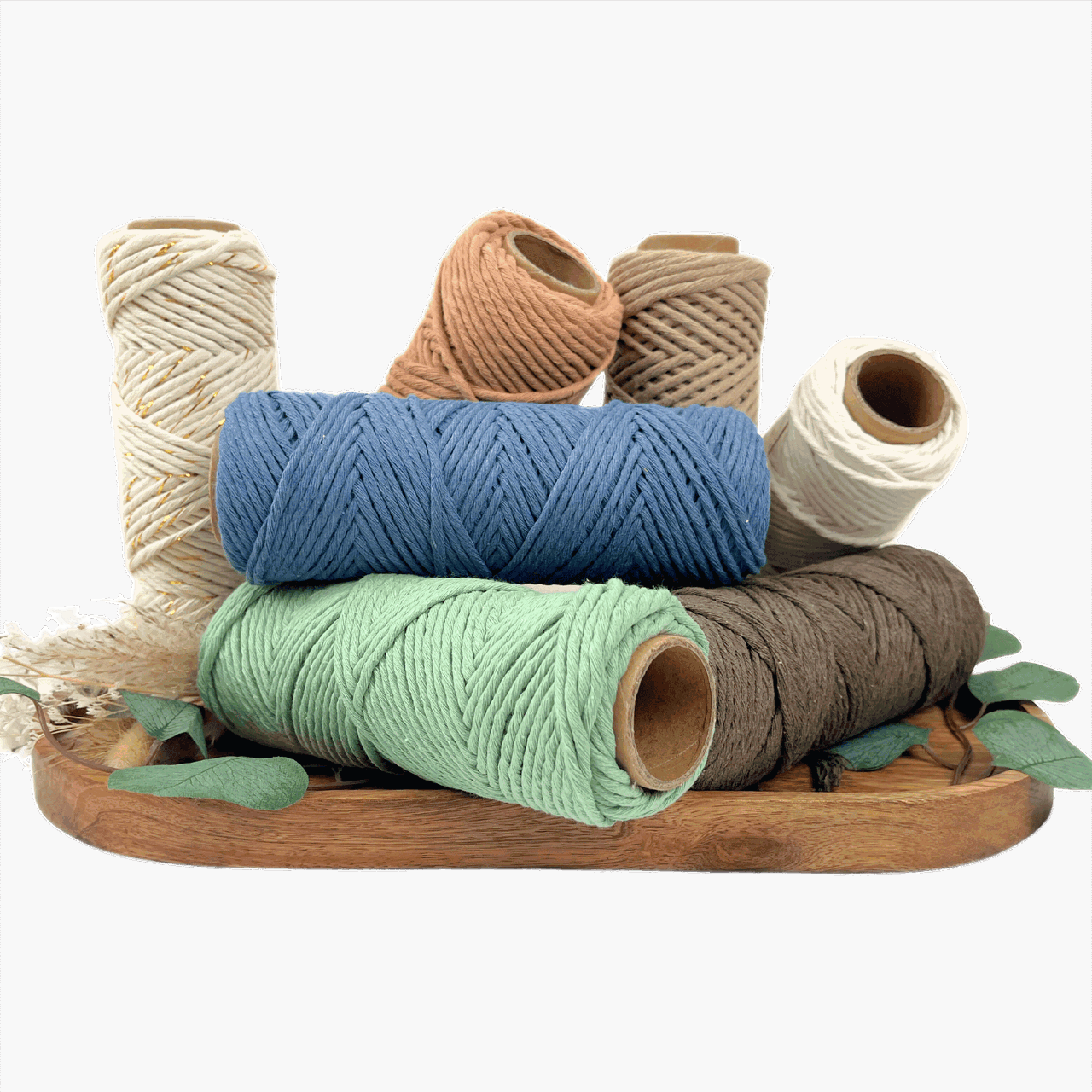
Quick Comparison: All Cord Materials at a Glance
| Material | Texture & Feel | Best For | Fringe? | Skill Level |
|---|---|---|---|---|
| Natural Cotton | Soft, matte, slightly fluffy | Everything — most versatile | Yes ✓ | All levels |
| Organic Cotton | Soft, natural cream-white | Natural aesthetic, eco projects | Yes ✓ | All levels |
| Recycled Cotton | Slightly textured, artisan feel | Sustainable projects, gifts | Yes ✓ | All levels |
| Egyptian Giza Cotton | Ultra-smooth, silky, fine | Premium décor, gifts, commissions | Yes ✓ | Intermediate+ |
| Bamboo-Rayon | Silky, lustrous sheen, drapes fluidly | Luxury home décor, fashion, wearables | Moderate | Intermediate+ |
| Metallic | Firm, sparkly, catches light | Holiday décor, jewelry, statement pieces | No ✗ | Intermediate |
| Wax Cord | Smooth, waxy, very firm | Jewelry, micro-macramé, bracelets | No ✗ | All levels |
| Hemp | Rough, stiff, natural golden-tan | Rustic décor, outdoor, garden | No ✗ | Intermediate |
| Satin | Extremely slippery, high sheen | Fine jewelry, wearables, decorative knots | No ✗ | Intermediate–Advanced |
Organic Cotton Cord — For Natural Purists

Organic cotton is grown without synthetic pesticides, fertilisers, or bleaching agents. In terms of knotting performance, it's essentially identical to standard cotton. The difference is in what's not in it.
- Safe for homes with pets, young children, or people with chemical sensitivities
- The natural cream-white colour pairs beautifully with wood, dried botanicals, and stone
- Takes natural/plant-based dyes exceptionally well (walnut, avocado, turmeric)
- Aligns with eco-conscious values without compromising craft quality
Limitation: Only available in the natural cream-white — no pre-dyed range.
Best for: Natural aesthetic home décor, eco-friendly gifts, crafters who care deeply about materials
→ Shop organic cotton cord
Recycled Cotton Cord — Sustainable Without Compromise

Recycled cotton cord is made from reclaimed textile fibres — giving manufacturing waste a second life as a premium craft supply. It requires significantly less water and energy than virgin cotton production.
- Slight textural variation from mixed fibre sources gives finished pieces an artisan, handmade character
- Knots well, frays into fringe, same performance as standard cotton
- Available in a range of colors — each lot has natural slight variation, which many crafters love
- A meaningful story to tell if you sell your work
Limitation: Minor colour variation between production lots. For large uniform projects, buy all cord from the same batch.
Best for: Any project where cotton works, with the added benefit of sustainability
→ Shop recycled cotton cord
Join the community: Share your finished piece with 40,000+ crafters in the Bochiknot Facebook Community. Tag us on Instagram @bochiknot — we repost our favourites.
Egyptian Giza Cotton — The Connoisseur's Cord

Egyptian Giza cotton is the same long-staple cotton variety used in luxury bed linen and fine dress shirts. The extra-long fibres produce a cord that is noticeably smoother, stronger, and more refined than standard cotton — you can feel the quality difference the moment you pick it up.
- Creates exceptionally clean, sharp knot edges — patterns look precise and intentional
- The smooth surface gives finished pieces a polished, high-end appearance
- Very strong — suitable for weight-bearing applications
- Available in natural white and premium dyed colorways
Best for: Custom commissions, high-end wall art, premium gifts, any project where the quality of finish matters
→ Shop Lush Egyptian Giza cord
Bamboo-Rayon Cord — The Luxury Upgrade

Bamboo-rayon cord is in a completely different aesthetic category from cotton. The natural lustre and fluid drape create finished pieces that look genuinely high-end — the kind of macramé you'd see priced in a design studio.
- Silky smooth texture: Unlike any cotton cord — bamboo has a natural sheen that photographs beautifully
- Fluid drape: Creates a more flowing, elegant quality in finished pieces
- Rich colour depth: Dyed bamboo produces deeper, more saturated colours than cotton
- Softer in finished pieces: Ideal for wearable accessories and anything that touches skin
Limitation: More slippery than cotton — knots must be tightened carefully. Harder to fringe. More expensive. Not recommended as a first cord for beginners.
Best for: Premium home décor, fashion accessories, wearable pieces, gift-quality projects, anything where the look is everything
→ Shop Lush bamboo-rayon cord · Browse full Lush collection
Pro tip: Not sure whether to upgrade to Lush? Buy one 50m roll of Lush bamboo or Giza alongside your usual cotton and make the same small project twice. The quality difference will be immediately visible — and you'll know which level to stock going forward.
Metallic Macramé Cord — For Statement & Seasonal Pieces

Metallic cord blends cotton or nylon fibres with metallic thread woven through the twist. The result is cord that catches the light and adds shimmer and sparkle to finished pieces. It's not an everyday macramé cord — but for the right project, there's nothing else like it.
Material makeup: Cotton or nylon core fibres wrapped or blended with metallic thread (polyester-based metallic). Our 3-ply metallic cord adds the shimmer to the structural body of the rope, so it doesn't rub off or fall out with use.
Texture and feel: Firmer than pure cotton — the metallic thread adds structure. Slightly stiff at first but becomes easier to work with as you knot. Does not fray into fringe.
Best for:
- Christmas ornaments, garlands, and seasonal décor
- New Year's and event décor where shimmer is part of the aesthetic
- Macramé jewelry — rings, necklaces, bracelets
- Contemporary wall art in spaces that need a modern, glamorous touch
- Wedding and event installations
Not ideal for: Everyday macramé projects, pieces requiring fringe, anything that needs the softness of pure cotton
→ Shop Bochiknot Metallic 3-Ply Macramé Cord
Other Cord Types: Wax, Hemp & Satin
Cotton dominates macramé for good reason — it's versatile, beginner-friendly, and produces beautiful results across nearly every project type. But three other cord types are worth knowing: wax cord for jewelry and micro-macramé, hemp cord for rustic work, and satin cord for contemporary decorative pieces.
Wax Cord — For Micro-Macramé & Jewelry
Wax cord is polyester or nylon cord coated with a thin layer of wax. The wax coating gives it a smooth, slightly sticky surface that causes knots to grip tightly and hold their position precisely — a completely different experience from knotting cotton. Available in 0.5–2mm widths in a wide range of solid colors. Knots feel solid and won't shift; the wax gives a subtle sheen without being overtly glossy.
Best for: Macramé jewelry (bracelets, rings, anklets, necklaces), micro-macramé, friendship bracelets and adjustable knotted closures, any project where small, precise, color-accurate knots matter.
Not ideal for: Large-scale macramé, fringe work, or anything requiring the soft natural aesthetic of cotton.
Hemp Cord — Rustic, Natural & Durable
Hemp is one of the oldest plant fibres in craft and textiles, with a rough, stiff character that creates a distinctly rustic aesthetic. Natural golden-tan to greenish-brown in colour. One of the most sustainable fibre crops — grows without pesticides and requires minimal water. Noticeably rougher and stiffer than cotton and can be hard on hands during long knotting sessions.
Best for: Rustic wall art and décor with an earthy, natural aesthetic; outdoor garden plant hangers (more weather-resistant than cotton); botanical-style décor.
Not ideal for: Beginner projects (stiffness makes knotting harder), fringe work, anything requiring softness or precision.
Satin Cord — High Sheen for Decorative & Wearable Work
Satin cord (also called rattail or Chinese knotting cord) is a braided polyester or nylon cord with a smooth, high-gloss satin finish. The sheen is bold and distinctive — very different from the matte natural look of cotton. Extremely smooth — almost slippery. Knots slide easily, which makes complex patterns achievable, but means knots can loosen if tension isn't maintained carefully. Available in vivid colors; finished pieces look polished and contemporary.
Best for: Fine jewelry (rings, pendants, statement necklaces), decorative Chinese-style knotwork, hair accessories, contemporary fashion macramé.
Not ideal for: Traditional wall hangings, plant hangers, fringe. The slippery surface makes it challenging for beginners.
💡 Quick rule: If you're brand new to macramé, stick with cotton. Wax, hemp, and satin cords are best explored once you understand knot tension, pattern structure, and cord behaviour in standard cotton first.
Part 3: Cord Sizes — Choosing the Right Thickness
Cord thickness is measured in millimetres (mm) and is just as important as the material. A beautiful 3mm cotton cord is entirely wrong for a large statement wall hanging. A thick 6mm cord is overkill for a delicate keychain. Getting the size right makes the project work — and getting it wrong is frustrating.

1–2mm: Fine String & Micro-Macramé
The finest end of the macramé size range. At this scale, the cord behaves less like rope and more like thread. Knots are tight, intricate, and precise.
- Creates very detailed, small-scale knotwork
- Used primarily for jewelry, keychains, and accessories
- Takes much longer to work up per square inch than thicker cord
- Requires patience and good eyesight — not a beginners' size for large projects
Best for: Keychains, friendship bracelets, macramé earrings, pendants, intricate micro-macramé patterns
→ Shop 1–2mm fine string
3–5mm: The Standard Range (Most Projects)
This is where 80% of macramé projects live. The 3–5mm range hits the sweet spot between knot definition, project scale, and working speed.
- 3mm: Ideal for beginner projects, small-to-medium wall hangings, keychains, and detailed work. A 100m roll of 3mm cord handles most standard beginner projects.
- 4mm: The most versatile size. Works for plant hangers, medium wall hangings, and bags. 4mm cord is our most popular size for good reason — it's the easiest to tension correctly and works up at a satisfying pace.
- 5mm: Faster to work up, creates bolder visual impact. Best for large wall hangings, statement plant hangers, and projects where you want a chunky, substantial look without going into the oversized range.
| Size | Best For | Skill Level | Project Scale |
|---|---|---|---|
| 1–2mm | Jewelry, keychains, micro-macramé | Any | Micro / small |
| 3mm | Beginner projects, small wall hangings, feathers | Beginner | Small–Medium |
| 4mm | Plant hangers, medium wall hangings, bags | Beginner–Intermediate | Medium |
| 5mm | Large wall hangings, statement plant hangers | Beginner–Intermediate | Medium–Large |
| 6mm+ | Chunky wall art, room dividers, hammocks | Intermediate–Advanced | Large / oversized |
6mm and Above: Chunky, Oversized & Statement Work
Once you go above 5mm, you're in statement territory. These thick cords work up quickly, create bold visual impact, and are better suited to experienced makers who understand tension and scale.
- 6mm: Good for large decorative wall hangings, floor-length installations, thick plant hangers
- 9mm+: Oversized statement pieces, room dividers, hammocks, installations. Not recommended for beginners — difficult to tension evenly at this scale
The tradeoff with thick cord: projects work up fast, but mistakes are harder to hide and re-tying knots is much more effort. Master your tension on 3–4mm before moving up.
✨ Beginner shortcut: Start with 3mm single-strand natural cotton. It's the most forgiving size and material combination in macramé. You can make almost any beginner project with it, and it teaches you tension, knot spacing, and fringe technique better than any other cord.
How Much Cord Do I Need?
One of the most common frustrations for beginner makers: running out of cord halfway through a project. Use this reference table to get a rough idea of how much cord to buy — then order a little extra, just in case.
⚠️ Disclaimer: All yardage amounts below are approximations only. The actual cord length needed for any macramé project will vary depending on the intricacy of the pattern, the project size, and the cord thickness used. For a complete breakdown of how to calculate cord length accurately, read our guide: How to Measure Macramé Cord — The Complete Guide →
| Project | Cord Size | Approx. Amount Needed | Shop Cord |
|---|---|---|---|
| Keychain / small accessory | 1–2mm | 5–15m | 1–2mm fine string |
| Small wall hanging | 3mm | 50–100m | 3mm cord → |
| Single plant hanger | 4mm | 30–60m | 4mm cord → |
| Medium wall hanging | 3–4mm | 100–200m | 2× 100m rolls |
| Macramé tote bag | 4–5mm | 150–250m | 4mm cord → |
| Large wall hanging | 5mm | 200–400m | 5mm cord → |
| Curtain / room divider | 3–5mm | 500m+ | Browse cord bundles |
Ready to buy? Browse all cord on the Bochiknot store → — or find us on Amazon.com / Amazon.ca with Prime shipping.
Common Cord-Buying Mistakes (And How to Avoid Them)
Even experienced crafters make these mistakes. Save yourself the frustration — and the wasted cord.
1. Buying the wrong construction for the project
Using single-strand cord for a plant hanger (it won't hold weight well) or 3-ply for a wall hanging that needs fringe (it doesn't unravel cleanly). Match construction to project — see the Cord Decision Guide below.
2. Underestimating how much cord you need
The most common mistake. Macramé uses far more cord than beginners expect — a rough rule of thumb is 4–5× the finished length for each working cord. Use the yardage reference table above and always buy 20–30% extra.
3. Buying cheap cord that looks the same but isn't
Low-quality cord sheds fibres, twists unevenly, and produces knots that look sloppy rather than crisp and defined. The cord is the entire finished product — this is not the place to cut corners. Cord from a reputable macramé brand will produce noticeably cleaner results.
4. Choosing cord thickness by appearance rather than project scale
A wall hanging that looks large in a photo may have been made with 3mm cord. If you scale up the design but keep 3mm cord, the finished piece will look too fine and delicate. Match the cord size to the scale of your intended finished piece.
5. Confusing "macramé cord" with regular rope or twine
Hardware store rope and garden twine are not macramé cord. They knot poorly, look rough, and don't produce the clean knot definition you see in finished macramé. Use cord specifically spun for macramé.
6. Ignoring the material entirely
If you're making a gift piece or something you want to last, material matters. Standard cotton for everyday projects, Lush premium cord when quality counts, recycled cotton when sustainability is a priority.
Choosing Cord Colour: Natural vs Pre-Dyed
Colour is often the last thing makers think about — but it's frequently the first thing people notice in a finished piece.
Natural / Undyed Cord
The classic macramé look. Natural cotton cord is an off-white to warm cream colour — not bright white, not beige. This is what you see in the majority of macramé wall hangings, boho décor, and minimalist interiors. Natural cord:
- Suits almost any interior style — especially neutral, boho, Scandi and minimalist aesthetics
- Is the most forgiving — small tension variations are harder to see in natural than in solid colour
- Can be dyed at home with fabric dye or dip-dyed for gradient effects
- Ages gracefully — natural fibres soften beautifully over time
→ Shop natural organic cotton cord
Pre-Dyed & Coloured Cord
Pre-dyed cotton cord opens up a wide range of design possibilities — from subtle earthy tones to bold statement colours. Things to know:
- Consistency matters: Quality-dyed cord should have consistent colour throughout the roll with no patchiness
- Consider colourfastness: If the piece may be washed, check whether the dye is colourfast before washing
- Colour accuracy online: Colours appear differently on different screens — order a small amount first if exact colour matching is critical
- Combining colours: Colour-blocked designs, ombré effects, and tonal combinations (e.g. cream + tan + caramel) are all achievable with pre-dyed cord
✨ Design tip: If you're unsure about colour, start with natural. You can always dip-dye a finished piece for an ombré effect — but you can't un-dye a coloured cord.
Cord Care & Washing Your Macramé
Cotton macramé is more durable than it looks — but it benefits from a little care to stay looking its best.
Dusting & light cleaning: For wall hangings and décor, a soft brush, lint roller, or gentle shake is usually all that's needed for regular maintenance. Use a hairdryer on a cool setting to fluff out fringe.
Storing unused cord: Keep rolls in a cool, dry place away from direct sunlight. UV exposure gradually yellows and weakens natural cotton fibres. Resealable bags or a dedicated craft storage box are ideal.
Metallic and wax cord: Spot clean only — do not soak or machine wash. The metallic thread and wax coatings are not designed for full immersion washing.
What to Look for When Buying Macramé Cord Online
Not all cord sold as "macramé cord" is the same. Here's what to look for — and what to avoid — when shopping online.
✅ Check for:
- Consistent twist: Good macramé cord is twisted evenly throughout the roll. Uneven twist produces uneven knots.
- Clear material disclosure: The listing should state whether it's cotton, recycled cotton, bamboo-rayon, or synthetic. Vague descriptions like "soft rope" or "natural fibre" are red flags.
- Accurate diameter: 3mm should be 3mm. Some budget cords are labelled generously — product photos showing the cord against a ruler are a good sign.
- Clean fibres: No excessive shedding or pilling visible in product photos. Reviews mentioning shedding are worth noting.
- Roll vs cut length: Make sure you know whether you're buying a full roll (e.g. 100m) or a pre-cut length. Some listings are priced per metre and look cheaper than they are.
🚩 Watch out for:
- Listings with no material information or vague descriptions
- Suspiciously cheap prices — quality macramé cord has real production costs
- Cords marketed as "jute rope" or "garden twine" rather than macramé cord
- No brand or manufacturer information — no-name cord has no reputation to protect
The safest place to buy macramé cord online is directly from a dedicated macramé brand that stakes its reputation on product quality:
Cord Decision Guide — Find Your Cord in Under a Minute
Use this table to go straight to the right cord for your project:
| I'm a complete beginner | → 3mm or 4mm single-strand natural cotton. Most forgiving — start here. |
| I care about eco impact | → Recycled cotton first. Organic cotton second. |
| I want a premium finish | → Lush bamboo-rayon for silky sheen. Giza cotton for ultra-smooth precision. |
| I'm making a wall hanging | → Single-strand cotton in 3mm, 4mm, or 5mm for large pieces. Single-strand = best fringe. |
| I'm making a plant hanger or bag | → 3-ply or braided cotton 3–5mm. More structure, holds shape under weight. |
| I'm making jewelry or keychains | → 1–2mm fine cotton string. Or wax cord for micro-macramé jewelry. |
| I want a rustic, earthy look | → Hemp cord. Rougher texture, natural golden colour — but harder on hands than cotton. |
| I'm making holiday or event décor | → Metallic 3-ply cord for shimmer. Seasonal cotton for colored accents. |
| I want shiny, glossy knotwork | → Satin cord for high sheen. Note: slippery — intermediate skill level required. |
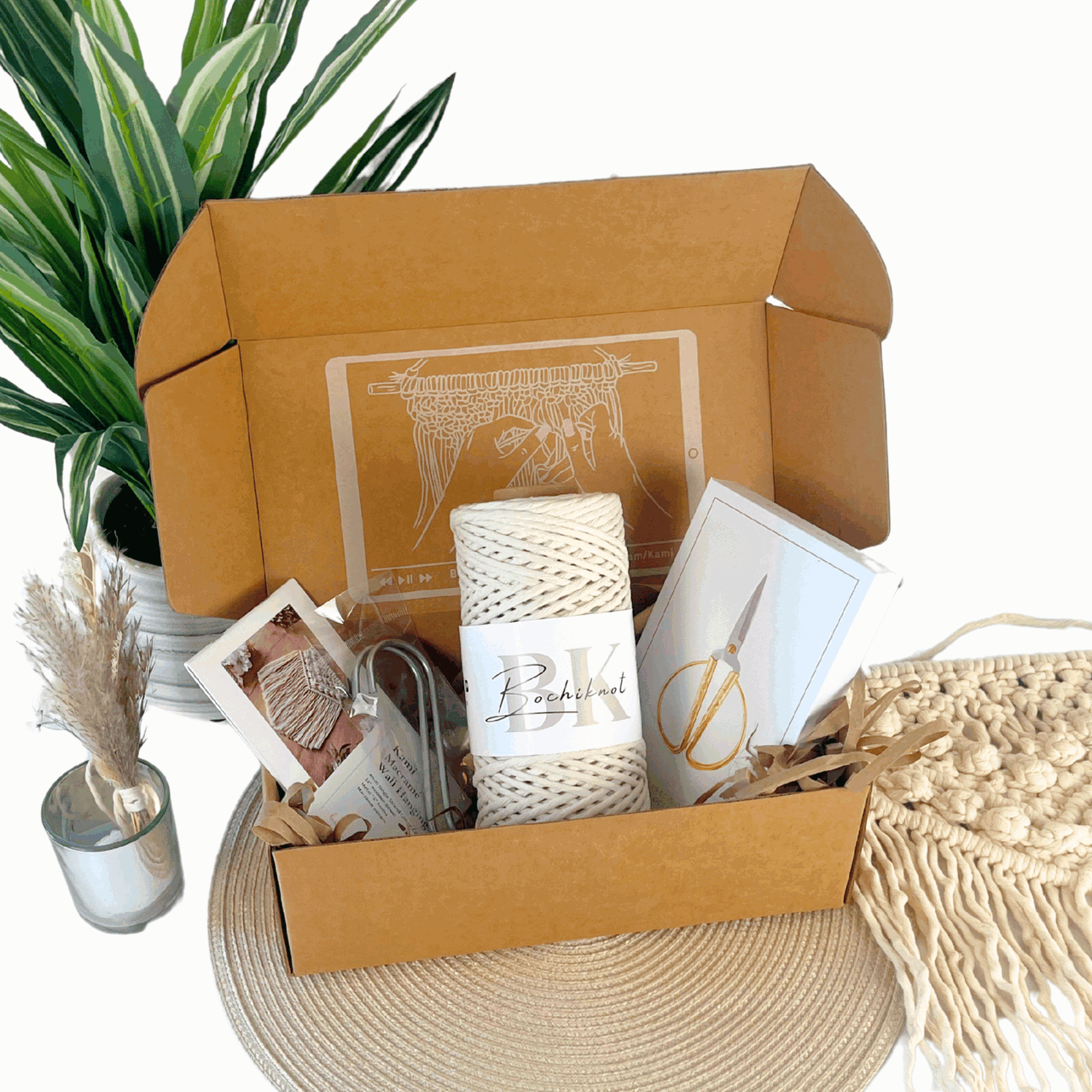
| I want everything in one box | → Starter kits — cord, hardware, pattern and video tutorial included. |

Skip the guesswork — everything's included
Cord, dowel, pattern & video tutorial in one box. No experience needed.
Shop Starter Kits →Also available on Amazon.com and Amazon.ca with Prime shipping.
Get 10% Off Your First Order
Join 10,000+ crafters. Free tutorials, new patterns & exclusive offers — straight to your inbox. No spam, unsubscribe any time.
We respect your inbox. Unsubscribe any time.
Frequently Asked Questions
What is the best macramé cord for beginners?
3mm single-strand natural cotton is the best starting cord for beginners. It's soft, forgiving, knots cleanly, and frays into beautiful fringe. A 100m roll is enough for most standard beginner wall hangings or plant hangers. Shop 3mm cord →
What's the difference between single-strand and 3-ply macramé cord?
Single-strand cord is loosely twisted — it's soft, beginner-friendly, and unravels into fluffy fringe. 3-ply is three strands twisted together — firmer, more structured, and better suited for plant hangers, bags, and pieces that need to hold weight. Both are cotton — the construction is the key difference.
What is the difference between recycled cotton and Egyptian Giza cord?
Recycled cotton is made from reclaimed textile fibres — it performs like standard cotton but has a slightly varied, artisan texture and a strong sustainability story. Egyptian Giza cotton is a premium long-staple variety that produces an ultra-smooth, refined cord with exceptional knot definition. Both are excellent quality at different price points and aesthetics.
Is cotton or jute better for macramé?
Cotton is better for the vast majority of macramé projects. It's softer, more flexible, easier on hands, and brushes into clean fringe. Jute is rough and can be harsh on hands during long sessions. It suits rustic, outdoor or garden-style pieces but is not recommended for beginners.
What is Lush cord and is it worth it?
Lush is Bochiknot's premium cord line — featuring bamboo-rayon and Egyptian Giza cotton. Both are noticeably higher quality than standard cotton — smoother, more refined, and producing more polished finished pieces. They're worth it for gift pieces, commissions, and any work where quality matters. For practice and everyday projects, standard cotton is the practical choice. Browse the Lush collection →
What macramé cord size should I buy for a wall hanging?
For most beginner wall hangings, 3mm single-strand cotton is ideal. For larger pieces (over 60cm wide), use 4mm or 5mm — they work up faster and create more visual impact at scale. A 100m roll handles most beginner and intermediate-sized wall hangings.
Can I mix different cord types in one project?
Yes — mixing cord types and textures is an advanced technique that can produce beautiful results. A common approach is using standard cotton for the main knotwork and a Lush cord as accent sections. Make sure cords are similar in thickness for consistent tension.
What cord do I need for macramé jewelry?
For jewelry, use 1–2mm fine cotton string for lightweight pieces, wax cord for precise micro-macramé work, or satin cord for high-sheen contemporary jewelry. The metallic cord range is also popular for pendants and statement pieces.
How do I know if my macramé cord is good quality?
Good quality macramé cord is evenly twisted or braided along its entire length with no thin or thick spots. It should feel consistent between your fingers and not shed excessive fibres when handled. Premium single-strand cord will unravel cleanly into soft fringe when brushed — poor quality cord shreds unevenly. Check that the fibres are tightly bound at cut ends with no loose splaying.
Does macramé cord thickness affect knot size?
Yes — cord thickness directly affects how large your knots appear. A square knot tied in 3mm cord will be roughly half the visual size of the same knot in 5mm cord. Thicker cord works up faster and creates bolder, more impactful patterns. Thinner cord produces delicate, intricate knotwork. Always match cord thickness to your project scale — a small keychain needs 2–3mm; a large statement wall hanging suits 5mm or thicker.
Can I use regular rope or string for macramé?
Technically yes, but regular hardware rope (polypropylene, nylon, sisal) is stiff, rough on hands, and won't produce the soft, brushable fringe that defines modern macramé. Macramé-specific cotton cord is purpose-built to be soft, flexible, and easy to knot for hours. For beginners, always start with proper macramé cotton cord — it makes a significant difference in both the process and the finished result.
How much macramé cord do I need for a plant hanger?
A standard single-pot plant hanger using 4mm cord requires approximately 50–75 metres (55–82 yards) of cord. Cut each strand to 4× the finished project length — for a 60cm plant hanger that means 2.4m per strand, and a typical plant hanger uses 8–16 strands. For a large multi-tier plant hanger, budget 100–150 metres. Always cut a little extra — you can trim excess but cannot add length.

About Nicole Woo
Nicole is the founder of Bochiknot Macramé and has been teaching macramé for over 5 years. She's helped over 100,000 people learn macramé through free YouTube tutorials and leads a community of 40,000+ crafters on Facebook. Bochiknot's premium macramé cord, starter kits, and patterns are trusted by makers across the US, Canada, and Australia. Read our story →
Continue Your Macramé Journey

Complete Materials Guide
Every cord type, tool, and supply explained — beginner to advanced
Read guide


Nicole has the most comprehensive information on the internet!! I never have any questions left after any of her articles. A wealth of information on all things macrame! Thank you!
Leave a comment