





How to Tie a Reverse Lark's Head + Half Hitch Knot (Step-by-Step)

Decorative Knot Tutorial · Updated May 23, 2026 · 12 min read · Phase 1
The reverse lark's head plus half hitch knot — sometimes shortened to RLHPHH — is the decorative upgrade to the basic reverse lark's head. You tie a standard reverse lark's head first, then add a single half hitch on each side. The result: a sturdier, more polished mounting knot with a small V-shape on either side that adds texture and structure to the top of any macramé wall hanging.

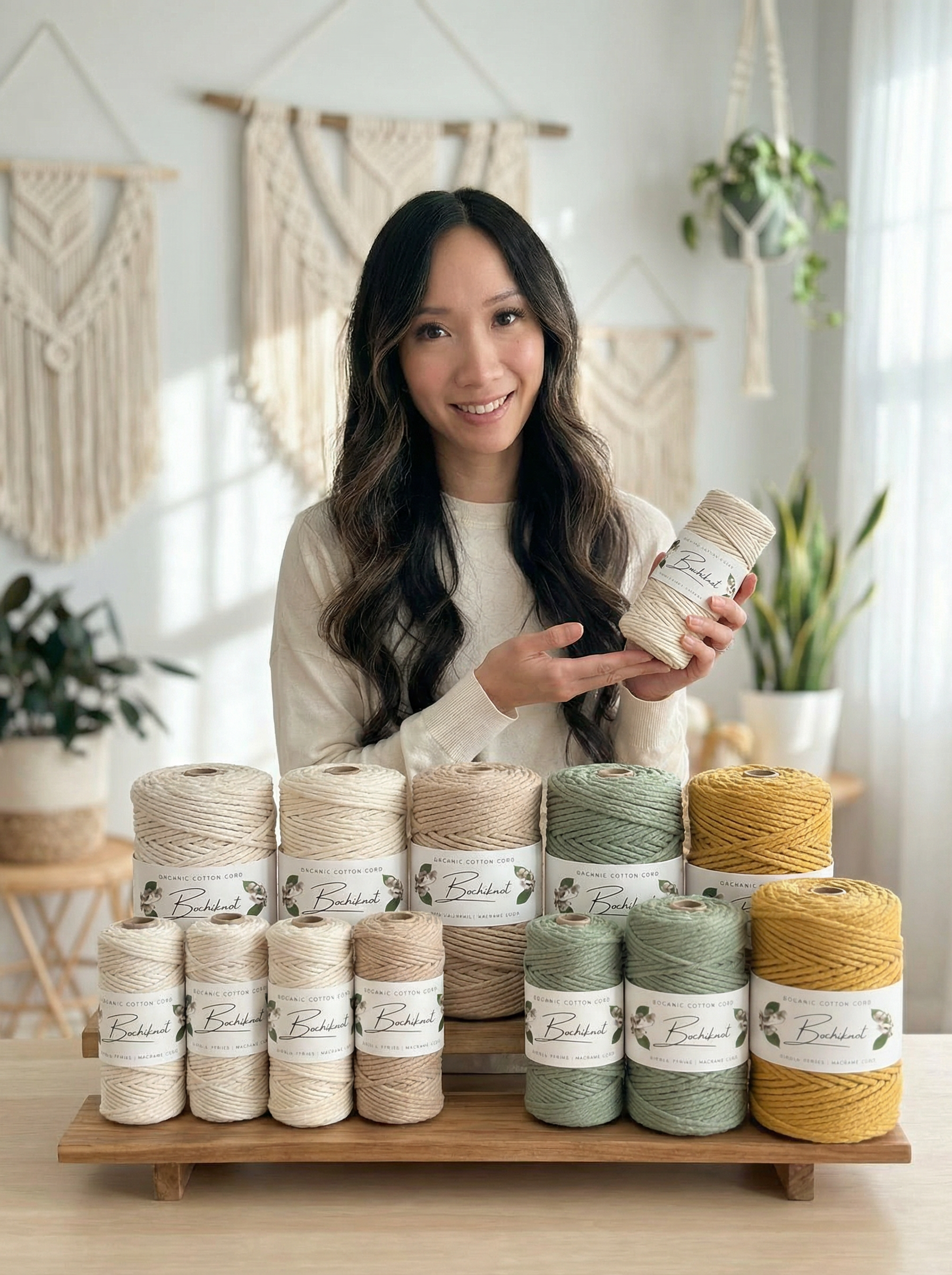
Written by Nicole Woo
Founder of Bochiknot · Teaching macramé since 2018
This knot is what I reach for whenever I want a wall hanging's top edge to look intentional. The basic reverse lark's head is perfectly fine — but adding the two half hitches gives the mounting row a sculpted, almost architectural quality that elevates the whole piece. It's a small change with a disproportionate impact on how finished your work looks.
Below is the complete walkthrough: what the knot is, why combining these two knots works, how to tie it step by step (with the diagram), when to use it instead of a plain lark's head, projects that show it off, common mistakes I see in classes, and an FAQ covering the questions students always ask.
In this tutorial:
What Is the Reverse Lark's Head + Half Hitch Knot?
The reverse lark's head plus half hitch knot is a decorative combination mounting knot. You tie a regular reverse lark's head to mount the cord onto your dowel, then add one half hitch knot on each side of it. The two half hitches sit just below the reverse lark's head, forming a small symmetrical V shape that frames the mount point.
It's used in the same places you'd use a plain lark's head — to attach cord to a dowel, ring, or branch at the start of a macramé project — but it adds two extra elements:
- Decorative texture. The half hitches on each side create visible angular detail that draws the eye to the top of your piece.
- Extra grip. The half hitches lock the lark's head in place against the dowel, which helps with slippery cord or heavy projects.
- A polished finish. The mounting row stops looking "functional" and starts looking "designed."
You'll sometimes see this knot abbreviated as RLHPHH in pattern guides and macramé forums. It's the same knot.
Why Combine These Two Knots?
This is the question I get every time I teach the RLHPHH in a class. The honest answer is that the combination solves three small problems at once:
1. Visual rhythm at the top of a wall hanging
A row of plain reverse lark's heads looks neat — but flat. A row of reverse lark's heads with half hitches on each side creates a repeating pattern across the top that draws the eye horizontally. It's especially striking on minimalist pieces where the top edge is fully visible against a clean wall.
2. Grip and security on slippery cord
If you're working with braided cord, synthetic cord, or large-diameter cord on a smooth dowel, a plain lark's head can shift under tension. The two half hitches act like little anchor points that lock the mounting knot in place. Same logic as why sailors add extra wraps to high-load knots — more friction = more security.
3. Bridge between mounting and pattern
The half hitches in this knot use the same technique you'll use later in the piece for diagonal lines (the double half hitch knot). Practicing them up front means your hands learn the motion before they have to repeat it in a pattern context. It's a gentle skill-build.
What You'll Need
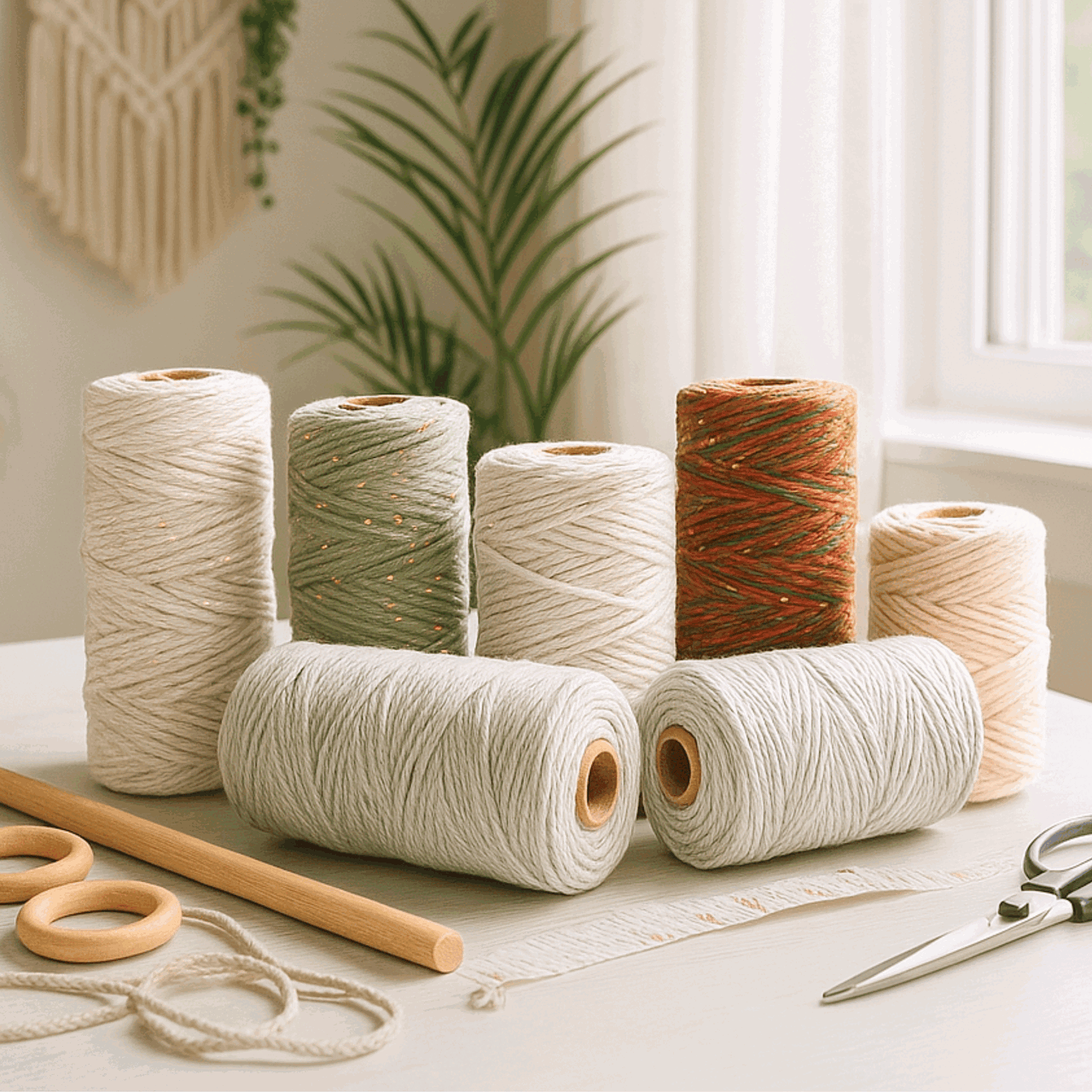
Same as any beginner macramé knot — three things, and you can practice on scrap cord.
✅ The 3-item setup
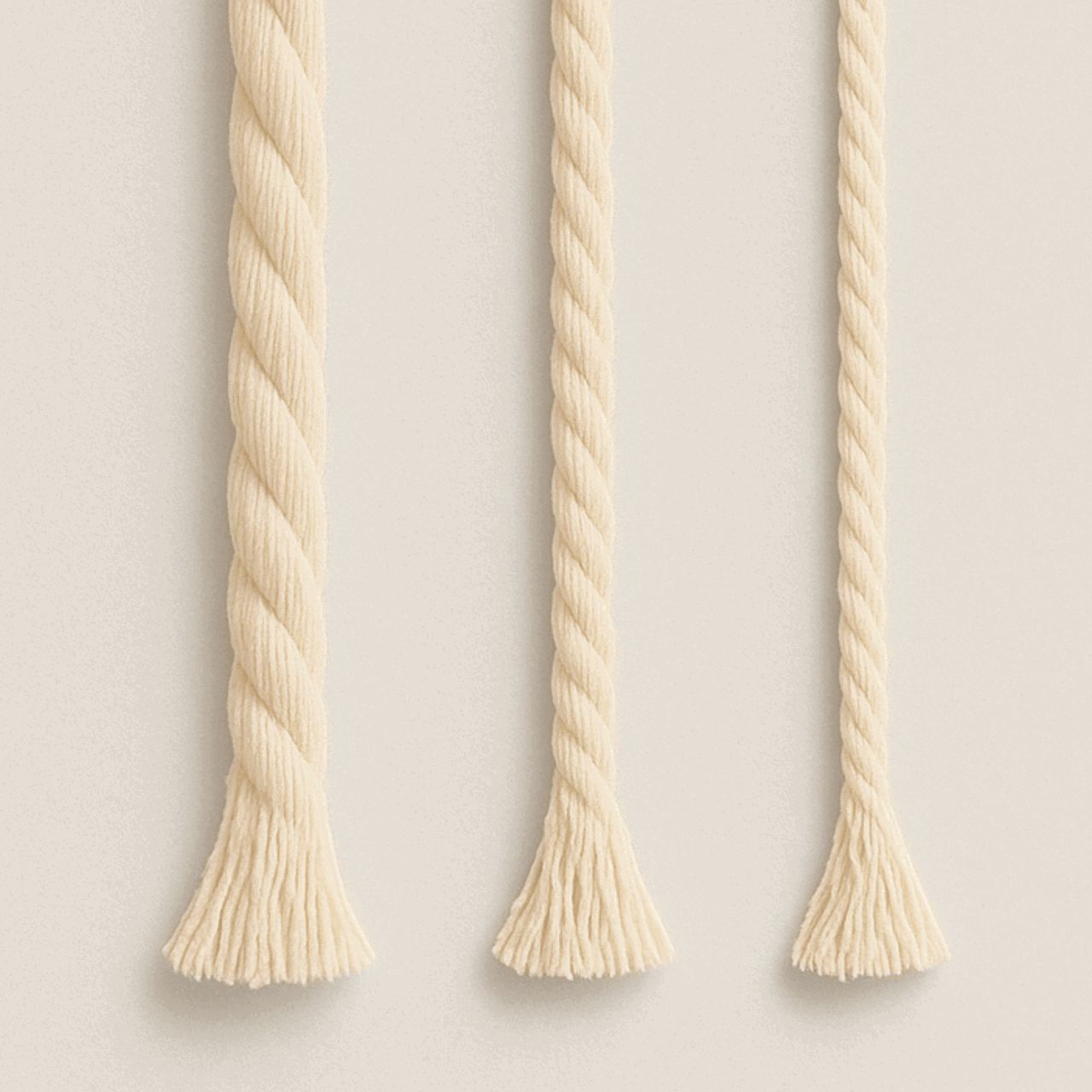
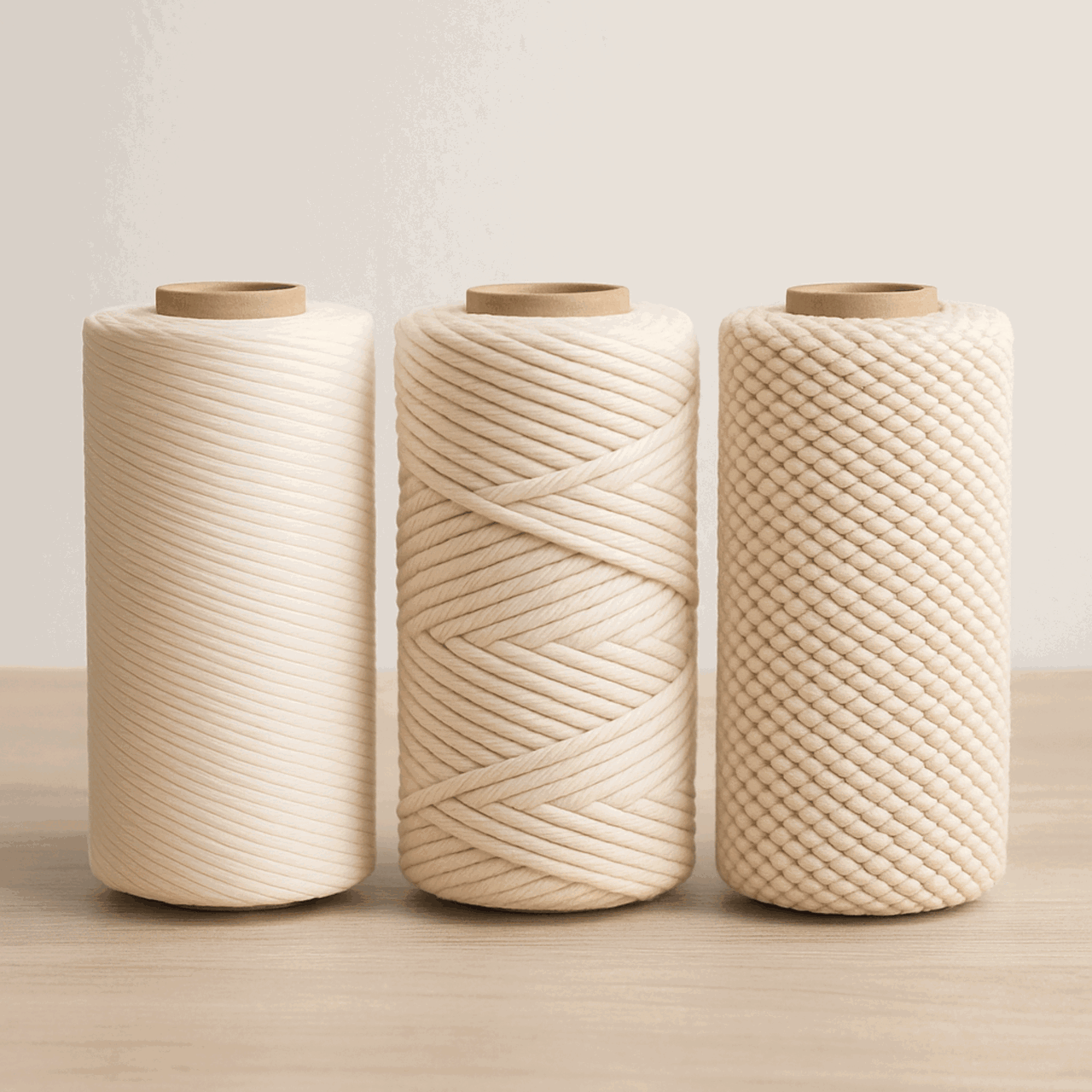
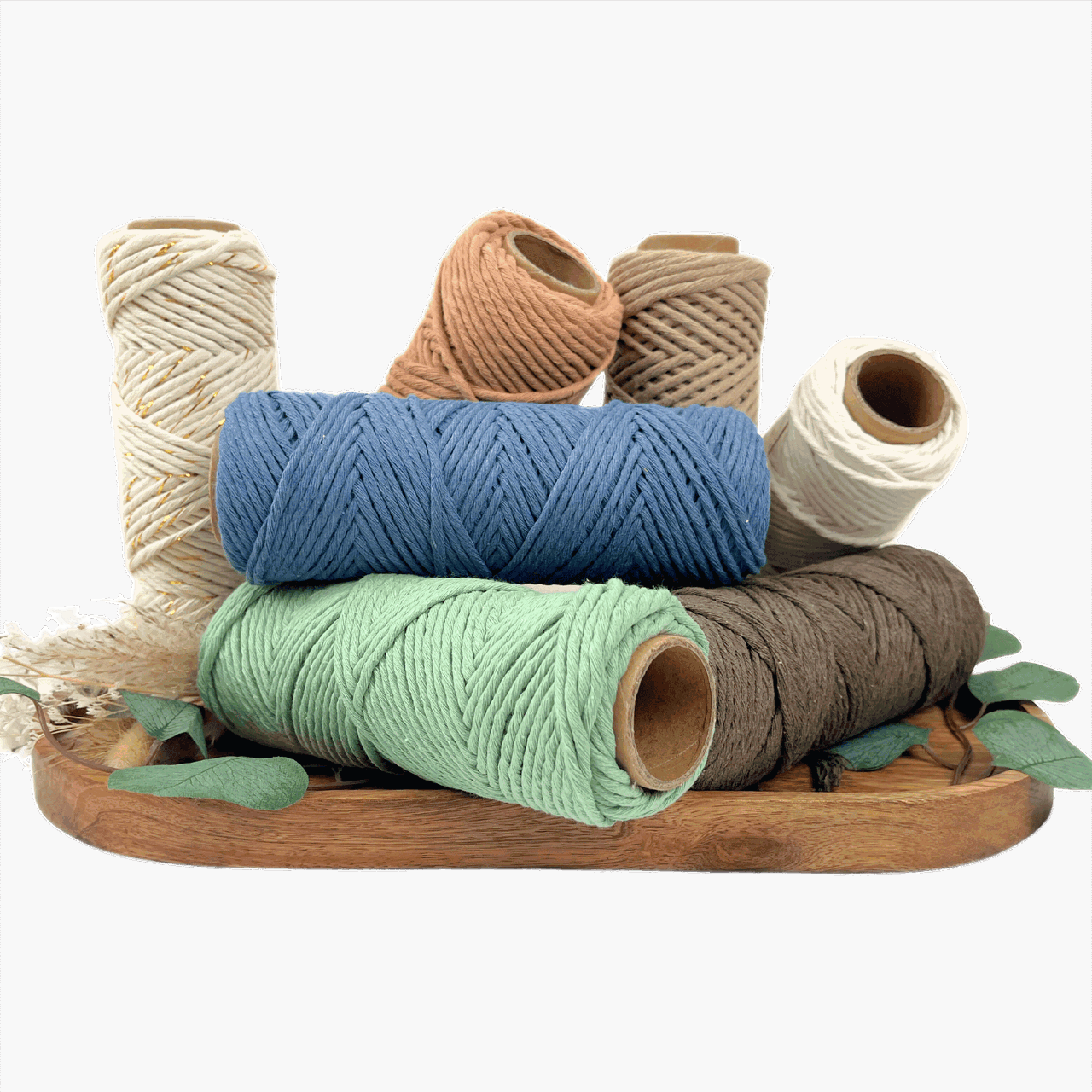
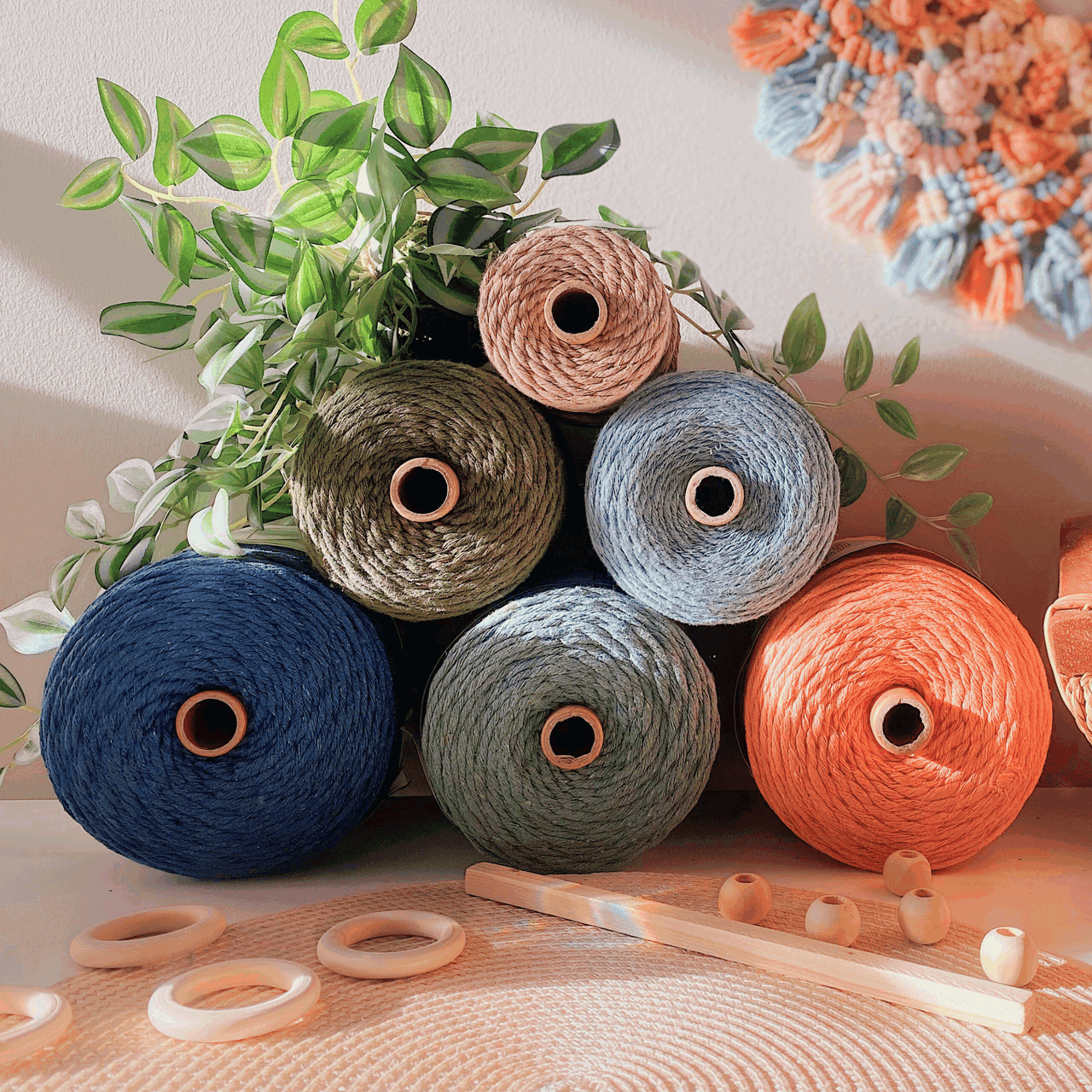
- One length of macramé cord — about 4 feet long, 3mm or 5mm single-strand cotton. Shop single-strand cord →
- A wooden dowel or branch — anything 0.5–1 inch thick works for practice. Shop wooden dowels →
- Something to hang the dowel from — an S-hook on a doorframe, a chair back, or a wall hook at eye level.
Haven't mastered the basic lark's head yet? Start with my lark's head knot tutorial first — this combo knot builds directly on it.
How to Tie the Reverse Lark's Head + Half Hitch Knot (Step-by-Step)
This knot takes about 10 seconds once you've practiced it. Here's the walkthrough — the diagram below shows all four steps at a glance, then the detailed instructions follow.

1Tie a reverse lark's head first
Fold one length of cord in half. Bring the folded loop up and over the top of the dowel from behind, letting it drop in front. Take the two cut ends from behind, feed them through the loop in front, and pull both ends downward firmly. The front of the dowel should now look smooth and flat — that's the reverse lark's head, with the bumps facing the back.
2Add a half hitch on the right side
Take the right working cord (the one on the right side of the lark's head). Bring it up and over the top of the dowel, then wrap it back under the dowel and loop it through itself — creating a single half hitch knot. Pull down firmly. You should see a small decorative knot sitting just below and to the right of the reverse lark's head.
3Add a half hitch on the left side
Now do the same thing on the left. Take the left working cord, bring it up and over the top of the dowel, wrap it under, and loop it through itself in the mirror direction of the right side. Pull down firmly. You now have a half hitch on each side of the reverse lark's head, forming a small V shape.
4Tighten and align both halves
Give both cord ends a final tug downward — equal pressure on each side — to lock everything flush against the dowel. Look at the front: you should see the smooth reverse lark's head in the center, with two small angular half hitches framing it on either side. Both cord ends should now be hanging straight down, ready to start your project.
That's it. Four steps, about 10 seconds once it's muscle memory.
When and Where to Use This Knot
This is a decorative mounting knot, so it shines in places where the mounting row is part of the visual design — not just a starting point. Here's where I use it most:
| Project type | Why it works here |
|---|---|
| Modern wall hangings | The decorative top edge becomes a visible design feature instead of a hidden mount point |
| Minimalist designs | Adds texture and detail without overdoing it — perfect for pieces where every element matters |
| Weight-bearing pieces | The extra half hitches give a more secure grip than a plain lark's head |
| Ring-based wall hangings | The V-shape sits cleanly on a curved surface and frames the ring beautifully |
| Garlands and banners | Decorative top edge looks like part of the design when hung horizontally |
| Geometric pattern pieces | The angular shape of the half hitches echoes diamond and chevron patterns lower in the piece |
| Multi-cord chunky pieces | Helps lock the larger cord against the dowel where a plain lark's head might shift |
Avoid it on: jewelry, keychains, hidden mounting rows, projects where the dowel itself will be covered (e.g. some hat hangers).
RLHPHH vs. Plain Reverse Lark's Head
Both are reverse lark's heads at the core. The half hitches are the only difference. Here's the quick comparison:
| Feature | Plain reverse lark's head | Reverse lark's head + half hitch |
|---|---|---|
| Time to tie | ~5 seconds | ~10 seconds |
| Cord used | Standard | ~1–2 inches more per knot |
| Top-edge look | Smooth, minimal | Decorative V-shape, textured |
| Grip on the dowel | Good | Excellent (locked by two half hitches) |
| Difficulty | Beginner | Beginner+ (needs lark's head first) |
| Best for | Hidden mount rows, fast pieces | Visible decorative top edges |
For a deeper dive on the underlying knot, see my complete lark's head knot tutorial — it covers both the standard and reverse versions step by step.
Variations
Once you've got the basic RLHPHH down, three small variations expand what you can do with it.
1. Double half hitch version
Instead of one half hitch per side, tie two stacked half hitches per side (a double half hitch). This bulks up the V-shape and creates more pronounced angular detail. Best for chunky cord (5mm+) or large-scale wall hangings where a single half hitch would look too small relative to the cord weight.
2. Asymmetrical RLHPHH
Tie the half hitch only on one side — typically the right — instead of both. Creates a leaning, deliberately off-balance look that's interesting on asymmetric designs. Less common but striking in modern minimalist pieces.
3. Triple-stacked decorative mount
Reverse lark's head + half hitch + a second smaller half hitch directly below the first. Creates a longer cascading V-shape that reads almost like fringe at the top of your piece. Best on larger statement wall hangings where the top edge is a major visual element.
Common Mistakes
After teaching this knot in classes for years, I see four mistakes on repeat:
- Tying a standard lark's head instead of a reverse. The base must be a REVERSE lark's head — bumps facing the back — or the half hitches will sit awkwardly. If your starting knot has bumps facing the front, you've tied the wrong base. Untie and redo from step 1.
- Mismatched half hitch angles left vs. right. The two half hitches should mirror each other. If the right leans down-right and the left leans down-left at different steepness, the V-shape will look crooked. Tighten one or the other to match.
- Pulling one half hitch tighter than the other. Uneven tension makes the lark's head shift sideways slightly. Always pull both half hitches with the same firm downward pressure.
- Forgetting which direction the half hitch wraps. The right half hitch wraps clockwise around the dowel; the left wraps counterclockwise (mirror). Beginners sometimes do both the same direction, which makes one side look "off" without an obvious reason why.
Troubleshooting
"My half hitches keep sliding loose"
Two likely causes: (1) you didn't pull the half hitch tight enough at the end — push down firmly until it locks against the dowel; or (2) you're using slippery cord. Switch to single-strand cotton cord for better grip, or add an extra wrap to each half hitch to bulk it up.
"The V-shape looks crooked or uneven"
Inconsistent angles between the left and right half hitches. Compare the two by looking straight on at the dowel — they should mirror each other exactly. If one is steeper, loosen and re-tie that side at the matching angle.
"My lark's head bumps are showing on the front"
You tied a standard lark's head instead of a reverse. The base of the RLHPHH must be a reverse lark's head (smooth front, bumps on the back). Untie everything and restart from step 1 of the reverse lark's head technique.
"The whole knot looks too big / bulky"
You may have used the double half hitch variation by accident. Single half hitches should be small, neat, and sit close against the lark's head. If they look like the chunky knots you'd see in a diagonal pattern, you tied a double when you meant a single.
Projects That Use This Knot
Every project here benefits from the decorative top edge that the RLHPHH provides. Each one starts with a row of these knots across the dowel before any other knotting begins.
- Modern minimalist wall hanging — A row of 6–10 RLHPHH knots across a 12-inch dowel, then a few rows of square knots, finished with a clean horizontal trim. The decorative top edge is the focal point.
- Statement geometric wall hanging — RLHPHH across the dowel, then diamond patterns using double half hitches below. The V-shape at the top echoes the V-shapes in the pattern for visual rhythm.
- Ring-based wall hanging — Mount RLHPHH knots around a 10–12 inch wooden ring instead of a dowel. The V-shapes radiate outward beautifully on a curved base.
- Macramé garland or banner — A horizontal cord with RLHPHH knots mounting decorative tassels at intervals. Common for nursery decor and seasonal banners.
- Heavyweight plant hanger — Mount your cords on a wooden ring with RLHPHH for extra grip, then continue with standard plant-hanger sennits below. The extra security matters more on heavier pots.
Reverse Lark's Head + Half Hitch FAQ
What is the reverse lark's head plus half hitch knot?
It's a decorative combination mounting knot — a reverse lark's head tied first, then a single half hitch added on each side. The result is a sturdier, more textured starting knot that looks like a small V shape at the top of a wall hanging.
How is it different from a regular reverse lark's head knot?
A regular reverse lark's head is just the mounting knot. The reverse lark's head plus half hitch adds two extra half hitches (one per side) for decoration and grip. Same starting position; two more knots tied on top.
When should I use this knot instead of a plain reverse lark's head?
Use it when you want extra texture, a more decorative top edge, or extra grip on slippery cord. It's especially good for wall hangings where the top is fully visible, weight-bearing pieces, and geometric pattern designs.
Is the half hitch the same as the double half hitch?
No. A single half hitch is one wrap around the dowel and back through itself. The double half hitch (used for diagonal lines) is two half hitches stacked. The RLHPHH uses single half hitches on each side.
How long should my cord be for this knot?
About 1–2 inches more per knot than a plain reverse lark's head. Stick with the 4× rule: each working cord should be 4× the finished length of your project before folding in half.
Can I tie this knot on a ring?
Yes — the technique works identically on wooden or metal rings. The reverse lark's head wraps the ring's curved surface cleanly, and the half hitches add the same decorative finish.
Why are my half hitches sliding loose?
You didn't pull them tight enough, or you're using slippery cord. Pull each half hitch down firmly so it locks against the reverse lark's head. Switch to single-strand cotton cord if slipping continues.
What does the RLHPHH abbreviation mean?
RLHPHH is shorthand for Reverse Lark's Head Plus Half Hitch. You'll see this abbreviation in pattern guides and macramé forums.
Can beginners learn this knot?
Yes — if you can already tie a reverse lark's head, this combo only adds two simple wraps. Most beginners pick it up in under 5 minutes of practice.
What projects look best with this knot?
Wall hangings with visible top edges, modern minimalist plant hangers, garlands and banners, ring-style wall hangings, and any project where the mounting row is a design feature.
Your Next Macramé Knot
The RLHPHH is one of several decorative variations you can build on the basic knots. Once you've got it down, these are the natural next steps:
- The lark's head knot — standard and reverse · The foundation this combo builds on
- The square knot — the workhorse · The next knot you'll tie below this mount row
- The double half hitch — for diagonals · Same half-hitch technique, scaled up for patterns
- The gathering knot — how you finish · The neck of every plant hanger
Or jump back to the complete beginner's guide to macramé for the full Phase 1 foundation.
Join the Bochiknot Patreon Community
Monthly exclusive patterns, early video access, and 1-on-1 knot feedback. Where my most engaged beginners go to keep learning.
Become a patron →The RLHPHH is one of those small upgrades that takes a wall hanging from "I made this" to "I designed this." Once you've tied it a few times, you'll wonder how you ever finished a piece with a plain lark's head row.
When you finish your first row, tag @bochiknot on Instagram. I love seeing the small details that make pieces feel finished. Happy knotting. 🌾
Nicole Woo — Founder, Bochiknot
Macramé educator & designer · Teaching since 2018
Nicole is a self-taught macramé artist who left a career in accounting to teach the craft full-time. Through Bochiknot, she's helped thousands of beginners take their first knot — sharing step-by-step tutorials on YouTube, premium cotton cord in the shop, and beginner-friendly kits.
You might also like
Basic knot · Tutorial
How to Tie a Lark's Head Knot
The foundation knot — standard and reverse versions, step-by-step.
Basic knot · Tutorial
How to Tie a Double Half Hitch
Same half-hitch technique, scaled up for diagonal patterns.
Phase 1 · Pillar
Macramé for Beginners: The Complete Guide
The full pillar — 4 knots, supplies, your first project, and more.


Leave a comment