








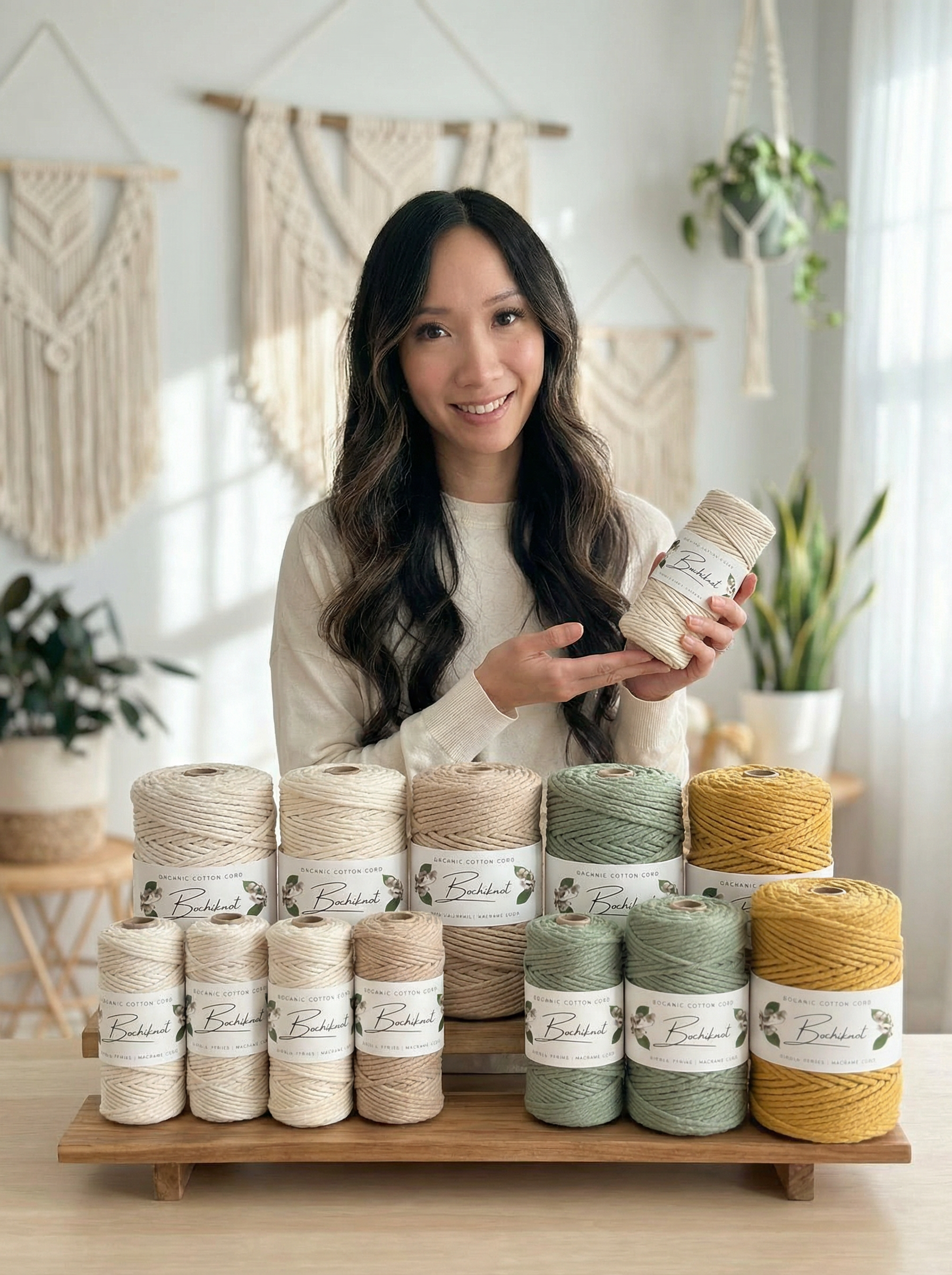
Macramé for Beginners: The Complete Guide (2026)

- Buy 3mm or 5mm single-strand cotton cord (~$15 for a starter spool) and a 12-inch wooden dowel.
- Get sharp scissors and a hanging spot at eye level (S-hook on a doorframe works).
- Learn the 4 basic knots: lark's head (mounting), square knot (decorative), double half hitch (diagonal lines), gathering knot (finishing).
- Tie your first project: a small wall hanging, keychain, or plant hanger using just those 4 knots.
- Finish, hang, and start project #2 — repetition is how every macramé skill locks in.
Time to learn: ~30 minutes · Time to first project: 2–3 hours · Cost to start: $25–$50
📌 Featured Resources — Jump to a Section
Complete Beginner Guide · Updated April 22, 2026 · 45 min read · Phase 1

Written by Nicole Woo
Founder of Bochiknot · Teaching macramé since 2018
Eight years ago I was crunching spreadsheets as a Chartered Public Accountant in Calgary, learning macramé in evenings from YouTube videos, and quietly hating my day job. Today I run Bochiknot full-time and I've taught thousands of beginners — through YouTube tutorials, in-person classes, and the Patreon community we built together. This guide is everything I wish I'd had on my first day.
Below is the complete walkthrough: what macramé actually is, where it came from, why it's surprisingly good for your mental health, the supplies you genuinely need (and the ones you don't), the four knots that cover 95% of every pattern you'll ever see, a decision tree for picking your first project, troubleshooting for the inevitable "wait, why does mine look like that?" moments, how to hang and care for your finished piece, and even how to price your work if you want to sell. Bookmark this page. By the end of it, you'll know exactly how to start.
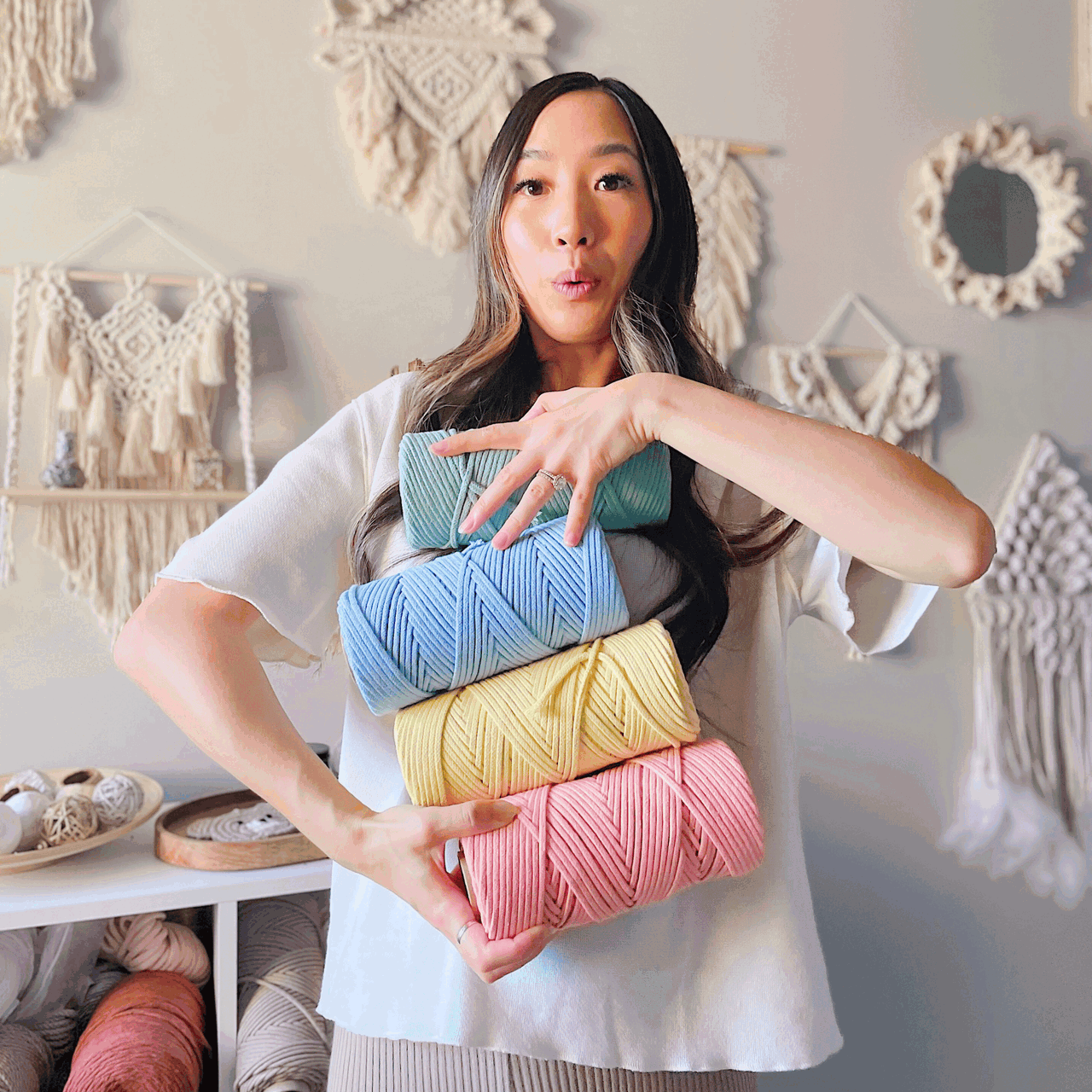
📺 Watch the complete beginner tutorial:

In this complete guide:
- What is macramé?
- A brief history of macramé
- Why macramé, why now?
- Is macramé hard to learn?
- How long does it take to learn?
- How much does it cost to start?
- Macramé vs. other fiber crafts
- What you need to start (today)
- Choosing your first macramé cord
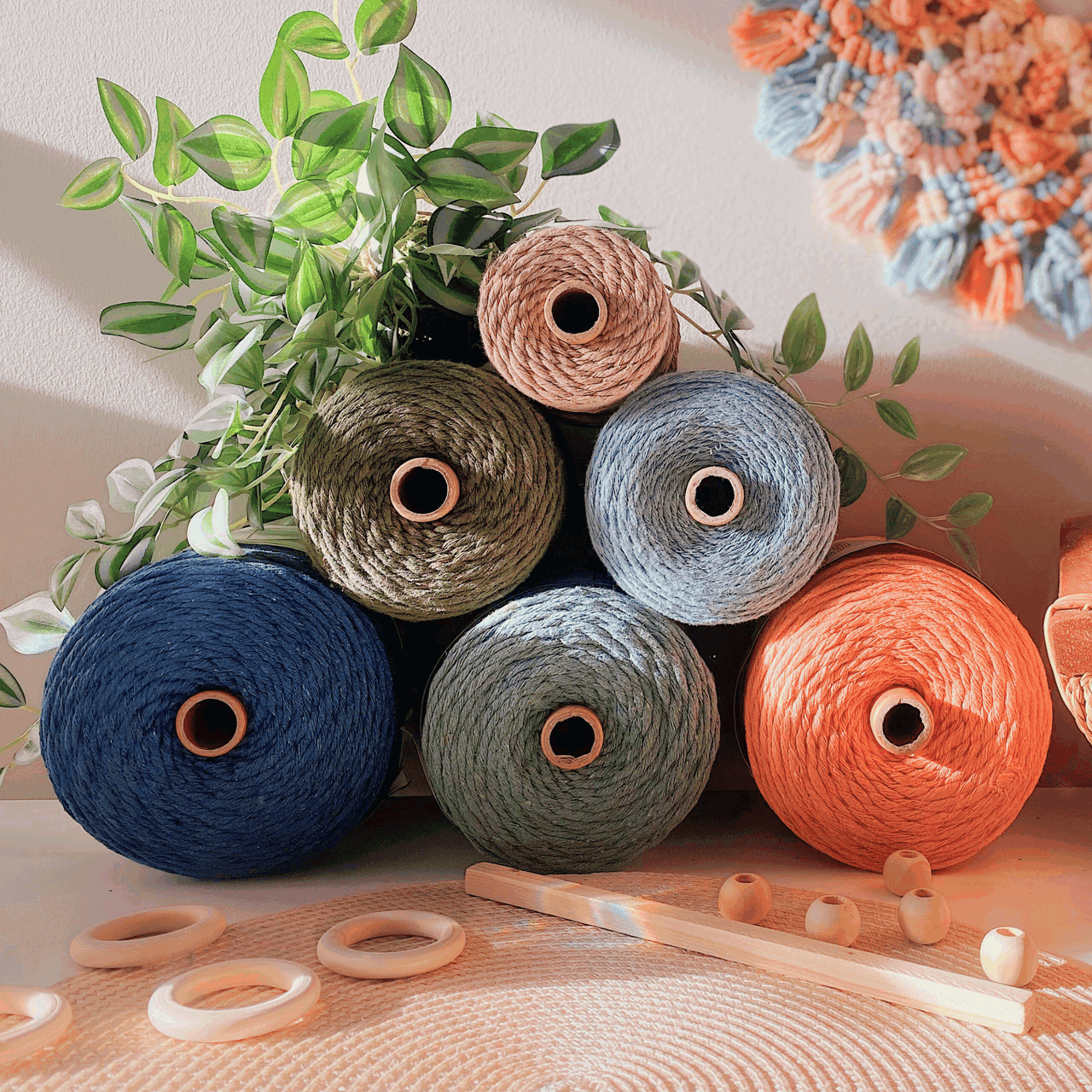
- Choosing macramé cord color
- Is macramé sustainable?
- Setting up your workstation
- The 4 basic macramé knots
- How to tie your first knot — walkthrough
- How much cord do you need?
- Choose your first project (flowchart)
- Your first 5 beginner projects
- What Bochiknot students say
- Common beginner mistakes
- Troubleshooting common problems
- How to make your macramé look professional
- How to hang & display your macramé
- How to care for & clean macramé
- How to price macramé to sell
- Macramé glossary
- Frequently asked questions
- Inspiration gallery
- Your next steps in macramé
What Is Macramé?
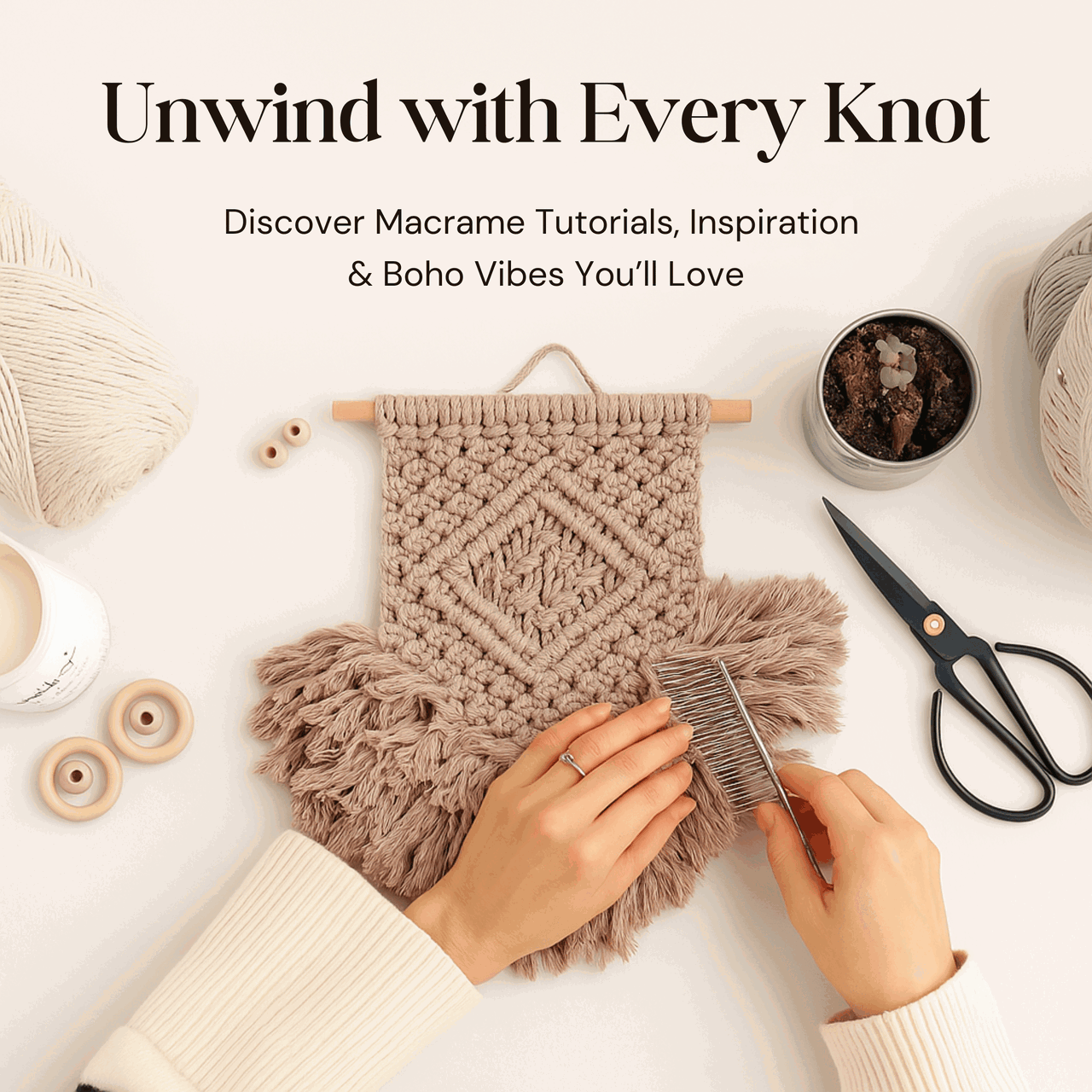
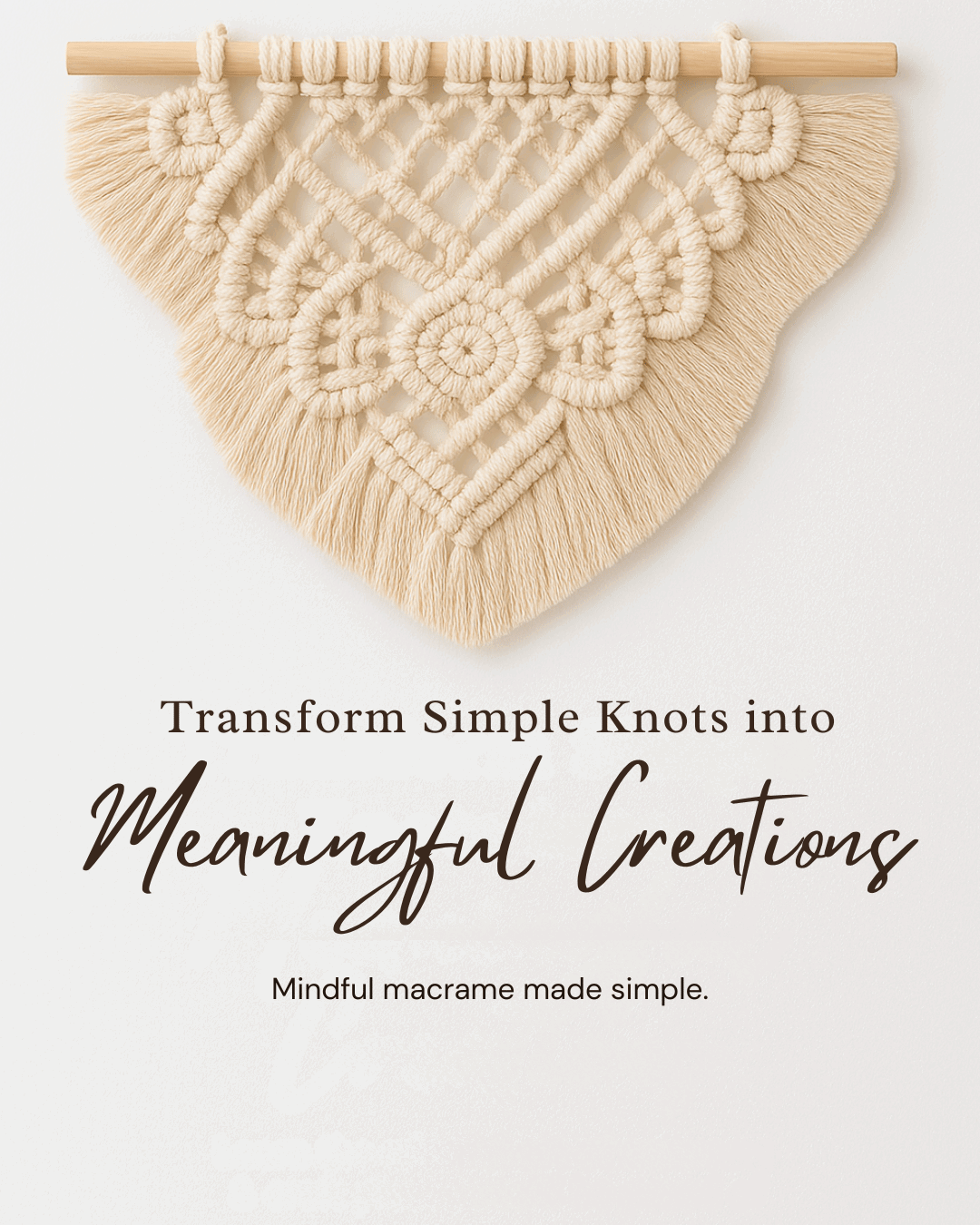
Macramé is the craft of creating textiles by knotting cord. No needles, no hooks, no looms — just your hands, a few lengths of cord, and a base to mount them to (usually a wooden dowel, a metal or wooden ring, or a branch). You combine four basic knots in different sequences to create patterns, plant hangers, wall hangings, jewelry, table runners, room dividers, and more.
Unlike weaving (which needs a loom) or crochet (which needs a hook), macramé is the most "tools-free" of all the fiber crafts. The only thing you absolutely need beyond your hands is a pair of sharp scissors. That's also why it's the easiest craft for adults to pick up cold — there's no muscle memory of holding a hook or pulling yarn through loops; you just tie knots, the same way you'd tie a shoelace.
The word macramé (pronounced MACK-rah-may) comes from the Arabic migramah — meaning "fringe" or "ornamental fringe." That's a clue to where it began: as the decorative finishing edge on woven textiles.

Modern macramé covers an enormous range of projects:
- Wall hangings — the most common starter project; ranges from a 12-inch dowel to a 6-foot statement piece
- Plant hangers — single-tier (for one pot) to multi-tier (a vertical garden)
- Jewelry — bracelets, necklaces, earrings (typically 1–2mm cord)
- Functional textiles — bags, table runners, curtain tiebacks, lampshades
- Sculptural pieces — room dividers, headboards, large-scale gallery installations
The reason it's having such a long moment is that the same four foundational knots produce all of these. Once you can tie those four — and you'll have them in 30 minutes of practice — you can technically attempt any macramé project on the internet. The rest is patience, taste, and reps.
A Brief History of Macramé

Macramé isn't a new craft — it's a very old one having a very modern moment. Knowing its history makes the craft feel rooted, which is part of why it's so satisfying to do.
13th century: Arab weavers and the origin of the name
The earliest documented macramé was practiced by 13th-century Arab weavers, who used decorative knots to finish the edges of fabric and prevent the threads from unraveling. The Arabic word for those decorative knotted edges — migramah — gave us "macramé." It's literally the craft of fringe.
Moorish Spain and the spread to Europe
When the Moors brought macramé to Spain, the techniques spread quickly through Italy and France. By the 16th and 17th centuries, macramé was a popular decorative art across Europe — used on church textiles, ladies' fans, and household linens.
17th–19th centuries: sailors carry it worldwide
This is the chapter most people don't know. Sailors took to macramé during long voyages — they had cord, time, and no entertainment. They knotted hammocks, belts, bottle holders, and what they called "square knot" decorations to sell or barter at ports. Through them, macramé spread to China, the Americas, and across the Pacific. The Victorian era saw it surge in popularity in domestic decor.
1970s: the bohemian revival
If you grew up in the 70s — or if you've ever seen Brady Bunch-era décor — you've seen macramé. Owl wall hangings, plant hangers in every window, jute belts, and beaded curtains were everywhere. The craft was woven into the bohemian, back-to-the-land aesthetic of the decade.
2010s–2026: the modern revival
After two quiet decades, macramé came back hard around 2015 — driven by Pinterest, Etsy, Instagram, and the rise of slow-craft and "cottagecore" aesthetics. The modern version trades the 70s jute and orange tones for natural cream cotton, minimalist designs, and modern home interiors. As of 2026, macramé remains a top-search craft worldwide, with steady growth on both Pinterest and YouTube.
Why Macramé, Why Now?

If you're standing at the door wondering "is this actually worth my time?" — here's the honest case for why macramé makes a great hobby in 2026 specifically.
It's a slow craft (which we increasingly need)
The dopamine hits we get from phones are quick, shallow, and forgettable. Tying a row of square knots is the opposite: slow, steady, deeply attentional. There's growing research that working with your hands — sewing, knitting, knotting, drawing — measurably reduces anxiety, improves mood, and helps regulate the nervous system. Macramé fits squarely into that "active meditation" category. I have students who tell me an hour of macramé does more for their stress than an hour of scrolling ever has.
Low cost, low equipment, immediate results
You can start macramé for under $35. You don't need a sewing machine, a loom, a hook, or a class. You can sit on your couch, finish a wall hanging in an afternoon, and hang it that same night. Very few hobbies offer that fast a result-to-investment ratio.
The output is genuinely useful
Knitting gets you scarves and sweaters. Painting gets you paintings. Macramé gets you decor — pieces that go on your wall, in your window, on your bag, on your keys. Every finished project earns its space in your home. That's a different kind of reward.
Beginner-friendly community
Macramé makers are notoriously kind. Instagram and TikTok are full of teachers (myself included) actively rooting for beginners. Free YouTube tutorials cover essentially every pattern. Patreon communities offer feedback and accountability. It's the rare hobby where the community is genuinely glad you showed up.
Is Macramé Hard to Learn?
No — macramé is one of the easiest fiber crafts to start. It only uses four basic knots, no specialized tools, and most beginners finish their first small project (a wall hanging or plant hanger) within 2–3 hours of sitting down with their cord.
What trips beginners up isn't the knots — it's three small things I see in every class I teach:
- Tension. Pulling each knot tight enough to look intentional, but not so tight the piece warps. This takes 20 minutes of practice to dial in.
- Cord length. Beginners almost always cut their cord too short. (We'll fix this in the sizing section below.)
- Patience with the first knot row. The opening of any project is where most makers want to rush. Slowing down here pays off every inch after.
None of those are skill issues. They're just things no one tells you. If this guide does one thing for you, I hope it's getting you past those three small hurdles so your first project comes out looking the way you imagined.

How Long Does It Take to Learn Macramé?
Faster than you think. Here's the realistic timeline I see in my classes.
| Milestone | Time investment | What you'll be able to do |
|---|---|---|
| Learn the 4 basic knots | ~30 minutes | Tie a lark's head, square knot, double half hitch, and gathering knot on scrap cord |
| Finish your first small project | ~2–3 hours | A 12-inch dowel wall hanging or a single-tier plant hanger |
| Feel confident at the basics | ~1–2 weeks (2–3 projects) | You stop checking the tutorial every five seconds |
| Tackle a multi-tier or pattern piece | ~1 month | Diamond patterns, multi-tier plant hangers, larger wall hangings |
| Design your own pieces | ~3–6 months | You can sketch a piece and figure out the knot sequence yourself |
| Sell or teach | ~6–12 months | You're consistent enough to commission, run a market booth, or teach a friend |
Notice how fast the first row is — 30 minutes. That's because macramé front-loads almost all the learning into a tiny set of fundamentals. After that first half-hour, you're not really learning new knots; you're just stacking the same four in different sequences.
How Much Does It Cost to Start Macramé?
Between $25 and $50 USD to start — less than dinner out. Here's the honest breakdown of what you'll spend, depending on how much you want.
| Setup | Cost (USD) | What's included |
|---|---|---|
| Bare minimum | $15–25 | 100 ft of 3mm cotton cord, scrap-wood dowel, household scissors |
| Recommended starter | $30–50 | 100 ft premium 5mm cord, finished wooden dowel, fabric scissors, measuring tape, S-hook |
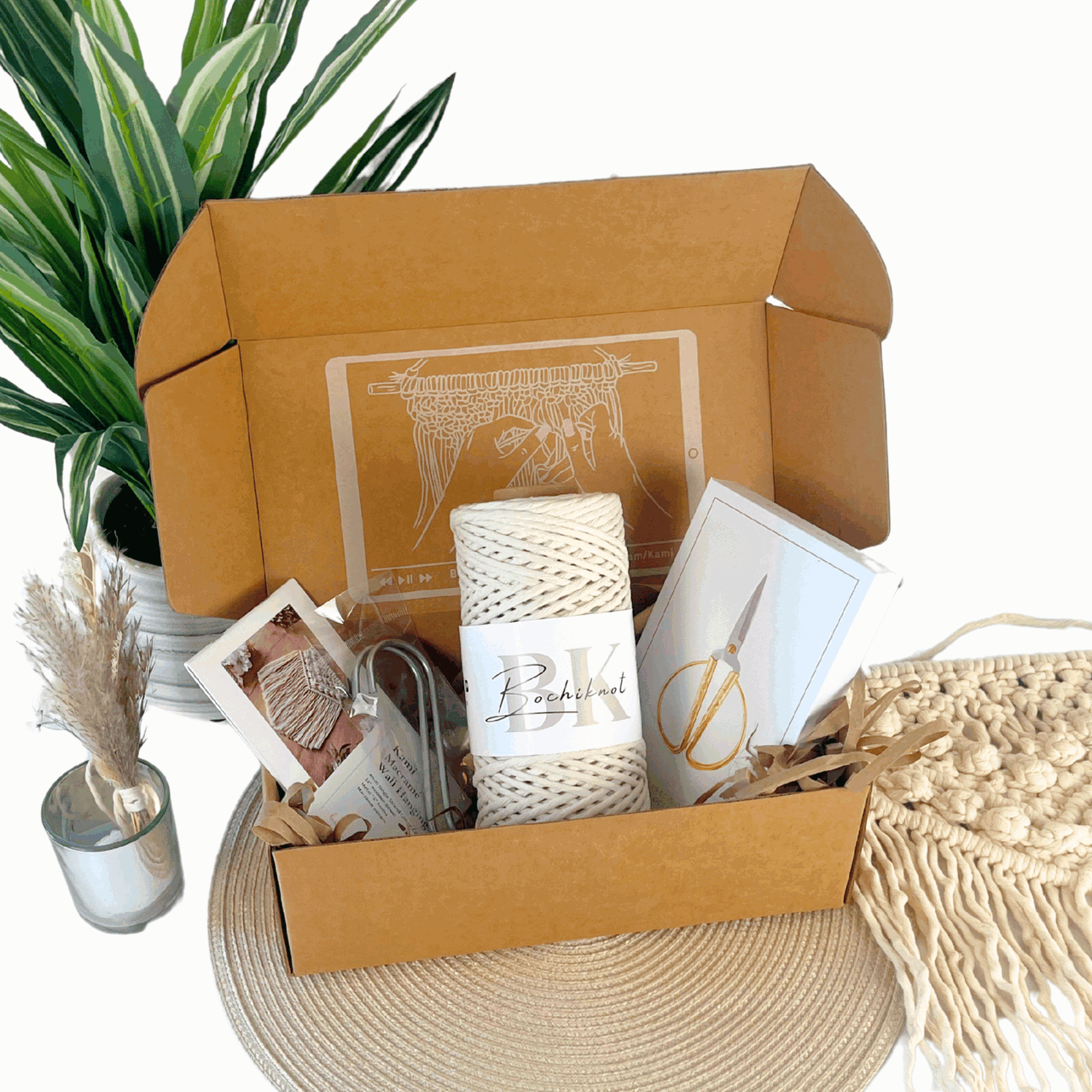
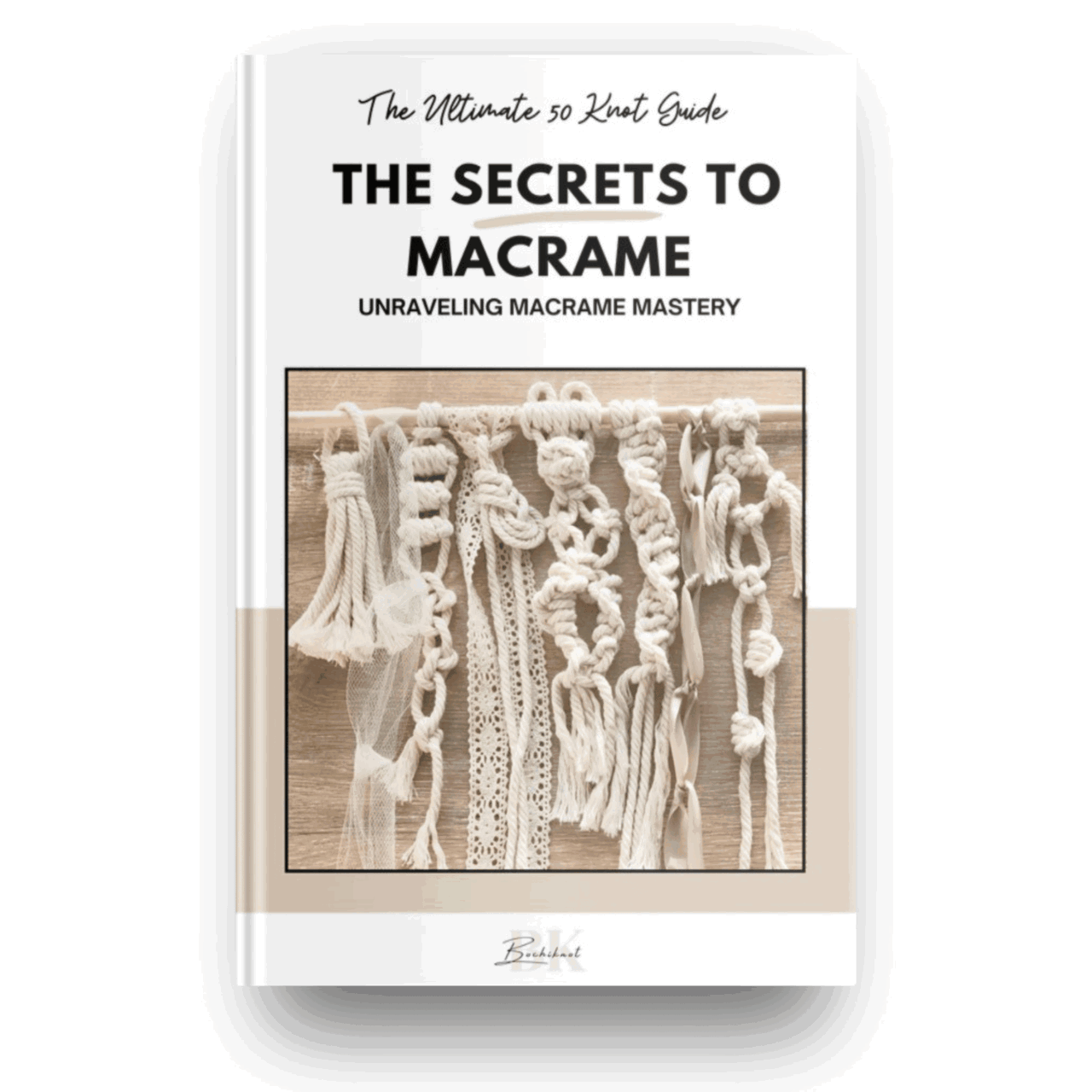
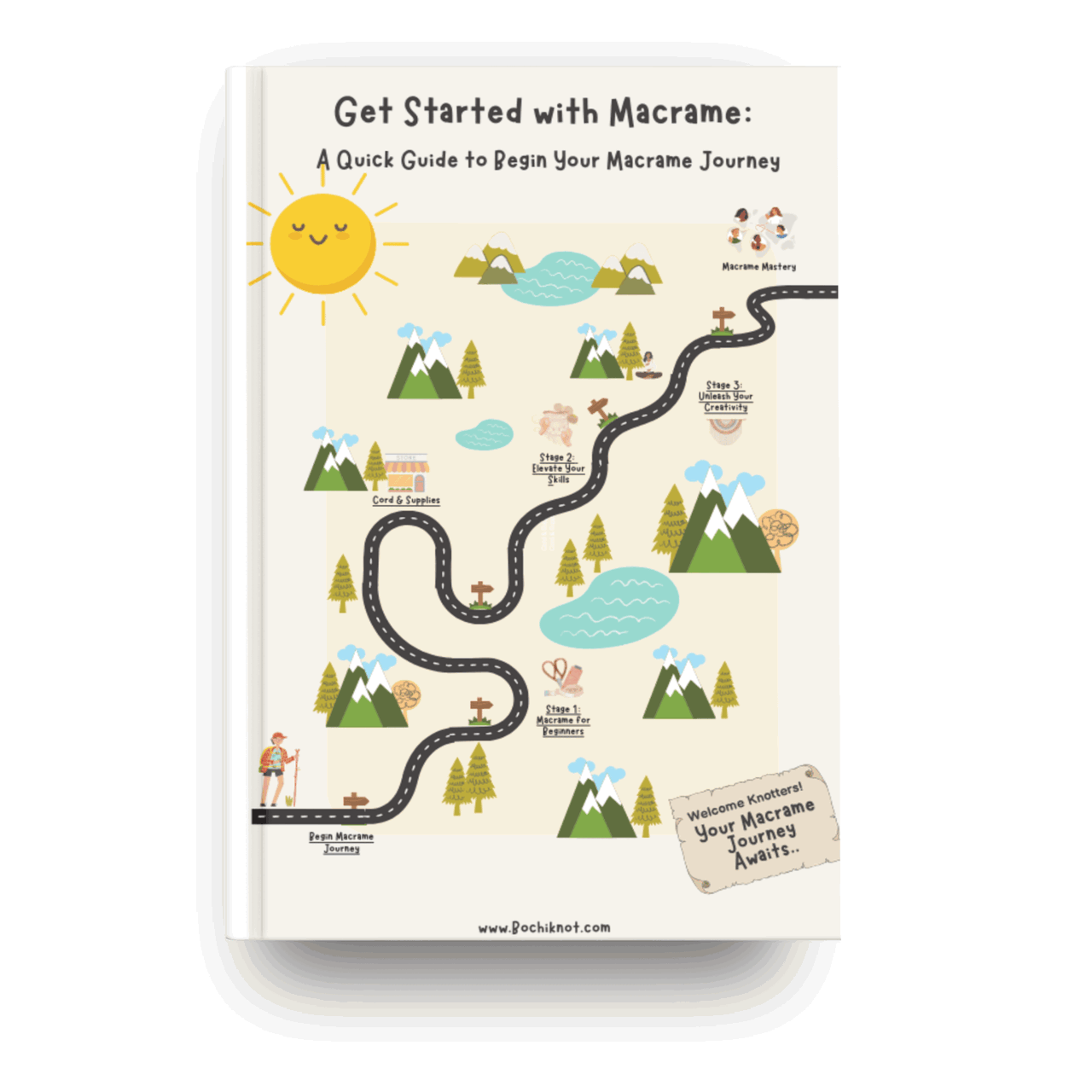
| All-in starter kit | $45–65 | The recommended starter + a beginner pattern, fringe comb, and step-by-step instructions (e.g. the Bochiknot Welcome Kit) |
| "I want everything" | $80–150 | Multiple cord sizes, multiple dowels, wooden rings, project board, premium scissors, fringe comb, a few patterns |
Most beginners massively over-buy. If you're just trying macramé for the first time, the bare minimum or starter kit option is genuinely all you need. You can always upgrade later if you fall in love with it (most people do).
Macramé vs. Other Fiber Crafts
If you're choosing between macramé, crochet, knitting, and weaving — here's how they actually compare, from someone who's tried all four.
| Craft | Tools needed | Learning curve | What you make | Time to first finished piece |
|---|---|---|---|---|
| Macramé | Scissors, dowel, cord | Easiest — 4 knots, no tool to learn | Wall hangings, plant hangers, jewelry, bags | 2–3 hours |
| Crochet | Crochet hook, yarn | Easy — but you must learn hook grip + stitch tension | Sweaters, scarves, blankets, amigurumi | 4–8 hours (e.g. a scarf) |
| Knitting | Two needles, yarn | Moderate — two-hand coordination + stitch shape | Sweaters, socks, blankets, hats | 1–2 days (e.g. a hat) |
| Weaving | Loom (frame, lap, or floor) | Moderate — set-up is the hardest part | Tapestries, rugs, fabric pieces | 6–12 hours (e.g. small tapestry) |
Macramé vs. crochet: the most common comparison
This is the one I'm asked about most. Macramé and crochet look adjacent but feel completely different to do:
- Macramé = knots tied by hand. Thicker cord (3mm–9mm). Decorative items. No tool besides scissors. The piece hangs from a base.
- Crochet = loops pulled through loops with a hook. Thinner yarn. Wearable items (sweaters, scarves) and functional items (blankets, amigurumi). The fabric grows row by row.
If you want to make decor — start with macramé. If you want to make clothing — start with crochet. They're not better or worse; they make different things.

What You Need to Start Macramé (Today)
Walk into any craft store and you'll see a wall of macramé supplies. Most of it is optional. Here's the honest minimum to finish your first project.
✅ The 5-item beginner starter kit
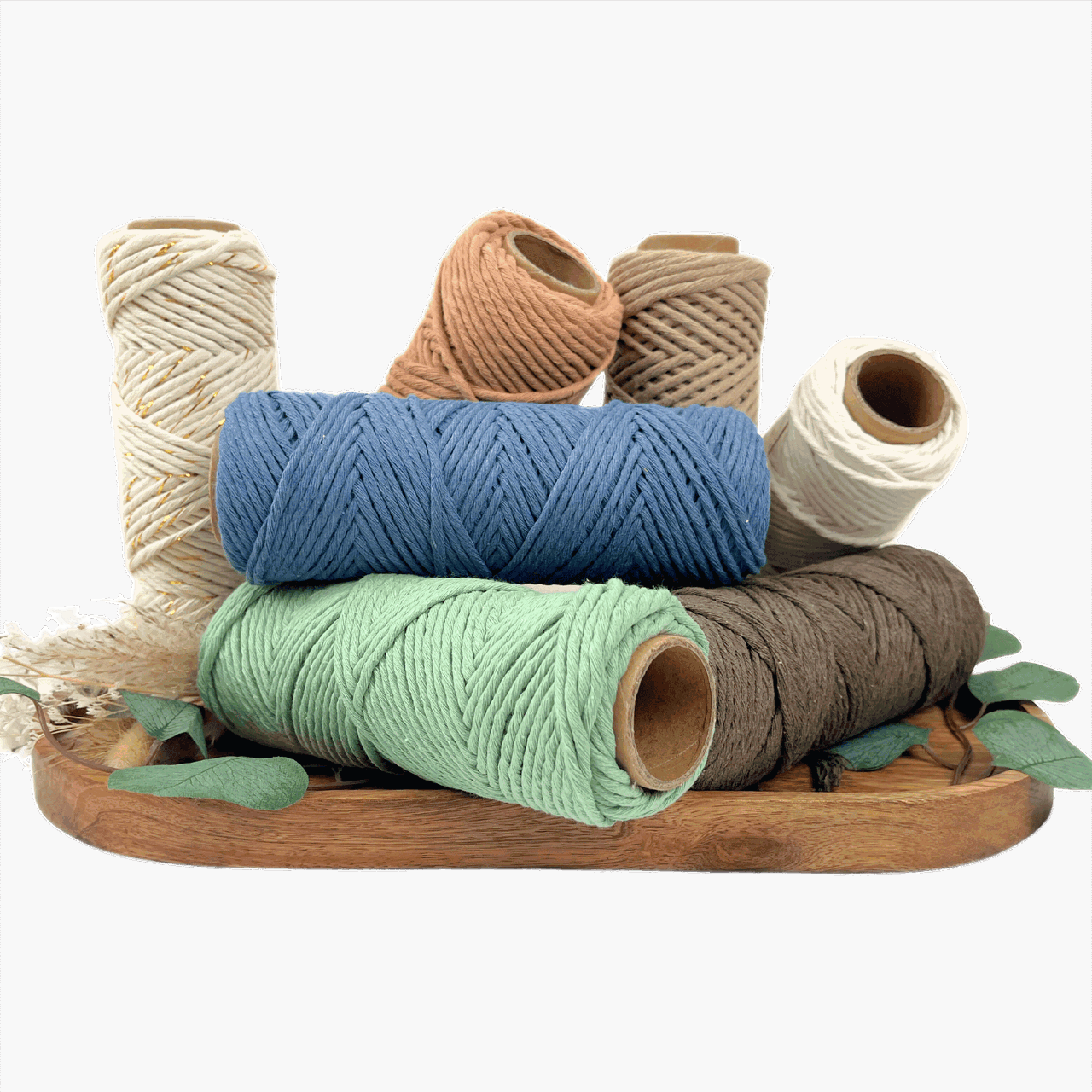
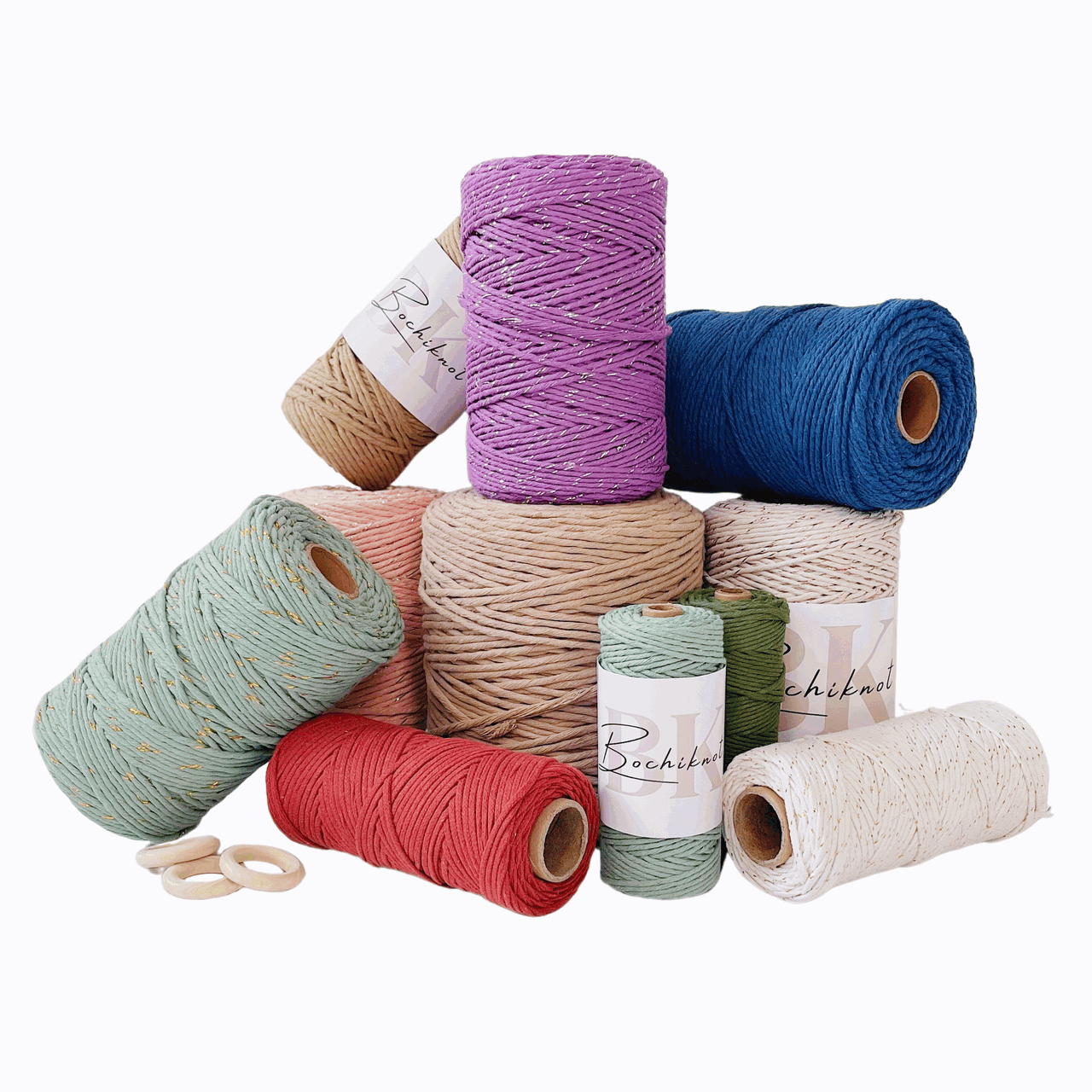
- Cotton macramé cord — 3mm or 5mm, single-strand, about 100 ft. Shop our single-strand cord →
- A wooden dowel or branch — 12–18 inches long, half-inch to 1-inch thick. Shop wooden dowels →
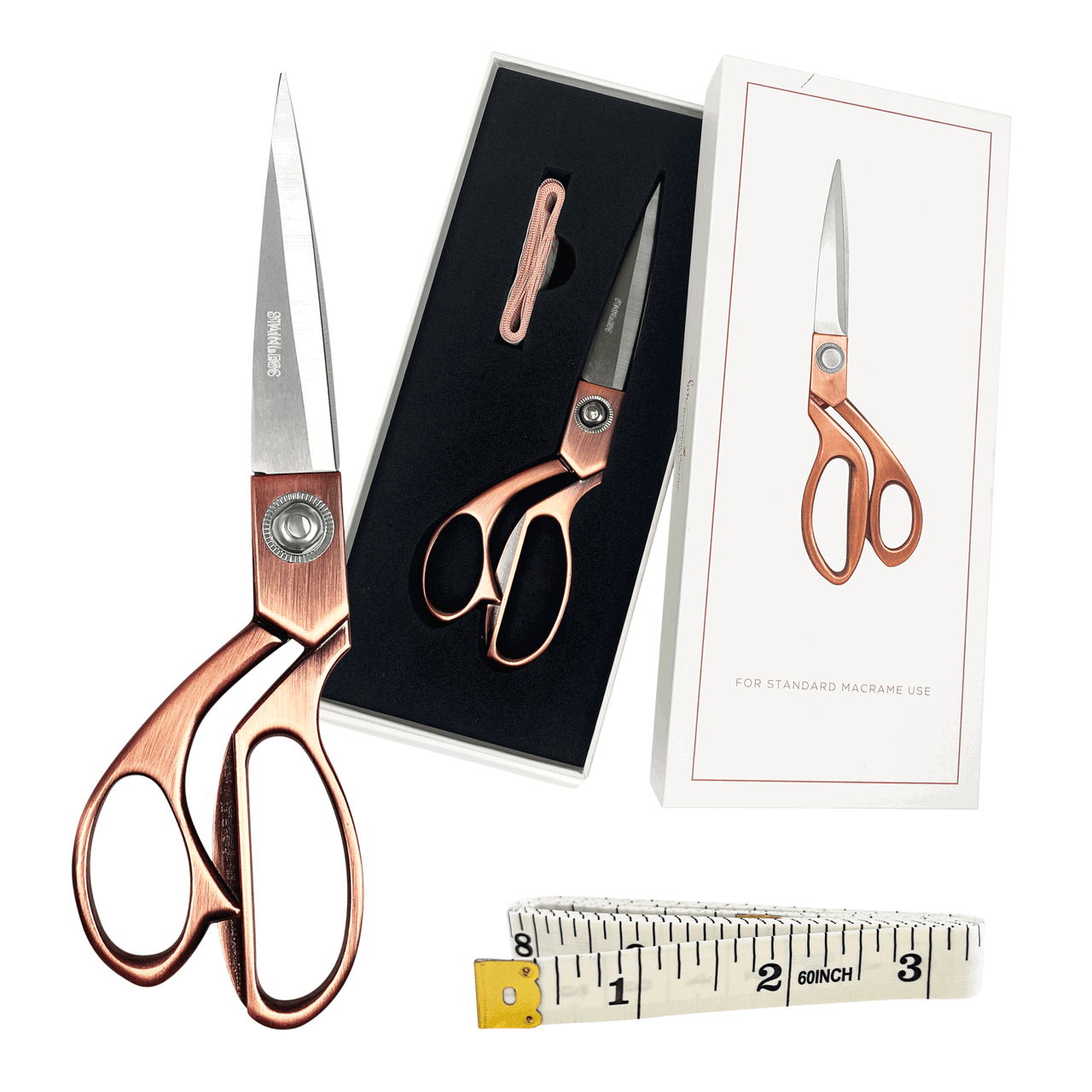
- Sharp scissors — fabric scissors, not paper scissors. Shop macramé scissors →
- A measuring tape — anything that measures to 10 feet works.
- An S-hook or wall hook — to hang your dowel at eye level while you work.
Don't want to source it piece-by-piece? Our Macramé Welcome Kit bundles all of it plus a beginner pattern.

Optional (nice to have, not required for project one)
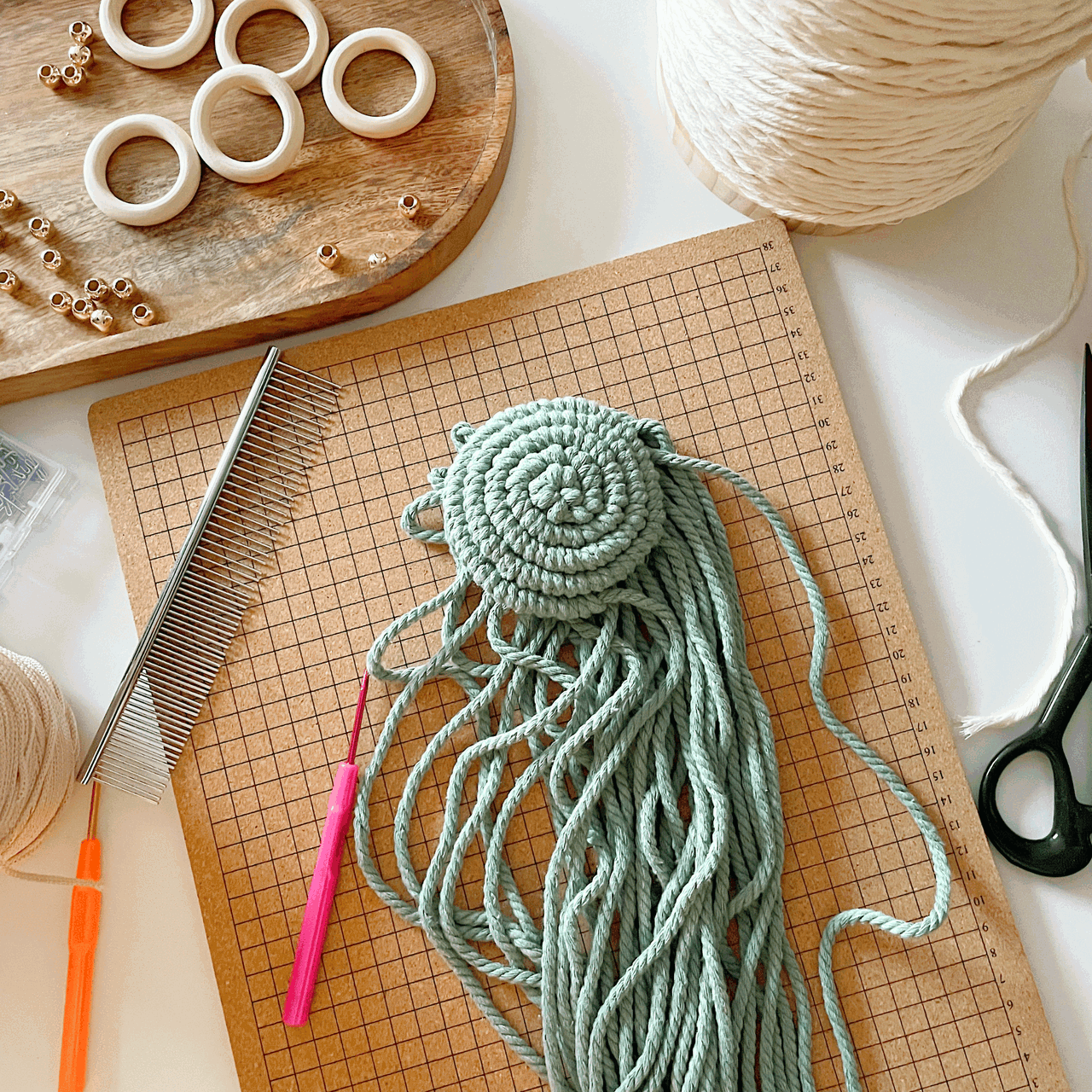
- Fringe comb — for brushing single-strand cord into fringe. Shop fringe combs → · (Or available on Amazon.)
- Wooden rings — for ring-based plant hangers and wall hangings. Shop beechwood hoops →
- Project board — foam board with a grid that helps with tension on larger pieces. (Available on Amazon.)
- Crochet hook — for hiding loose cord ends inside your finished piece. (Available on Amazon.)
- Lobster clasp swivel hook — for hanging multi-cord projects without tangle. (Available on Amazon.)
Choosing Your First Macramé Cord
Cord is the single biggest decision a beginner makes — and the one most likely to determine whether your first project looks like the Pinterest photo or like a tired noodle. Here's the short version: start with 3mm or 5mm single-strand cotton cord. It's soft, forgiving, and brushes into a beautiful fringe.
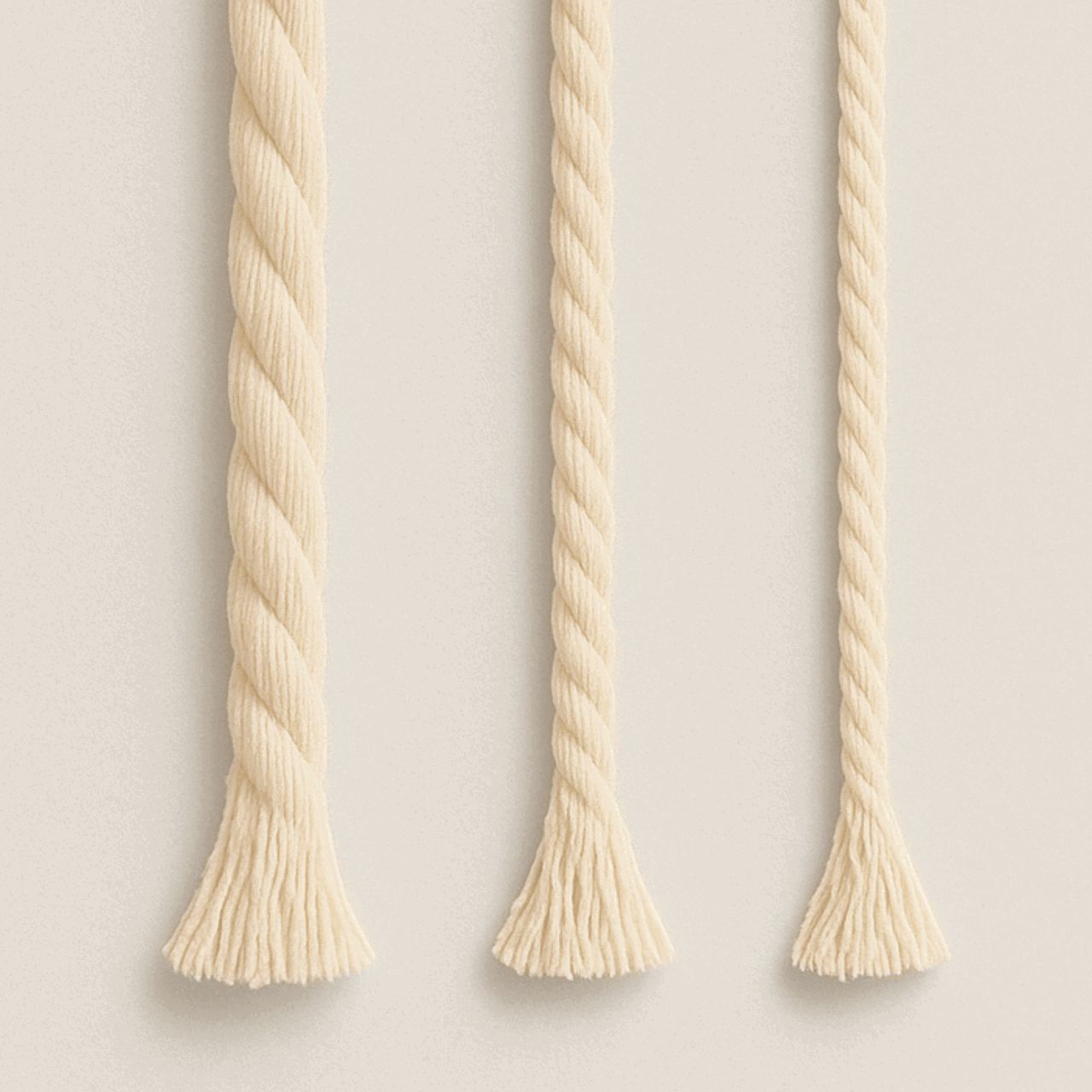
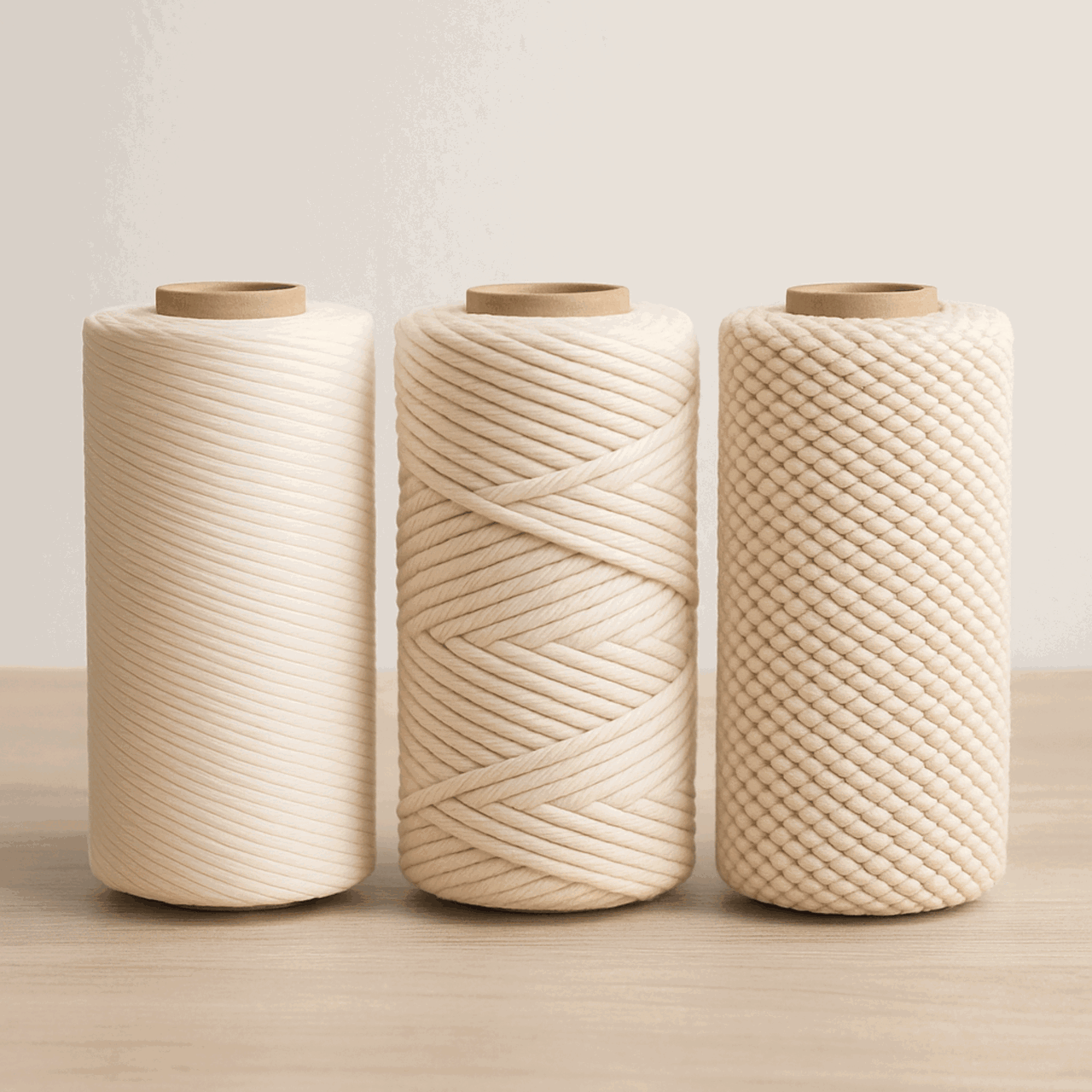
The 3 main types of macramé cord

| Cord type | Look & feel | Best for | Beginner-friendly? |
|---|---|---|---|
| Single-strand | Soft, fluffy, brushes out into clean fringe | Wall hangings, fringe-heavy projects, plant hangers | ✅ Yes — start here |
| 3-ply twisted | Structured, rope-like, holds knot shape tightly | Plant hangers, jewelry, structural projects | ⚠️ Intermediate — stiffer to untie |
| Braided | Smooth, polished, does not unravel | Jewelry, accessories, modern minimalist pieces | ✅ Yes — easy to handle |
Browse the full single-strand cord collection, 3-ply cord, or braided cord on Bochiknot.

Macramé cord sizes — which one for which project?
| Size | Diameter | Best for | Shop |
|---|---|---|---|
| 1–2mm | Very thin | Jewelry, micro-macramé, fine detail | 1–2mm collection |
| 3mm | Pencil-thick | Small wall hangings, plant hangers, keychains | 3mm collection |
| 4mm | Sharpie-thick | Medium wall hangings, bags, table runners | 4mm collection |
| 5mm | Marker-thick | Statement wall hangings, large plant hangers | 5mm collection |
| 7–9mm+ | Chunky rope | Oversized wall art, room dividers, sculptural pieces | Thick cord |
If you want a deeper dive on cord selection, read my complete guide to selecting macramé cord and materials.
Choosing Macramé Cord Color

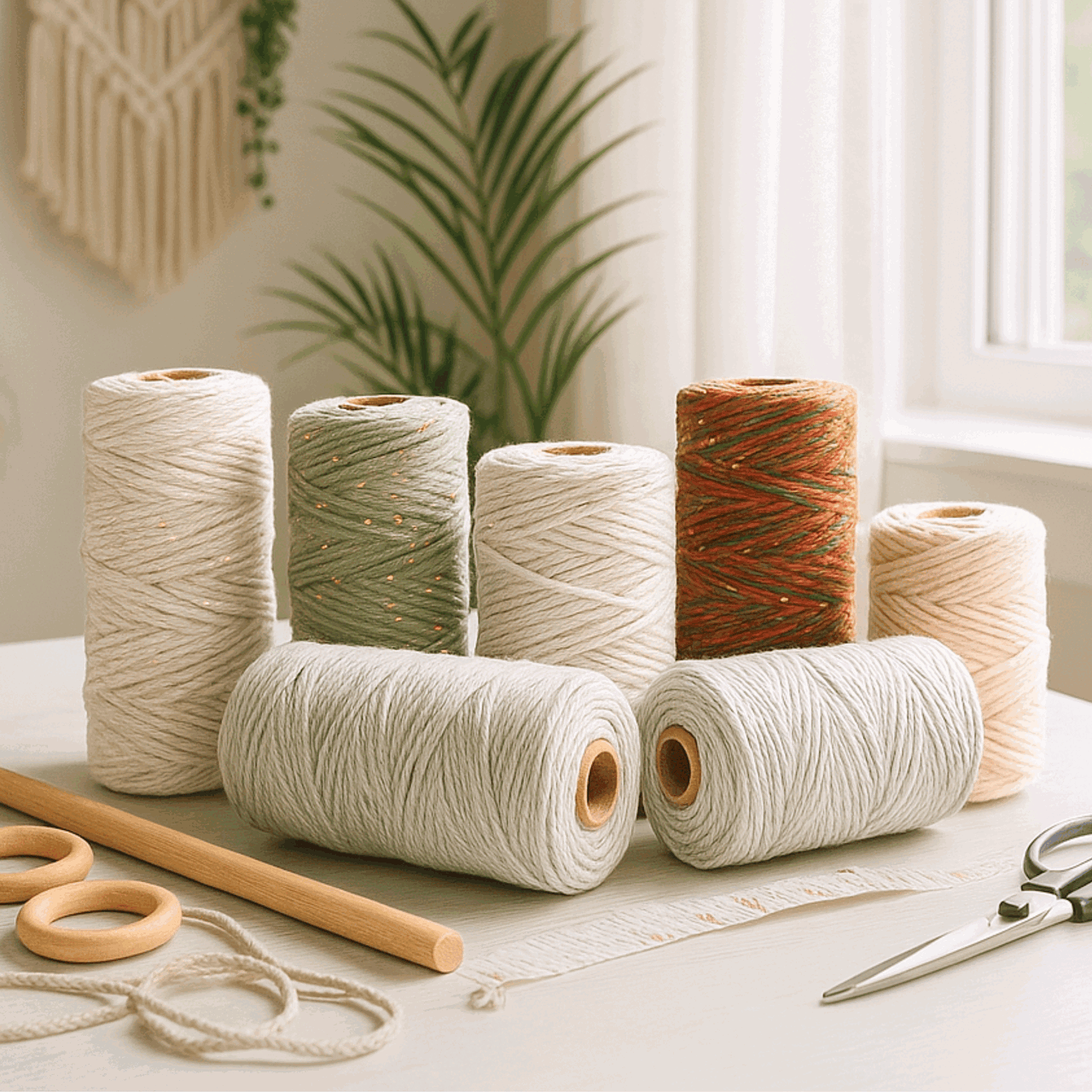
Cord color is the second-biggest aesthetic decision after cord size. The color you pick shapes the entire vibe of your finished piece — and most beginners default to natural cream, which is fine but not always the right call. Here's a quick aesthetic guide.
| Color | Vibe | Best for |
|---|---|---|
| Natural cream / off-white | Classic, versatile, neutral | Your first project. Goes with any decor. Shows off knot structure clearly. |
| Pure white | Modern, clean, minimalist | Bright modern spaces, gallery walls, Scandinavian/minimalist interiors |
| Beige / oatmeal | Warm, earthy, cozy | Boho interiors, neutral palettes with wood accents |
| Mustard / terracotta | Bold, boho, vintage-inspired | Statement pieces, plant hangers in colorful rooms, fall décor |
| Black or charcoal | Modern, edgy, graphic | Minimalist modern interiors, contrast against white walls |
| Sage / olive green | Natural, calming, biophilic | Plant-heavy spaces, organic modern aesthetic |
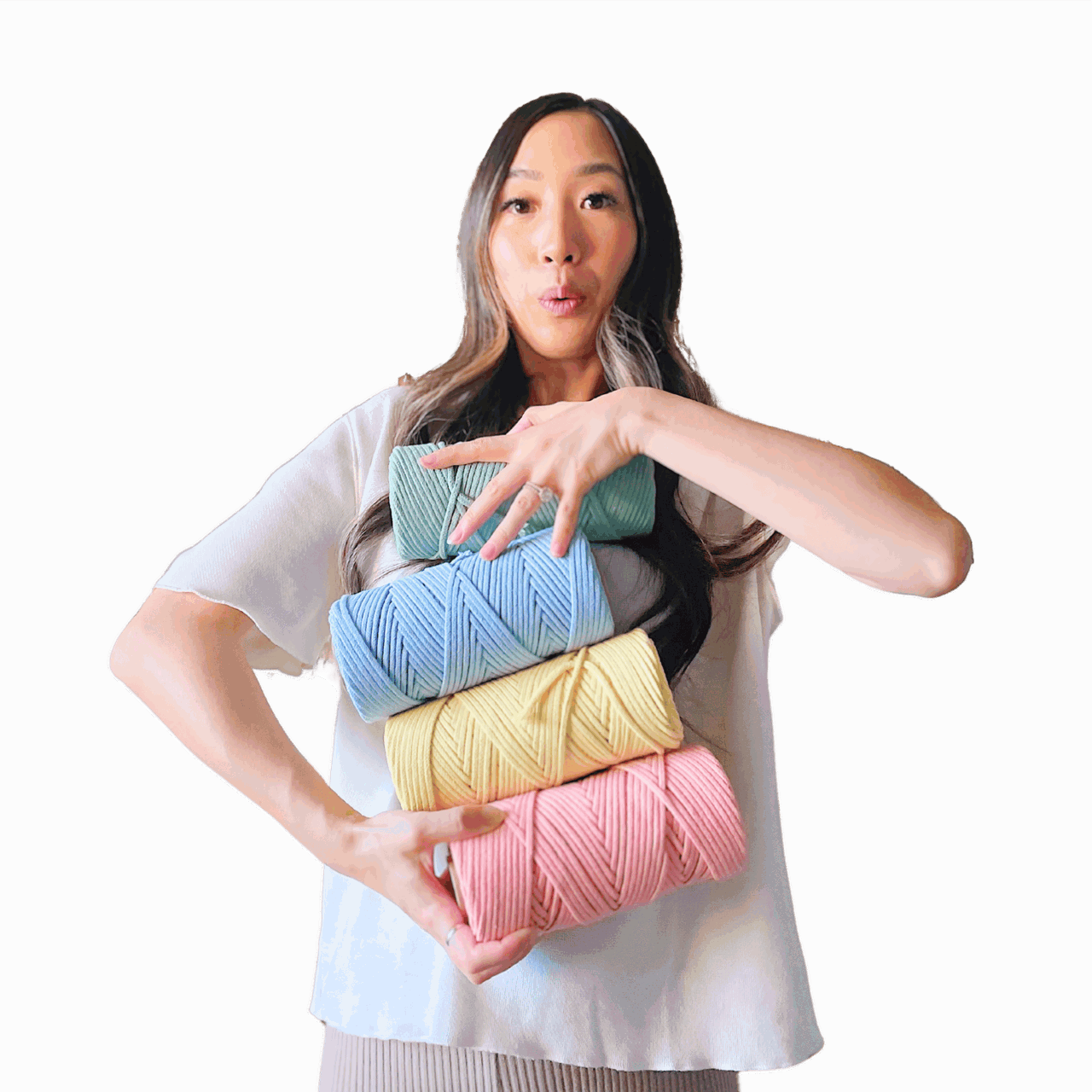
| Multicolor / dip-dyed | Playful, custom, eclectic | Kids' rooms, statement art, gifts with personality |
For mixed-color projects, browse our most popular cord collection or our color cord range.
Is Macramé Sustainable?

Short answer: yes, when you choose responsible cord. Cotton macramé cord is biodegradable, renewable, and (with proper care) lasts decades. The full picture has nuance, so here it is honestly.
Conventional cotton
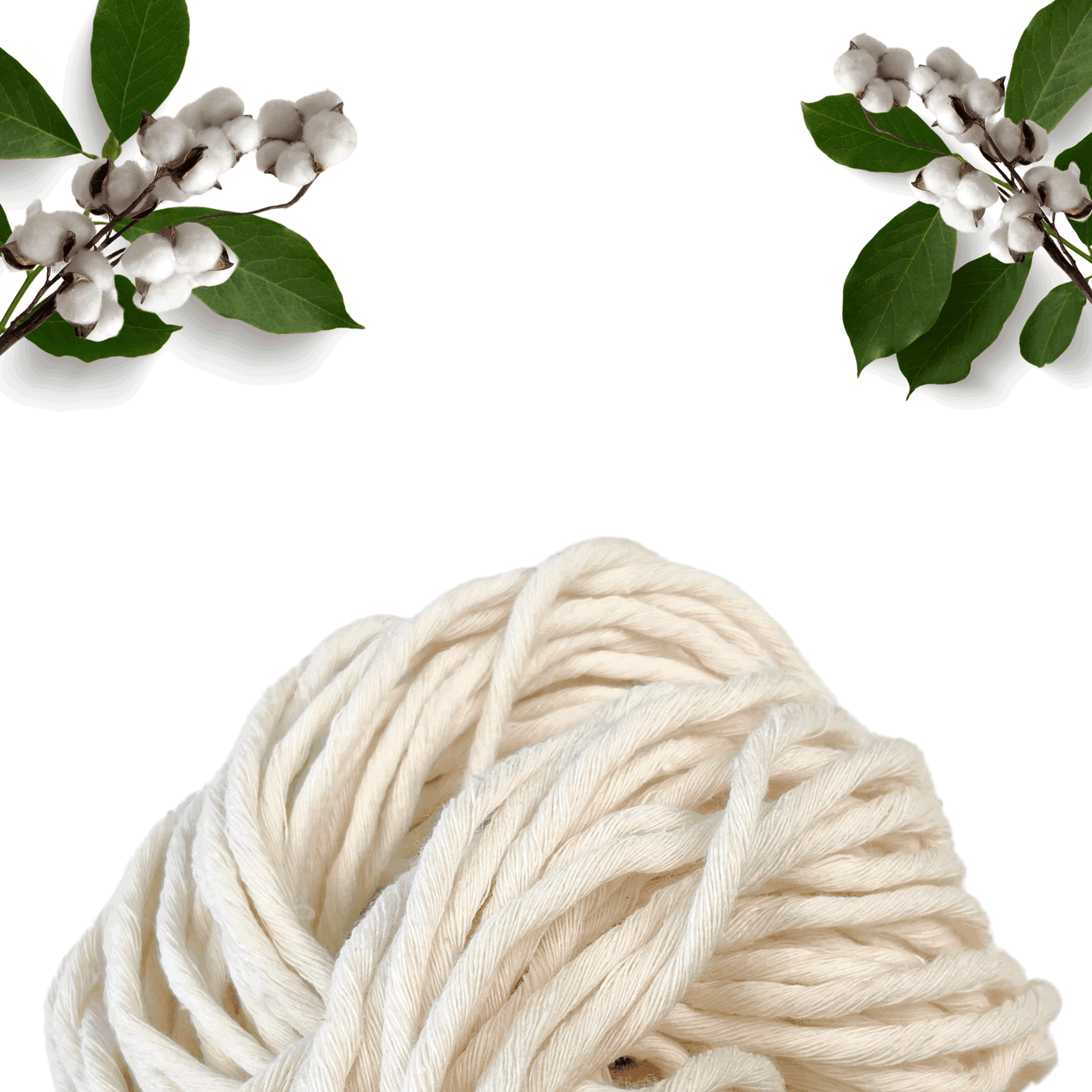
Cotton is renewable and biodegradable — both massive advantages over synthetic fibers like nylon or polyester. The drawback is that conventional cotton farming uses a lot of water and pesticides. If you're knotting a lot, choosing better-sourced cord makes a real difference.
Organic cotton
Grown without synthetic pesticides and using less water than conventional cotton. Slightly more expensive (~10–20%) but much friendlier to soil, water systems, and the farmers harvesting it. Browse our organic cotton collection →
Recycled cotton
Made from post-industrial cotton scraps that would otherwise end up in landfill. The most eco-friendly option, and the price is often comparable to conventional. The texture is slightly more rustic, which actually looks lovely in finished work. Browse our recycled cotton →
What to avoid
Synthetic macramé "cord" (nylon, polyester) is sometimes sold as a cheaper alternative. It doesn't biodegrade, doesn't brush into fringe properly, and feels plasticky in finished work. Stick with cotton.
Setting Up Your Macramé Workstation


You don't need a craft room. You need a place to hang your dowel at eye level and enough space to reach the bottom of your cords without slouching. Here are the three setups that actually work — pick whichever fits your space.
Option 1: The S-hook setup (the easiest)
Hang an S-hook on a wall hook, doorframe trim, or the top of a closet door. Hang your dowel from the S-hook with two short loops of cord. This is what I use 90% of the time. It takes 30 seconds to set up and 30 seconds to take down — perfect for living-room makers who don't want a permanent installation.
Option 2: The clothing rack setup
A free-standing clothing rack (the $30 IKEA kind) is the best portable workstation if you don't want anything permanent on your walls. Hang your dowel from the top bar with an S-hook. Bonus: you can wheel it around chasing natural light, and it folds away when you're not working.
Option 3: The wall-mounted setup
If you make macramé regularly, install a small wall hook at standing eye level — about 5.5–6 feet up. This is the most ergonomic workstation because you don't have to crouch or stretch for any part of your project. Best for makers who plan to sell, teach, or work on larger statement pieces.

The 4 Basic Macramé Knots Every Beginner Needs

Four knots cover roughly 95% of every macramé pattern you'll ever see: the lark's head knot, the square knot, the double half hitch, and the gathering knot. Learn these four — and that's it. The rest of macramé is just combining them in different sequences.
I've made dedicated step-by-step tutorials for each. Below is the short orientation; click through for the full visual breakdown.
1. The Lark's Head Knot — how you mount cord
The lark's head is the very first knot in almost every macramé project. You use it to attach your working cords onto a base (a dowel, a ring, or another cord). It takes about 5 seconds per knot once you've done a few, and learning to keep them all facing the same direction is the only thing you have to watch for.
When you'll use it: Mounting cords to the dowel at the start of every wall hanging and plant hanger. → Full lark's head tutorial

2. The Square Knot — the workhorse
The square knot is the most common knot in macramé. It uses four cords — two "fillers" in the middle and two "working" cords on the outside — to create the chunky, symmetric blocks you see all over modern wall hangings. It's the knot you'll tie thousands of times. Get this one comfortable and the rest of macramé opens up.
When you'll use it: Pretty much everywhere. Wall hangings, plant hangers, bags, table runners. → Full square knot tutorial

3. The Double Half Hitch — for diagonal lines
The double half hitch (sometimes called the half hitch knot or clove hitch) is the knot you use to create diagonal and horizontal lines across your piece. Think of every wall hanging with a clean V-shape or diamond pattern across the top — that's double half hitches.
When you'll use it: Creating decorative diagonal and horizontal lines, V-shapes, diamond patterns, geometric details. → Full double half hitch tutorial

4. The Gathering Knot — how you finish
The gathering knot (also called a wrap knot) is how you bind a bundle of cords together — to make the "neck" of a plant hanger, to gather a tassel, or to finish the top of a project. It's the most visually clean knot of the four and the one that gives your piece its polished, intentional look.

When you'll use it: The top of every plant hanger, the bottom of tassels, and anywhere you want to bundle cords cleanly. → Full gathering knot tutorial
🎯 Want all 4 knots in one place — physically?
Our Macramé Welcome Kit walks you through all four knots step-by-step with everything you need — cord, dowel, instructions — in one box.
Get the Welcome Kit →How to Tie Your First Knot — A Slow Walkthrough
The best knot to start with is the lark's head. It's the simplest, the fastest, and you'll use it at the start of almost every project. Here's the walkthrough.
- Cut one length of cord about 4 feet long. Doesn't matter exactly — this is practice.
- Fold the cord in half so the two ends are even.
- Hold the folded loop in front of your dowel. Bring the loop up and behind the dowel.
- Pull the loop forward over the top of the dowel so it hangs down in front.
- Take the two loose ends (now hanging behind the dowel) and bring them up and through the loop you just made.
- Pull both ends downward firmly until the knot tightens against the dowel. That's a lark's head.
That's it. Six steps, about 5 seconds once you've practiced. Now tie 5 more in a row on the same dowel. Make sure all of them face the same direction — bumps either all forward or all backward.

Once your six lark's heads are mounted, you have 10 hanging working cords — ready to start tying square knots, which is project one.
How Much Cord Do You Need?
This is where most beginners get tripped up. Cut cord too short and your project ends in tears. The math is simple, but no one tells beginners the formula. Here it is.
The 4× rule
Each working cord should be 4× the finished length of your project — before folding in half.
So if you want a wall hanging that's 2 feet long when finished, you need each working cord to be 8 feet long before you fold it in half (which gives you a 4-foot doubled cord, with enough to knot all the way down).
This is for a piece with light-to-medium knot density. If you're tying dense, tightly packed square knots the whole way down, bump that ratio to 5× or even 6×.
Cord-length quick reference
| Project type | Finished length | Cord per strand (4× rule) | Total cord (10–16 strands) |
|---|---|---|---|
| Small wall hanging | 12 inches | 4 ft | ~50–65 ft |
| Medium wall hanging | 24 inches | 8 ft | ~80–130 ft |
| Single-tier plant hanger | 32 inches | 10–11 ft | ~80–90 ft (8 cords) |
| Multi-tier plant hanger | 40+ inches | 13–14 ft | ~110–120 ft (8 cords) |
| Keychain | 4 inches | 2 ft | ~8–12 ft |
When in doubt, add 20%. You will never regret extra cord; you will absolutely regret running short three rows from the bottom of your wall hanging.
For the full sizing math — including how to plan for chunky vs. fine knot patterns — see my dedicated how to measure cord for macramé guide.
Choose Your First Project — The Beginner Flowchart
Beginners don't fail because the knots are too hard. Beginners fail because they choose a project that's too ambitious for their first afternoon and get discouraged. Use this flowchart to pick something you can actually finish.

The text version, if you want to skip the flowchart:
- Under 1 hour? Make a keychain or wristlet. Uses scrap cord, no dowel needed.
- 2–3 hours and you want decor? Make a small 12-inch dowel wall hanging.
- 2–3 hours and you want something functional? Make a single-tier plant hanger.
- 4+ hours and you want to feel proud? Make a diamond-pattern wall hanging or multi-tier plant hanger.
Your First 5 Beginner Macramé Projects

You've got the knots. Now what? These are the five projects I recommend to every beginner — in the order I'd tackle them. Each one builds on the last and uses only the four foundational knots.
- A small dowel wall hanging (12 inches). Two hours, single tier, uses lark's head + square knot + fringe. The ideal "I want to finish something today" project.
- A basic plant hanger. About 3 hours, uses lark's head + square knot + gathering knot. → See my full 5 ways to start a plant hanger guide.
- A keychain or wristlet. 30 minutes, great for using up scrap cord, perfect last-minute gift.
- A diamond-pattern wall hanging. 4 hours, introduces the double half hitch in a real pattern context.
- A multi-tier plant hanger. 4–5 hours, combines everything you've learned plus a layered design.

Want a curated list to work through? See my roundup of 12 free macramé projects for beginners.
What Bochiknot Students Say
You don't have to take my word for any of this. Here's what real beginners have made from the same four knots in this guide.

"I'd been intimidated by macramé for years — when I found Nicole's guide I figured I'd try just one plant hanger. I finished it in one Saturday afternoon. Now I have three hanging in my windows."

"I'd tried knitting twice and crochet three times — never finished any of them. Macramé I actually finished. The wall hanging behind me is mine, and this guide is the reason it exists."

"I read the cord-color section and went straight for navy beaded. Nicole's four-knot framework made the pattern feel achievable on my first try. It's hanging in my studio now."
Common Beginner Mistakes (and How to Avoid Them)
After teaching hundreds of beginners, I see the same five mistakes on repeat. None of them are skill-related. All five are fixable in 30 seconds once you know what to watch for.
- Cutting cord too short. Your working cord should be 4× the finished length before folding in half. When in doubt, add 20%.
- Uneven tension. Tie every knot with the same amount of pull. Loose knots look sloppy; over-tight knots warp the cord. Aim for "firm but not strained."
- Lark's head knots facing different directions. When you mount cords to the dowel, all lark's heads should face the same way. Mixing the two makes the top edge look chaotic.
- Working in poor light. You need to see your knots clearly. A floor lamp or daylight is non-negotiable for a clean finish.
- Trimming fringe before brushing it out. Always brush single-strand cord into fringe first, then trim. Trimming first leaves you with a stubbly, uneven edge.

Want more pro tips? My 18 tips to improve your macramé skills covers the studio habits that separate "handmade" from "looks professional."
Troubleshooting: Common Macramé Problems
You're three rows into your first wall hanging and something looks off. Use this section to diagnose what's happening — and fix it without starting over.
"My knots are crooked"
Three most likely causes: (1) inconsistent tension knot-to-knot, (2) your lark's head row at the top has knots facing different directions, or (3) your dowel isn't hanging perfectly horizontal. Check those three in order. The dowel one is the most overlooked.
"My piece is curling at the bottom"
This means your square knots are tied too tight. Cotton has a memory — if you over-pull, the cord twists and curls. Fix: loosen your tension for the bottom 3–4 rows, and let the piece hang overnight before judging.
"My fringe looks stubbly and uneven"
You trimmed before brushing. Always brush single-strand cord out into a full fringe first, then trim straight across with sharp scissors. If you've already trimmed, brush what's left, then carefully retrim — you'll lose some length but it'll look intentional.
"I ran out of cord halfway through"
Don't panic. You can splice in new cord by hiding the join inside a square knot. Lay the new cord parallel to the old one (overlap 4–5 inches), tie the next 3 square knots over both at once, then trim the old cord flush. The join is invisible from the front.
"My knots are too loose / falling apart"
The opposite of curling — your tension is too soft. As a fix, after each square knot, give the working cords a firm downward tug. If knots have already loosened, you can re-tighten by gently pulling individual loops with a crochet hook.
"The bottom of my piece is wider than the top"
This is normal for fringe-heavy pieces — the brushed cord fans out naturally. If you don't want that look, trim the fringe straight across at a narrower width than the dowel.
"My cord keeps tangling"
Use cord weights (small fishing weights or beads) on the bottom of each working cord. They cost a few dollars and eliminate 90% of beginner tangle frustration. Alternatively, butterfly-fold each working cord and secure with a small rubber band before you start.
"My finished piece doesn't lie flat against the wall"
The dowel is bowing. Check that your dowel is at least 0.5 inches thick — thinner dowels bend under the weight of cord and knots. Switch to a sturdier dowel and re-mount.
How to Make Your Macramé Look Professional
The gap between "a beginner made this" and "this is from a boutique" usually isn't skill. It's five small habits. Apply these and your second project will already look like your tenth.
1. Consistent tension, every single knot
The single biggest "tell" of a beginner piece is uneven tension — some knots loose, some tight. Pick one consistent pressure (think "firm but not strained") and tie every knot the same way. If you catch yourself easing up at the bottom, take a 5-minute break before continuing.
2. Square your dowel
Before you start, make sure your dowel is hanging perfectly horizontal. A 1-inch dowel hanging at a 5-degree tilt will give you a finished piece that looks crooked even though every knot is technically correct. Use a small level if you can't eyeball it.
3. Brush fringe with intention
For any single-strand cord project, the fringe is the last thing that makes it look "done" or "unfinished." Brush each strand fully open (use a fringe comb if you have one, a fine-toothed pet brush if you don't), then trim the bottom straight across. Brushing after trimming gives you stubble; brushing before gives you a clean, even bottom.
4. Hide your cord ends
The back of a professional-looking piece is as clean as the front. Use a crochet hook to thread any loose cord ends back up through 4–6 finished knots, then trim flush. Now the back looks intentional.
5. Photograph in natural light
Even if you only make macramé for yourself, photographing your finished piece will change how you see your own work. Hang it on a clean wall in indirect natural light (a window-lit corner is perfect), shoot from slightly below, and don't add filters. Suddenly your "beginner piece" looks like Pinterest content.
How to Hang & Display Your Macramé
You've finished your first piece. Now where does it go? Here's how to hang it without damaging your walls and how to choose where it lives in your home.
What hardware to use
| Piece weight | Recommended hardware | Best for |
|---|---|---|
| Under 1 lb (small wall hangings) | Command strips or removable adhesive hooks (rated 2+ lbs) | Rentals, drywall, dorms |
| 1–3 lbs (medium wall hangings, single-tier plant hangers) | Picture-frame nail or 3M Hangman hook | Drywall — minimal damage |
| 3–8 lbs (large wall hangings, multi-tier plant hangers with full pots) | Drywall anchor + screw hook, or ceiling anchor | Permanent installations, heavier loaded plant hangers |
| Over 8 lbs (statement pieces, room dividers) | Stud-mounted screw eye or ceiling joist anchor | Sculptural pieces, large installations |
Rental-friendly options (no holes)
- 3M Command strips — rated 2–7 lbs, removable without damage
- Over-the-door hooks — for hanging pieces over a closet door or interior door
- Tension rods between two walls — for hanging multiple plant hangers across a window
- Adhesive ceiling hooks — for plant hangers; rated 1–3 lbs, peel off cleanly
- Display on a clothing rack or ladder shelf — no walls required
Where to display macramé in your home
Macramé works almost anywhere, but some rooms wear it better than others:
- Living room above the couch — the classic statement spot for a medium-to-large wall hanging
- Bedroom above the bed — softer, more intimate vibe
- Sunny windows — best for plant hangers (good light + air circulation)
- Bathroom — adds texture in a tile-heavy space, but only if the bathroom has good ventilation (avoid steamy bathrooms — cotton hates prolonged moisture)
- Reading nook — small pieces above a chair or shelf
- Outdoor covered porch — yes! As long as it's not in direct sun or rain
How to Care for & Clean Macramé
Cotton macramé is more durable than it looks. With basic care, a finished piece will last decades.
Dust regularly
Once a week, give your hanging pieces a gentle shake outdoors or vacuum them on the lowest suction with a brush attachment. Cotton attracts dust just like fabric does.
Spot clean small stains
For minor stains, dab with a clean white cloth dipped in cool water and a tiny bit of mild dish soap. Blot, don't rub. Let air dry.
Hand-wash for deep cleaning
For a thorough wash:
- Fill a basin with cool water and a small amount of gentle detergent (Woolite or similar).
- Submerge the piece and gently agitate by hand. Don't twist or wring.
- Rinse in clean cool water until the water runs clear.
- Gently squeeze excess water out (no wringing — it will warp the knots).
- Lay flat on a clean towel to air dry. Reshape gently while still damp.
Never use the washing machine
A washing machine — even on delicate — will tangle, warp, and felt your cord. Hand wash only.
Avoid direct sun for hung pieces
Bright cotton cord will yellow slightly with extended direct UV exposure. If your piece hangs in a sunny window, expect gradual aging. Some people love this patina; others rotate pieces seasonally.
How to Price Macramé to Sell
Once you've finished a few projects, your friends will ask you to make them one. Then someone will offer to buy. Here's how to price your work without underselling.
The simple formula
Price = (Cost of Materials × 3) + (Hours × Your Hourly Rate)
The "× 3" on materials covers your cord, dowel, scissor wear, shipping supplies, Etsy fees, and a small profit margin. The hourly rate is what you'd want to be paid to do this work.
Worked example
- Small wall hanging: $8 in cord + $4 dowel = $12 materials × 3 = $36
- 3 hours at $20/hour = $60
- Total price: $96 (round to $95 or $99)
Typical market prices on Etsy (2026)
| Piece | Beginner-to-intermediate range | Premium / advanced range |
|---|---|---|
| Small wall hanging (12 in) | $30–60 | $80–150 |
| Medium wall hanging (24 in) | $60–120 | $150–350 |
| Single-tier plant hanger | $30–60 | $80–180 |
| Multi-tier plant hanger | $50–120 | $150–300 |
| Statement piece (4 ft+) | $200–500 | $500–2,000+ |
| Keychain / wristlet | $8–18 | $20–35 |
Where to sell
- Etsy — easiest start, but fees add up (12–15% of price)
- Local markets & craft fairs — higher margin, faster feedback, lower volume
- Your own Shopify or Squarespace — best margin, but you handle traffic
- Wholesale to local boutiques — bulk orders at lower per-piece price (~50% of retail)
- Instagram DMs / Patreon community — most personal, often best per-piece price
Macramé Glossary — The Terms You'll Hear
Every craft has its own language. Here are the macramé terms you'll see in patterns and tutorials, in plain English.
- Working cord
- The active cord you're tying knots with — the one moving.
- Filler cord
- The passive cord that stays in place while working cords wrap around it.
- Sennit
- A vertical column of repeated knots — usually square knots — that forms a thick braid down your piece.
- Fringe
- The unraveled, brushed-out bottom edge of a piece. → See my ultimate guide to macramé fringe.
- Mount
- The act of attaching working cords to a base — usually with a lark's head knot.
- Single-strand cord
- Cotton cord made of one twisted bundle of fibers. Soft, brushes into fringe easily.
- 3-ply cord
- Cotton cord made of three twisted strands. Rope-like, holds shape, doesn't unravel.
- Braided cord
- Cotton cord woven in a braid pattern. Smooth surface, doesn't unravel.
- Dowel
- A wooden rod used as the base for wall hangings. Usually 12–24 inches long.
- Lark's head reverse
- A lark's head knot flipped so the bumps face the back of the piece — clean top edge.
- Knot density
- How tightly packed knots are along a length. High density = more knots, more cord required.
- Spiral knot (half square)
- A variation of the square knot where you only tie half each time, creating a spiral down a sennit.
Frequently Asked Questions
What is macramé and how does it work?
Macramé is the craft of creating textiles by knotting cord — no needles, no hooks, just your hands. You mount cord to a base (a wooden dowel, ring, or branch), then combine four basic knots to build patterns, plant hangers, wall hangings, jewelry, and more.
Is macramé hard to learn?
No. Macramé only uses four basic knots and your hands. Most beginners finish a small wall hanging or plant hanger in their first 2–3 hours.
How long does it take to learn macramé?
About 30 minutes to learn the four basic knots, and 2–3 hours to finish your first small project.
How much does it cost to start macramé?
Between $25 and $50 USD. The bare minimum (cord, dowel, household scissors) is $15–25; a recommended starter kit with quality scissors is $30–50.
What's the easiest macramé project for a beginner?
A small single-tier plant hanger or a 12-inch dowel wall hanging.
What knots do I need to know to start macramé?
Four knots: the lark's head, square knot, double half hitch, and gathering knot.
What cord should a beginner use?
Start with 3mm or 5mm single-strand cotton cord. Skip 3-ply for project one.
How do I hang macramé without damaging walls?
Use Command strips rated for 1 lb above your piece's weight. For heavier pieces, use a small picture-frame nail or 3M Hangman product. Rental-friendly options include adhesive ceiling hooks and tension-rod displays.
What's the difference between macramé and crochet?
Macramé uses knots tied by hand. Crochet uses a hook to pull yarn through loops. Macramé makes decor; crochet makes wearables.
Can I use yarn instead of macramé cord?
Technically yes, but the results will look different. Yarn is too soft — knots won't hold their shape. Cotton macramé cord is purpose-made for the structured look.
How much cord do I need for a beginner project?
Small wall hanging: 50–80 ft of 3mm cord. Basic plant hanger: 80–120 ft. Rule of thumb — each working cord should be 4× the finished length before folding in half.
How much should I charge for a macramé piece?
Use the formula: (materials × 3) + (hours × hourly rate). Etsy buyers typically pay $30–150 for beginner-to-intermediate wall hangings and $40–200 for plant hangers.
What color cord should I use for macramé?
For your first project, natural cream — most versatile, shows off knot structure. Once you progress: beige/oatmeal for warmth, white for minimalism, mustard/terracotta for boho, or multicolor for statement pieces.
Is macramé sustainable?
Yes when you choose responsible cord. Cotton is biodegradable and renewable. Look for organic cotton or recycled cotton for the smallest footprint.
What supplies do I need to start macramé?
Five things: cotton macramé cord (3mm or 5mm), a wooden dowel or branch, sharp scissors, a measuring tape, and an S-hook or wall hook.
Is macramé still popular in 2026?
Yes — macramé has stayed strong through 2024, 2025, and into 2026 as both a slow-craft hobby and home decor trend.
Can I learn macramé without taking a class?
Yes — most macramé makers are self-taught. Free YouTube tutorials and beginner kits give you everything you need.
How do I make my macramé look professional?
Five things: consistent tension, lark's head knots facing same direction, good light, brushing fringe before trimming, and quality cotton cord.
Why are my macramé knots crooked?
Most commonly: inconsistent tension, lark's head knots at the top facing different directions, or a dowel not hanging horizontal. Check those three first.
How do I clean macramé?
Spot clean with cool water and mild soap. For deep cleaning, hand-wash in cool water with gentle detergent, gently squeeze (don't wring), and lay flat to air dry. Never use the washing machine.
Where did macramé originate?
13th-century Arab weavers used decorative knots to finish textile edges. The word comes from the Arabic migramah, meaning "fringe."
Is macramé good for mental health?
Yes — research shows working with your hands measurably reduces anxiety and improves mood. Macramé fits "active meditation" categories.
What yarn is best for macramé?
3 mm or 5 mm single-strand cotton macramé cord is the best yarn for macramé. It is thick enough to hold knot shape, soft enough to be comfortable to work with, and shows the knot structure cleanly. Avoid acrylic yarn (too slippery, knots will not hold) and avoid standard knitting yarn (too soft, knots flatten). Bochiknot's 3 mm single-strand cotton cord is purpose-made for macramé.
How long does a macramé piece take to make?
Project times vary by size and complexity. A simple keychain takes 15 to 30 minutes. A small wall hanging takes 2 to 3 hours. A basic plant hanger takes 3 to 4 hours. A large statement wall hanging can take 8 to 15 hours. As a rough rule, count 1 hour per ~50 square inches of finished piece for beginner skill level.
Is macramé profitable on Etsy?
Yes, macramé can be profitable on Etsy when priced correctly. Top sellers earn $1,000 to $5,000+ per month from plant hangers, wall hangings, and keychains. Use this pricing formula: (materials cost × 3) + (hours × $20-30 hourly rate). Beginner-to-intermediate wall hangings typically sell for $30 to $150; plant hangers for $40 to $200; keychains for $10 to $25. The key to profit is bulk production and consistent listing photos.
Why is macramé so popular?
Macramé became popular again because it sits at the intersection of three growing 2020s trends: slow, screen-free hobbies; sustainable, natural-fiber home decor; and boho-modern interior design. The craft is meditative and accessible (only 4 knots to learn), produces high-impact decor without expensive materials, and photographs beautifully for social media. Pinterest searches for "macramé" grew 280% from 2018 to 2024 and have stayed strong through 2026.
Can children learn macramé?
Yes — children 6+ can learn the lark's head and basic square knot with supervision. Use chunky 5mm cord and keep projects short.
Macramé Inspiration Gallery
Sometimes you just need to see the finished work to commit. Here's a curated gallery of beginner-to-intermediate macramé pieces — all made from the four foundational knots you just learned.


Each of these uses only the four knots in this guide. The difference between any of them and your first piece is one thing only: more reps.
Your Next Steps in Macramé
You've now got the foundation: what macramé is, where it comes from, the supplies you need, the four knots, your project plan, troubleshooting, hanging, care, and even pricing. Where do you go from here? Here's the Bochiknot learning path.
Phase 1 — Foundations (you're here)
- Complete guide to selecting macramé cord & materials
- 12 free macramé projects for beginners
- 9 top tips for macramé beginners
Phase 2 — Craft skills
- How to measure cord for macramé
- 5 ways to start a macramé plant hanger
- The ultimate guide to macramé fringe
- 18 tips to improve your macramé skills
- Macramé embellishments
Phase 3 — Pattern design
- Intro to intricate macramé knot patterns
- Guide to macramé design
- Incorporating unique elements in macramé design
Join the Bochiknot Community on Patreon
Monthly exclusive patterns, early video access, and 1-on-1 feedback. Where my most engaged beginners go to keep learning.
Become a patron →If you've made it to the bottom of this page, you're more ready than you think. The hardest part of macramé isn't the knots — it's giving yourself permission to try. Grab a length of cord this weekend, pick the smallest project from the list above, and just start. Your first piece won't be perfect, and that's exactly the point — it'll be yours.
When you finish, tag @bochiknot on Instagram. I read every tag and I love seeing first projects most of all. Happy knotting. 🌾
Nicole Woo — Founder, Bochiknot
Macramé educator & designer · Teaching since 2018
Nicole is a self-taught macramé artist who left a career in accounting to teach the craft full-time. Through Bochiknot, she's helped thousands of beginners take their first knot — sharing step-by-step tutorials on YouTube, premium cotton cord in the shop, and beginner-friendly kits designed to get you from "I want to make that" to "I made this" in a single weekend.
You might also like
Phase 1 · Guide
Selecting Macramé Cord & Materials
Single-strand, 3-ply, braided — which cord for which project.
Plant Hangers
5 Ways to Start a Macramé Plant Hanger
Five beginner methods, with or without a ring.
Phase 2 · Pro tips
18 Tips to Improve Your Macramé Skills
Small fixes that separate "handmade" from "looks professional."
Holiday Projects
Macramé Christmas Tree Ornament
Beginner pipa-knot ornament — under $5 each, 1–2 hours.
Coasters · Tutorial
Macramé Bear Coaster
A cute round coaster with a clean no-fringe edge — DHH practice project.
Coasters · Tutorial
Macramé Diamond Coaster
Square coaster with a single bold diamond — 30-min beginner project.
Baby & Kids · Tutorial
Macramé Baby Play Gym
Wooden play gym with hanging macramé teether toys — perfect baby shower DIY.
Baby & Kids · Tutorial
DIY Macramé Baby Teether
Soft daisy-knot teether — 4 cords + 2 wooden rings, beginner-friendly baby gift.
More Tutorials from Bochiknot on YouTube


Your YT vids and a PinnerConference got me started with Macrame. Thank you!🙏🏾
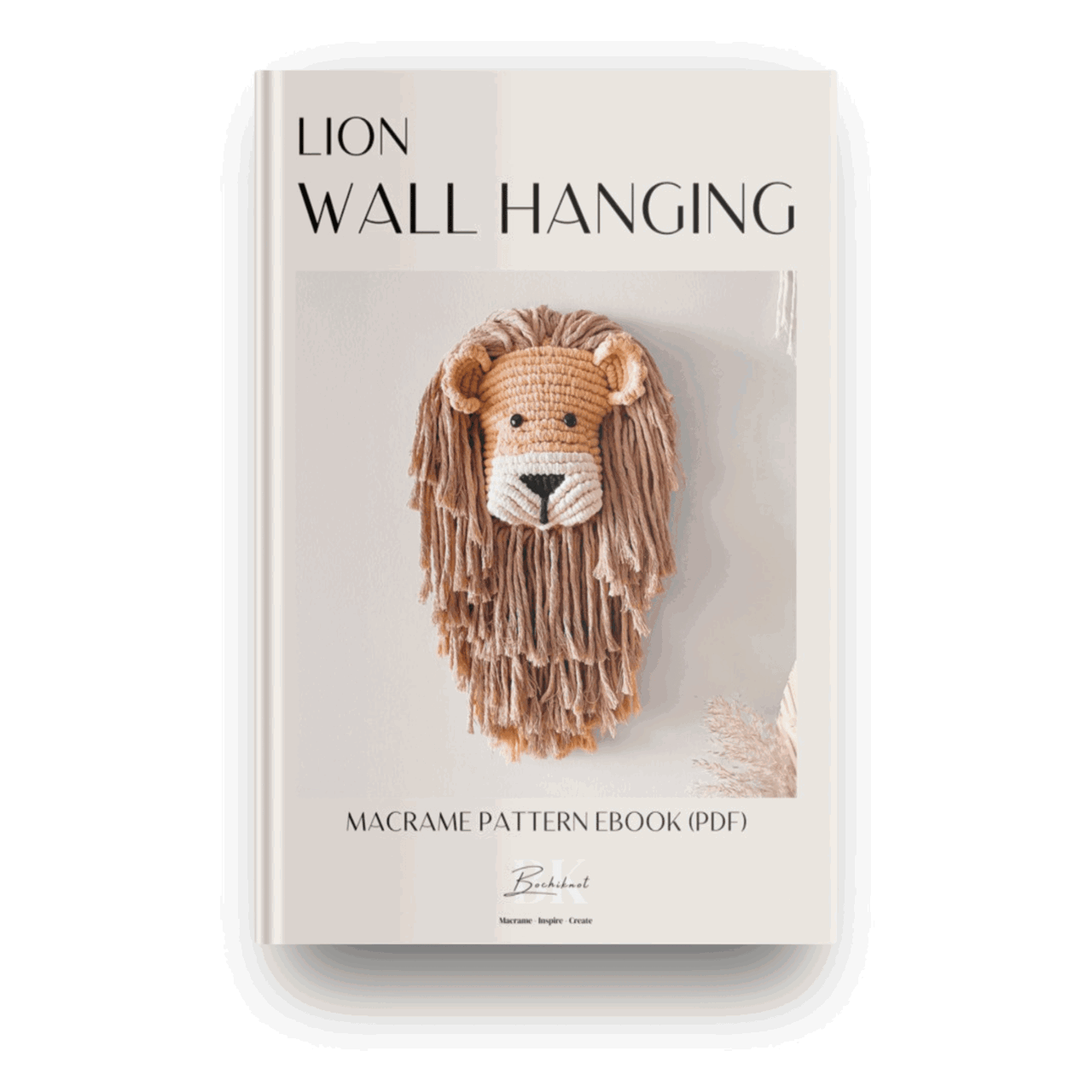
Hola, podrías venderme un tutorial de león que he visto en algún video?. Ya tengo un nivel avanzado de macrame y me gustaría hacer cosas diferentes. . También vi un azteca, ese también me gustaria aprender a ahacerlo
. En alguna ocasión te compré el de atrapasueños que es color rosita.
Thank you from Greece
Is this available in a hard copy? I work in a library and feel this would be an excellent addition to nour collection.
Leave a comment