




How to Tie an Endless Falls Knot in Macramé (Step-by-Step Tutorial)


Updated 2026 · 7 min read
🔖 Save for later
How to Tie an Endless Falls Knot in Macramé (Step-by-Step Tutorial)
- Tie a lark's head knot with Color #1 onto your dowel — but don't tighten it fully.
- Weave Color #2 horizontally through the loose lark's head knot, leaving equal ends on each side.
- Criss-cross the two ends of Color #2 into a small loop just below the two middle cords.
- Pull the two middle cords down through the back and up through the criss-crossed loop.
- Tighten the working cords to lock the row, then repeat to build the falls.
Total time per row: about 20 seconds · Cord used: 5× project length per cord · Difficulty: beginner-intermediate

📌 Pin this tutorial for later
Save this endless falls knot guide to your Pinterest board so you can come back to it mid-project.
Save to PinterestWhat You'll Learn
Tutorial Contents
- What is the endless falls knot?
- Also known as: braid knot, waterfall knot, endless falls sennit
- Anatomy of an endless falls knot
- The two-sided design: front vs. back
- When and where to use the endless falls knot
- What you'll need
- How to tie an endless falls knot (step-by-step)
- How to build a full endless falls sennit
- Common endless falls knot mistakes
- Troubleshooting
- Projects that use the endless falls knot
- Endless falls knot FAQ
- Your next macramé knot
- Keep learning with Bochiknot
What Is the Endless Falls Knot?
The endless falls knot is a decorative two-color macramé technique that creates a beautiful chunky braid down the front of your work and a clean ladder-style pattern down the back. It's built by tying a lark's head knot with one cord, weaving a second contrasting cord horizontally through it, and then looping the middle cords through to lock the row. Each repetition adds another "fall" to the sennit.
What makes the endless falls so special is its two-sided design. From the front, you see a tight braided column that reads almost like a knit stitch. From the back, the same cords form a neat ladder of horizontal bars. You essentially get two finished textures from one knot — which is rare in macramé.
The endless falls is most commonly tied in two contrasting colors because the alternating cords create the braided "falling" effect that gives the knot its name. With a single color it still works, but the visual rhythm is much weaker.
Also Known As: Braid Knot, Waterfall Knot, Endless Falls Sennit
The endless falls knot goes by several names depending on the pattern designer or community. They all describe the same knot:
| Name | Where you'll hear it |
|---|---|
| Endless falls knot | The most common name in modern English-language macramé patterns |
| Endless falls sennit | Technically more accurate — a "sennit" is any repeating knot pattern |
| Braid knot | Used when the focus is on the chunky front-facing braid |
| Waterfall knot | Common in plant hanger and jewelry patterns |
| Two-color braid knot | Used in YouTube tutorials and beginner books |
| Falling braid sennit | Occasionally used in fiber arts forums |
If you see "braid knot" or "waterfall knot" in a macramé pattern, it's almost always the endless falls.
Anatomy of an Endless Falls Knot
Every endless falls knot is built from 2 cords in 2 colors. Understanding the structure makes the tutorial much easier to follow:
- Color #1 (foundation cord): Folded in half and attached to the dowel with a lark's head knot. Once folded, you have 2 working ends of Color #1.
- Color #2 (weaving cord): A second cord woven horizontally through the lark's head knot. You have 2 working ends of Color #2.
- The lark's head loop: The opening at the top of the lark's head knot where Color #2 weaves through.
- The middle cords: The 2 inner working ends of Color #1 (the ones hanging straight down from the dowel). These get pulled through the criss-crossed loop in each repetition.
- The criss-cross loop: Created by crossing the two ends of Color #2 just below the lark's head.
Once tied, you essentially have a chain of these mini "weave + loop + lock" units stacked vertically — that's what creates the falls effect.
The Two-Sided Design: Front vs. Back
One of the most beautiful things about the endless falls knot is that it gives you two completely different finished textures from a single knot — a chunky braid on the front and a clean ladder pattern on the back.
Front side: Dense, chunky braid that reads almost like a column of knitted stitches. The two colors alternate down the column creating visual rhythm. Best used as the outward-facing surface in wall hangings, plant hangers, and accessories.

Back side: A clean, structured ladder pattern of horizontal bars with the second color showing through. Some makers actually prefer the back for minimalist designs because the geometry is so clean. It's especially nice on the underside of bag straps where structure matters more than texture.
When and Where to Use the Endless Falls Knot
The endless falls is one of the most visually-rewarding decorative knots in macramé. Anywhere you want a flat surface to read as braided, woven, or textured, the endless falls does it cleanly in two colors.
Plant Hangers
One endless falls column on each arm of a plant hanger turns a basic 4-arm hanger into a designer statement piece.
Keychains & Lanyards
A 3 to 5-knot endless falls sennit makes a perfectly weighted, chunky keychain or lanyard pull.
Bag Straps
The thick braided front + structured back makes endless falls ideal for handbag straps that need both texture and durability.
Wall Hangings
A vertical column of endless falls knots adds a "knit" texture to wall hangings — perfect for breaking up sections of square knots.
Jewelry
In fine 1–2mm cord, the endless falls makes beautiful two-tone bracelets and necklaces.
Garlands & Banners
Repeat endless falls in seasonal color pairs (red + green for Christmas, pink + white for nursery) for textured holiday garlands.
What You'll Need
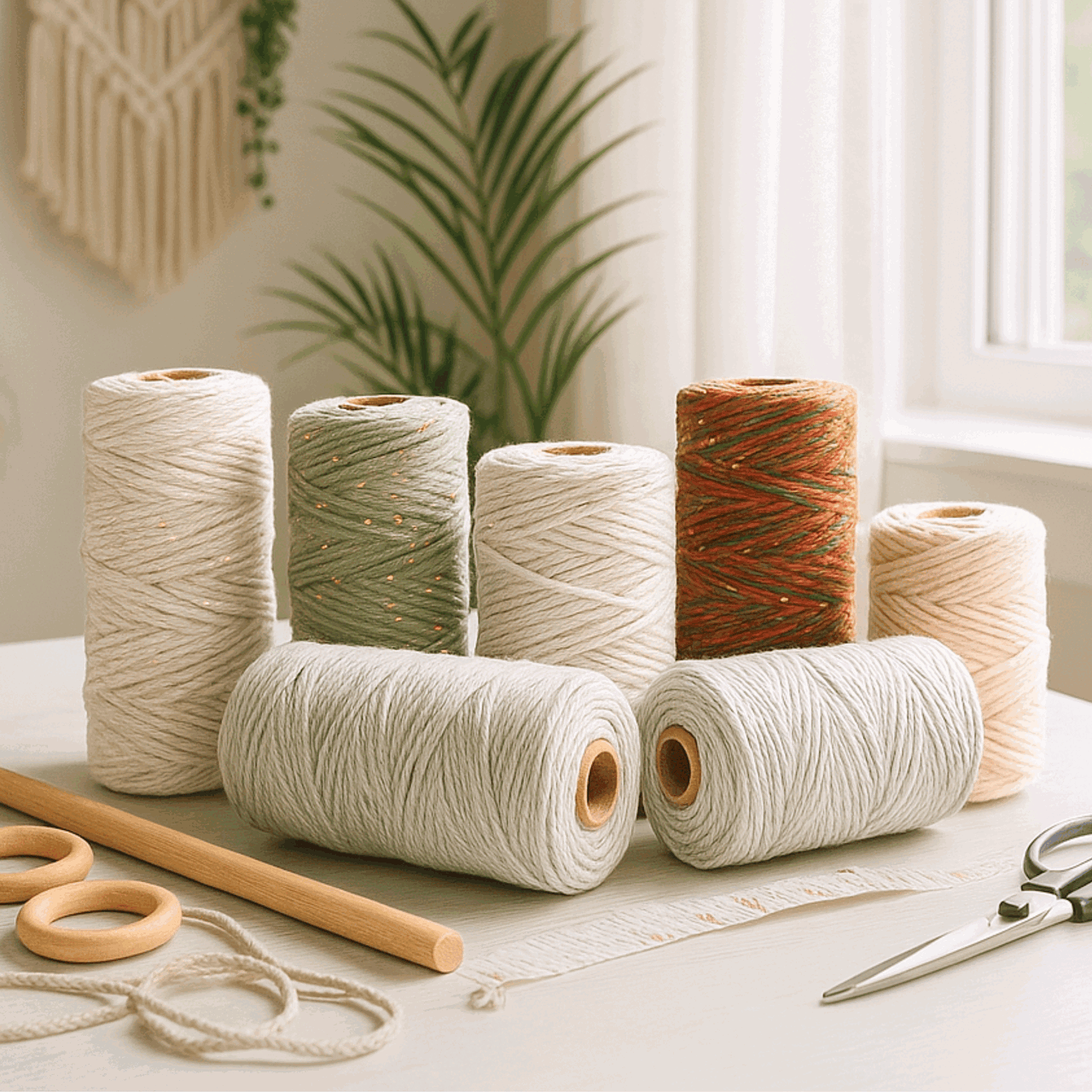
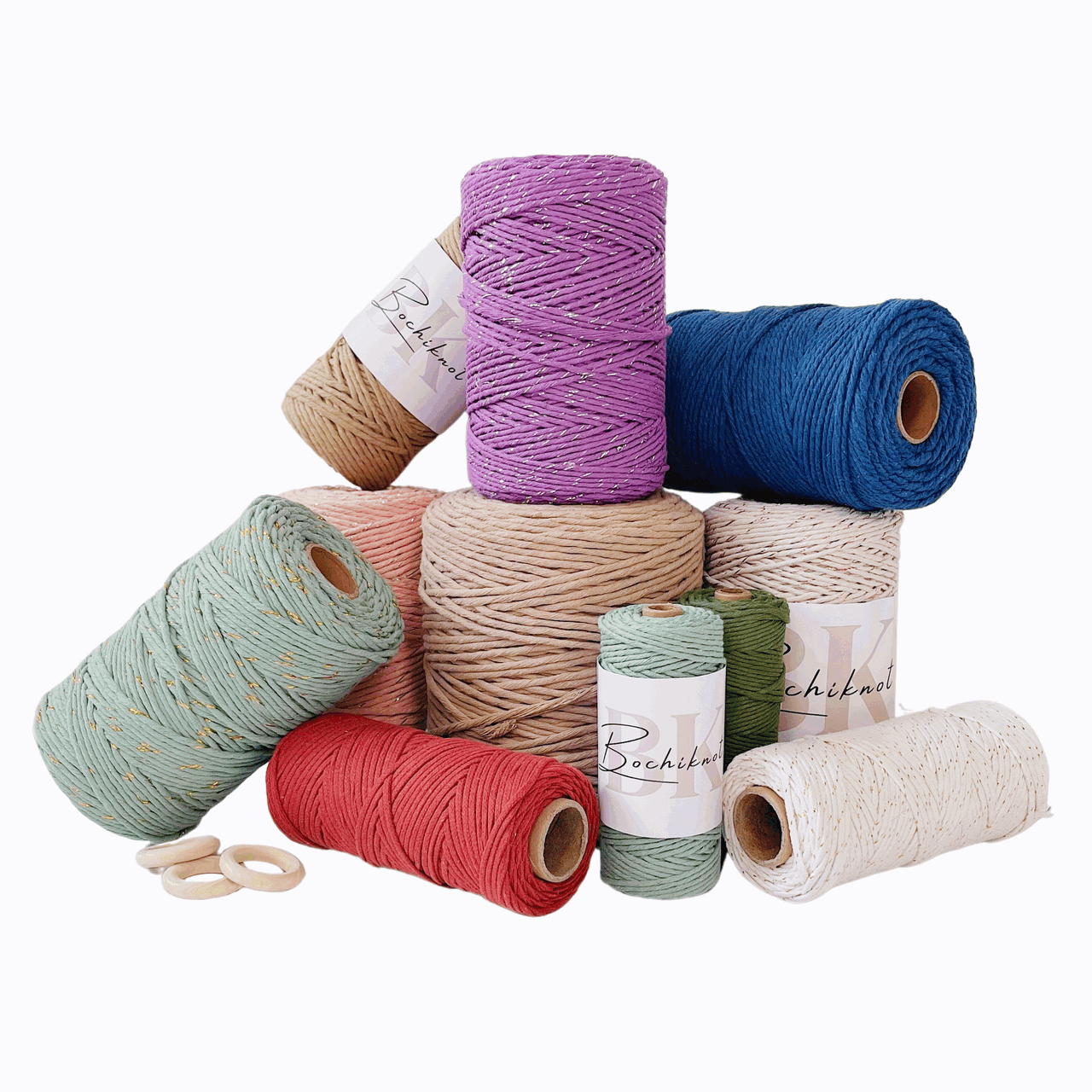
- 2 cords in 2 contrasting colors — each at least 30 inches (75 cm) long for practice
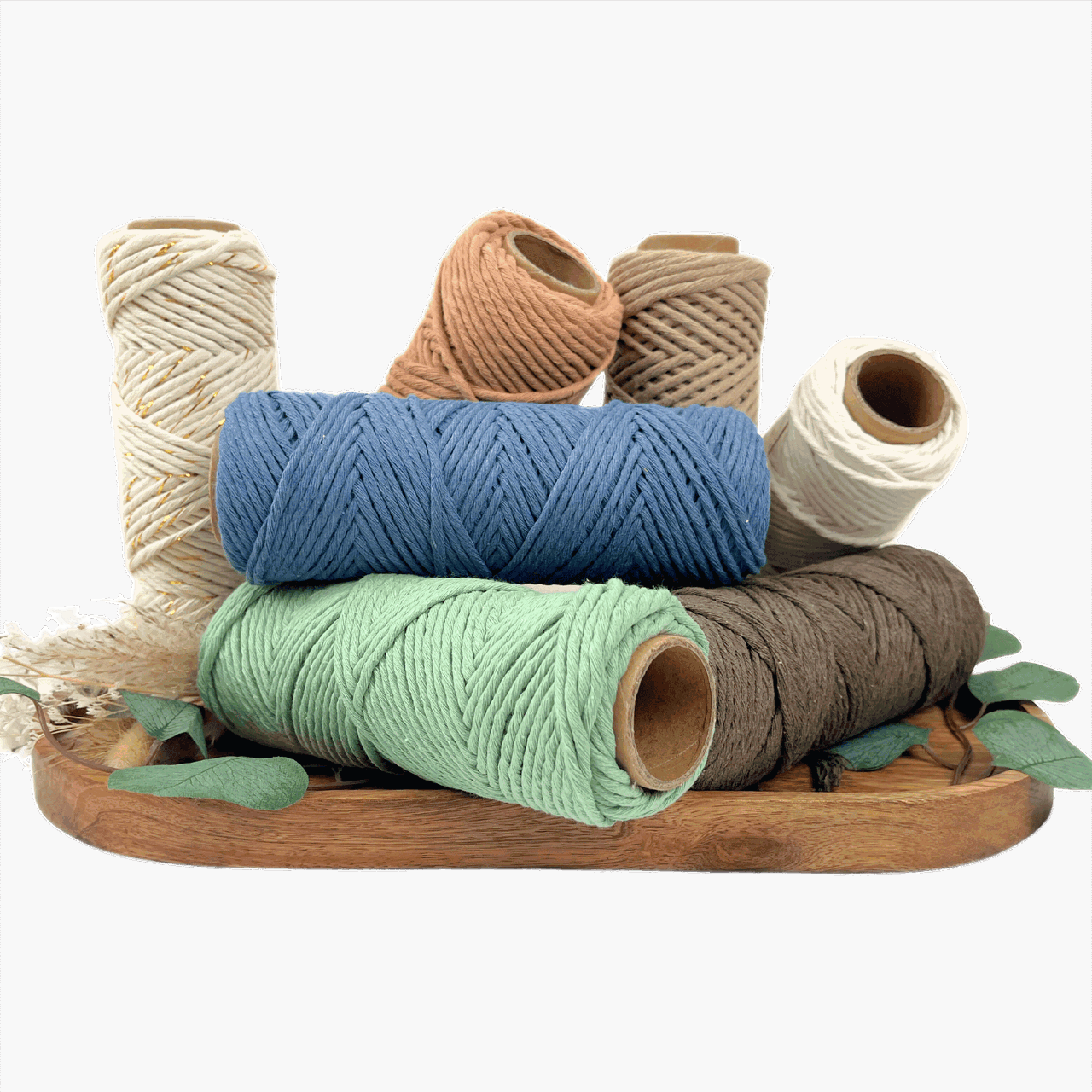
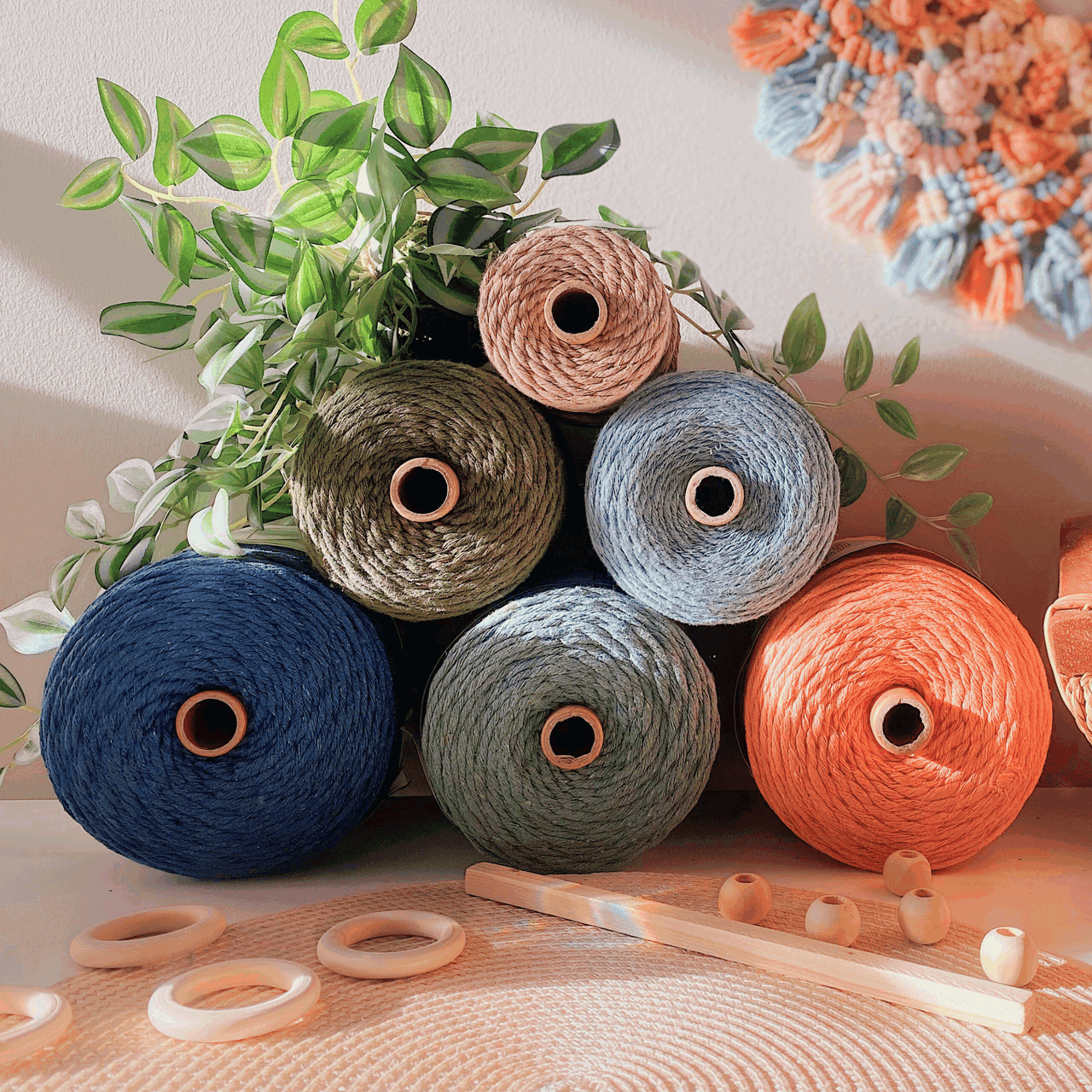
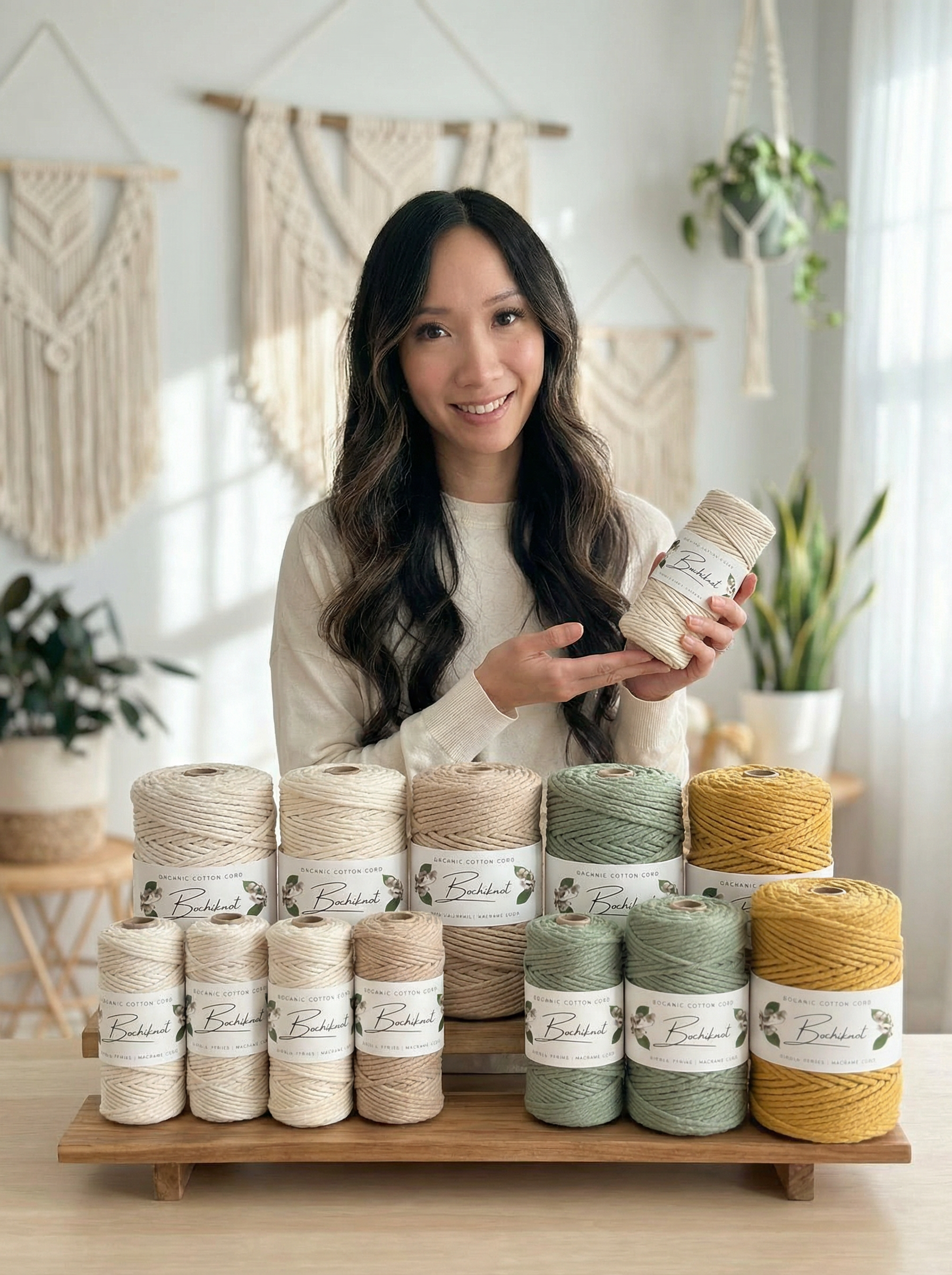
- 3mm or 5mm single-strand cotton cord works best — the structure shows clearly (shop Bochiknot cord)
- A wooden dowel or anchor point
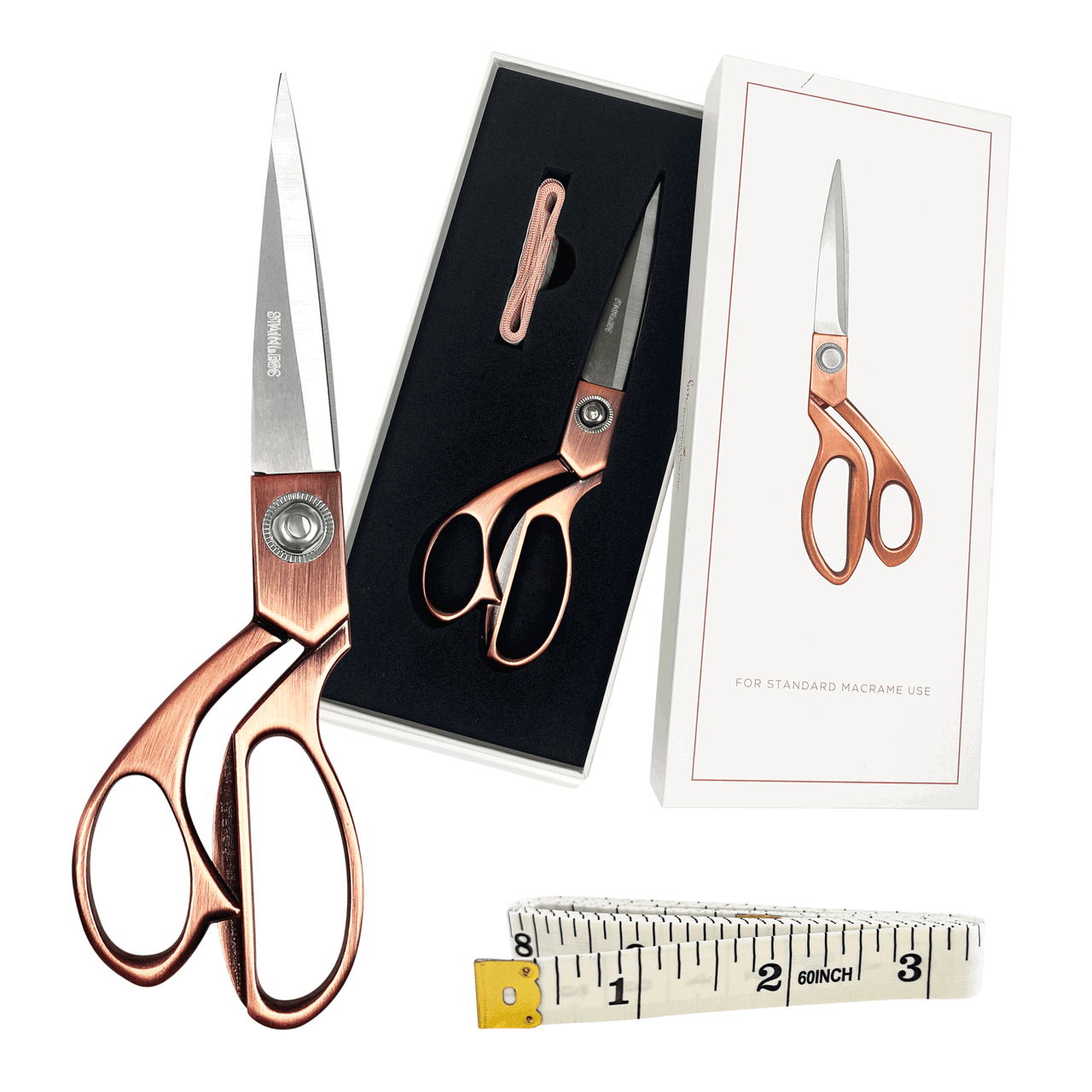
- Sharp macramé scissors for clean ends
- Optional: a tapestry needle or crochet hook to thread the weaving cord neatly
How to Tie an Endless Falls Knot (Step-by-Step)
Before you start, make sure you can tie a lark's head knot — the endless falls is built on top of one.

How to Build a Full Endless Falls Sennit
One endless falls "row" is just a single fall. The magic happens when you repeat it down the length of your project to build a full sennit:
- Continue the lark's head pattern. The two working ends of Color #1 that came up through the criss-cross loop in Step 4 are now your new "lark's head" — wrap Color #1 around itself to form the next loose lark's head shape just below the previous row.
- Re-weave Color #2 horizontally through the new loose loop, just like Step 2.
- Criss-cross Color #2 and pull the middle cords through, exactly as Steps 3 and 4.
- Tighten. You've added a second fall to the sennit.
- Repeat as many times as your project needs. 5 falls = a small keychain. 15 falls = a plant hanger arm. 30 falls = a full wall hanging column.
Common Endless Falls Knot Mistakes
| Mistake | What happens | How to fix it |
|---|---|---|
| Pulling the lark's head tight too early | Can't weave Color #2 through | Leave the lark's head loose until Color #2 is woven in |
| Uneven Color #2 lengths | One side of the falls runs out of cord first | Center Color #2 carefully before tightening the lark's head |
| Criss-crossing in the wrong direction | The falls twist or look uneven | Always cross Color #2 in the same direction every row (e.g. left-over-right) |
| Skipping the back-pull on the middle cords | Falls don't lock — the row unravels | Always pull middle cords behind the work first, then up through the loop |
| Single color instead of two | No visual braid effect — looks like a regular sennit | Use two contrasting colors for the signature endless falls look |
| Cord too short | Run out partway down the sennit | Cut at 5× project length minimum |
Troubleshooting: My Endless Falls Doesn't Look Right
| If your endless falls looks… | The most likely cause is… |
|---|---|
| Flat with no 3D braid effect | You didn't pull the middle cords behind the work before bringing them up — re-do Step 4 |
| Twisted to one side | You're criss-crossing Color #2 in alternating directions — always cross the same way |
| Stretched and stringy | You're over-tightening — pull only until the row sits flat |
| Loose and puffy | You're under-tightening — pull firmer in Step 5 |
| Visible "ladder" on the front (wrong side showing) | You've flipped the work — turn it over so the braid shows forward |
| Color #2 keeps slipping out | Lark's head not tightened enough after weaving — gently snug it |
| Uneven row spacing | Each new lark's head is being tied at different distances — measure consistently |
Projects That Use the Endless Falls Knot
Looking to put your new endless falls knot skill to use? These project types use it beautifully:
- Two-tone plant hangers — one endless falls sennit on each of 4 arms
- Macramé keychains and lanyards — 5 to 10 falls make a perfect chunky pull
- Bag and tote straps — endless falls gives a strong, structured strap with built-in texture
- Wall hangings — alternate endless falls columns with square knot panels for a knit-meets-macramé look
- Macramé bracelets — in 1–2mm cord, makes a beautiful two-color woven bracelet
- Christmas garlands — red + cream endless falls along a horizontal cord
- Dreamcatchers — short endless falls drops below the ring add chunky texture
Browse our full library of 12 free beginner macramé projects for patterns you can apply this knot to.
Endless Falls Knot FAQ
What is an endless falls knot in macramé?
The endless falls knot is a decorative two-color macramé technique that creates a chunky braided front and a ladder-style back. It's built by tying a loose lark's head knot in Color #1, weaving Color #2 horizontally through it, criss-crossing the Color #2 ends, and pulling the middle cords through the criss-cross to lock the row. Repeating the process builds a full endless falls sennit.
Is the endless falls knot the same as a braid knot or waterfall knot?
Yes. The endless falls knot, braid knot, and waterfall knot are all the same knot — just different names. You may also see it called an endless falls sennit, two-color braid knot, or falling braid sennit. All these terms describe the same technique.
How many cords do you need for an endless falls knot?
You need 2 cords total — one in Color #1 (folded in half and attached with a lark's head, giving you 2 working ends) and one in Color #2 (woven horizontally through). That's 4 working ends total once everything is set up.
Can you tie an endless falls knot with only one color?
Technically yes, but the visual braid effect that gives the endless falls its name is created by the contrast between the two colors. With a single color the structure still works but it just reads as a generic sennit. Always use two contrasting colors for the signature look.
What size cord is best for an endless falls knot?
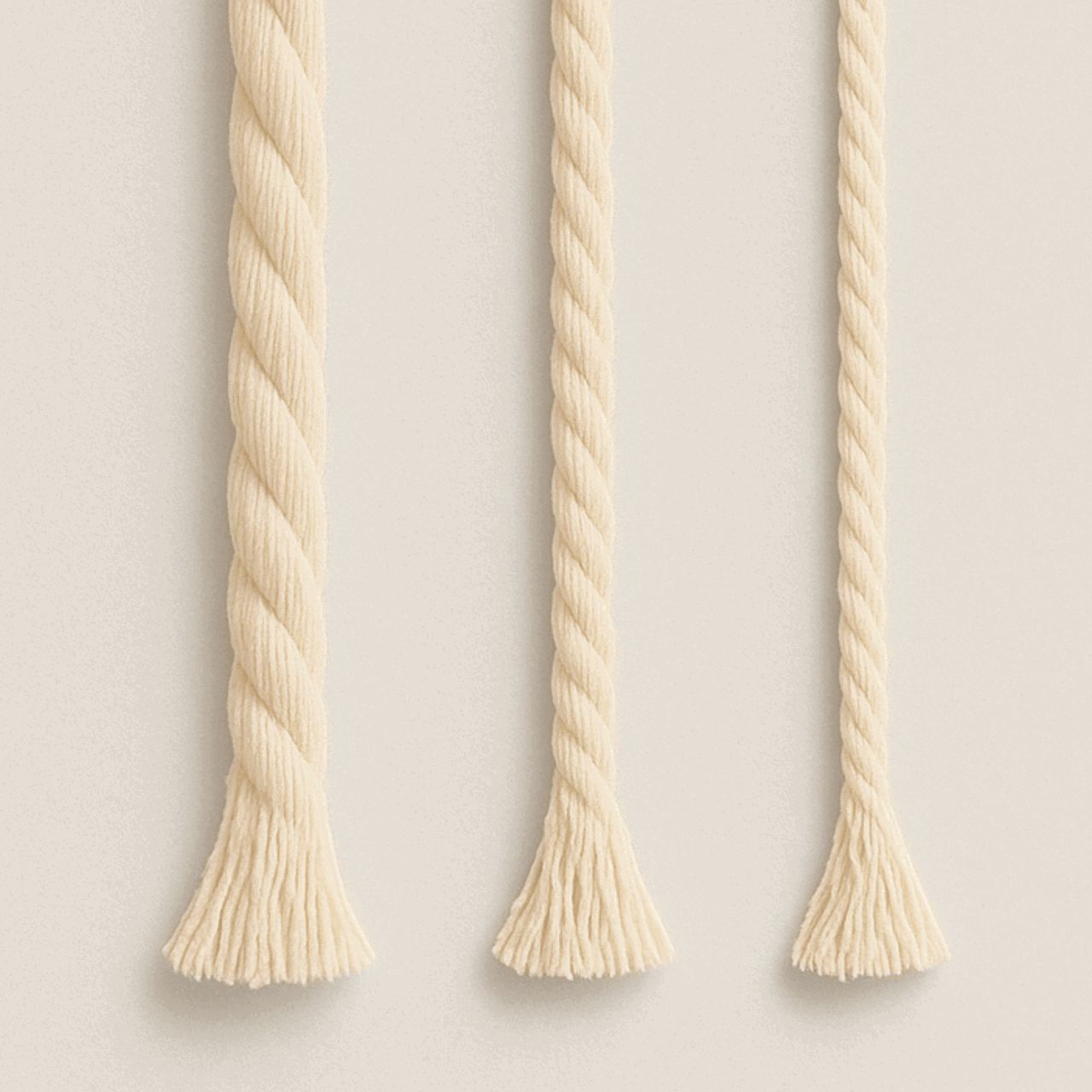
Single-strand 3mm or 5mm cotton cord works best because it shows the structure most clearly. 3-ply twisted cord works too but the falls look softer and less defined. For jewelry, use 1mm or 2mm cord. Avoid braided cord — the weave doesn't show as clearly.
Why is it called the endless falls knot?
It's called the endless falls knot because each completed row looks like a small braided "fall" cascading downward, and the pattern can be repeated endlessly to build a sennit of any length. The visual effect is reminiscent of a continuous waterfall.
Do I need to know another knot before learning the endless falls?
Yes — you should know how to tie a basic lark's head knot first, since the endless falls is built on top of one. The lark's head is one of the easiest macramé knots, so this is a small prerequisite.
How much cord does an endless falls knot use?
The endless falls uses cord faster than a square knot or basic lark's head sennit because each row weaves both vertically and horizontally. Plan for 5 times your finished project length per cord — the higher end of the macramé Golden Ratio.
What's the difference between the endless falls knot and the berry knot?
A berry knot creates a single rounded 3D bead-like bump using stacked square knots. The endless falls knot creates a continuous braided column using lark's head + woven cord pairs. Berry knots are localized focal points; endless falls are extended decorative sennits.
Can I make a wall hanging with just endless falls knots?
Yes — a wall hanging made entirely of side-by-side endless falls sennits looks gorgeous, almost like a woven tapestry. It will use a LOT of cord (plan for 6× project length per cord, not just 5×) but the finished texture is stunning.
How long should I make my endless falls sennit?
It depends on your project. A keychain pull needs 5 to 8 falls (about 4 inches / 10 cm). A plant hanger arm needs 10 to 15 falls (about 8 to 12 inches / 20 to 30 cm). A wall hanging column needs 20 to 40+ falls. Each fall in 5mm cord takes about 3/4 inch (2 cm) of vertical space.
Can the endless falls knot be tied flat instead of on a dowel?
Yes. You can tie endless falls by pinning the foundation cord to a clipboard or macramé board. The knot structure is identical — only the anchor point changes. The dowel is just more convenient for keeping tension consistent.
Your Next Macramé Knot
Now that you've mastered the endless falls knot, here are the next techniques to learn:


Golden Ratio Cord Math
Calculate cord length for cord-hungry projects like endless falls
Read the guideKeep Learning with Bochiknot
Want more macramé tutorials, patterns, and behind-the-scenes content? Connect with Nicole and the Bochiknot community across all of these platforms:
Patreon Membership
Exclusive patterns, video tutorials, and a private macramé community
Join PatreonAbout Nicole Woo
Nicole is the founder of Bochiknot Macramé and has been teaching macramé for over 5 years. She's helped thousands of beginners take their first knot through her tutorials, YouTube channel, Patreon community, and best-selling DIY patterns on Etsy. When she's not knotting, she's photographing every step so you don't have to guess.

Leave a comment