
















Beginner-Friendly DIY Macrame Baby Teether (Rattle + Teething Toy)


Updated 2026 · ~3 min read
🔖 Save for later
How to Make a DIY Macramé Baby Teether (Soft, Safe, Daisy-Knot Tutorial)

- Phase 1 — Prep the cords (Step 1): Cut 4 × 120 cm strands of organic cotton macramé cord, gather them evenly, tie a temporary overhand knot at the top, and pin to your work surface.
- Phase 2 — Build the daisy handle (Steps 2–5): Work 10 daisy patterns down the length using diagonal double half hitch knots. Mirror the left and right sides and close each daisy at the center.
- Phase 3 — Add the wooden rings (Steps 6–7): Remove the temporary knot, trim the bottom cords (save one 50 cm strand), thread on two 2-inch beech rings, and overlap the ends by 1–1.5".
- Phase 4 — Gathering knot finish (Steps 8–9): Wrap the overlapped section with a tight gathering knot, hide the tails under the wraps, tighten the anchor cords, and trim.
Total time: 1–2 hours · Finished size: 3.5" × 3.5" · Skill level: beginner · Cost: under $5 in materials

📌 Pin this tutorial for later
Save this macramé baby teether guide to your Pinterest nursery or DIY board.
Save to PinterestWhat You'll Learn
Tutorial Contents
- What is a macramé baby teether?
- Why make a handmade baby teether?
- Project details (skill, size, time)
- Materials & tools you'll need
- Cord lengths & cost breakdown
- Baby safety checklist
- Age guide
- Video walkthrough
- Step-by-step tutorial (9 steps)
- Pro tips & troubleshooting
- Common mistakes & fixes
- Color variations
- Baby teether FAQ
- Keep learning with Bochiknot
What Is a Macramé Baby Teether?
A macramé baby teether is a small handmade baby toy made from soft cotton cord and two untreated wooden rings. The cord is worked into a repeating "daisy" pattern of double half hitch knots, then closed into a loop and secured with a gathering knot. The two wooden rings ride along the loop so they clack gently against each other — adding both auditory stimulation and a safe surface for baby's gums to mouth.
What makes this DIY version so giftable:
- Natural & baby-safe. 100% unbleached cotton cord and untreated beech wood — no plastics, no dyes, no glues.
- Soothing texture. Soft cord against tender gums, smooth wood for tactile exploration.
- Built-in rattle. The two wooden rings give it a quiet, natural "clack" without batteries or electronics.
- Beginner-friendly. One repeating knot pattern means a clean, satisfying make for new macramé artists.
- Photogenic. The natural cream-and-wood look pairs beautifully with neutral nurseries, Montessori shelves, and baby shower gift baskets.
Why Make a Handmade Baby Teether?
Store-bought silicone teethers are everywhere, but a handmade macramé teether offers three big advantages:
- Materials you control. Pick organic cotton and untreated wood — no mystery plastics or factory finishes.
- Cost. Boutique handmade teethers sell for $18–$35 each on Etsy. You can make one at home for under $5.
- Personal touch. A handmade teether is one of the most-treasured baby shower gifts — exactly the kind of keepsake parents save for years.
Project Details
Materials & Tools You'll Need


Essential Macramé Tools

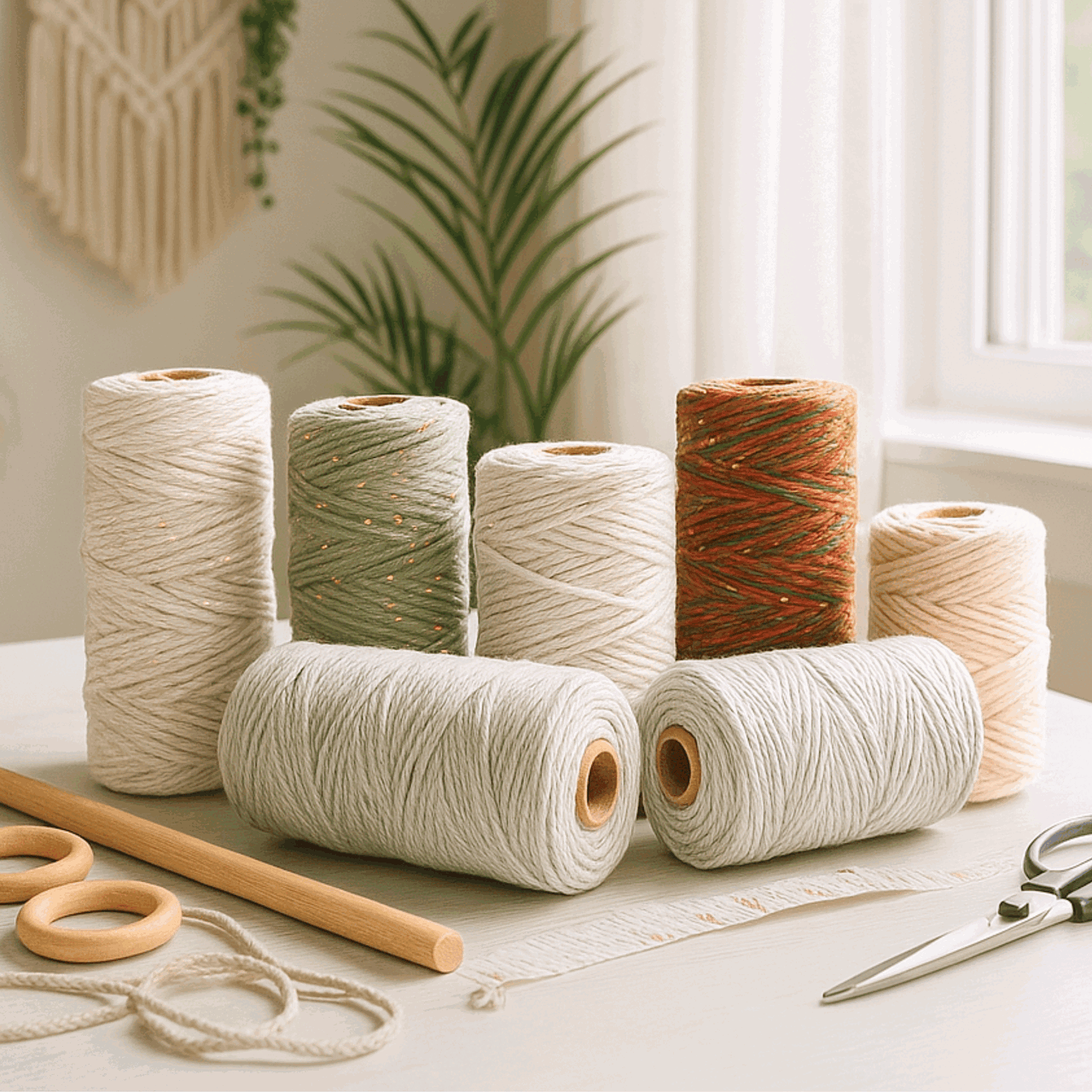
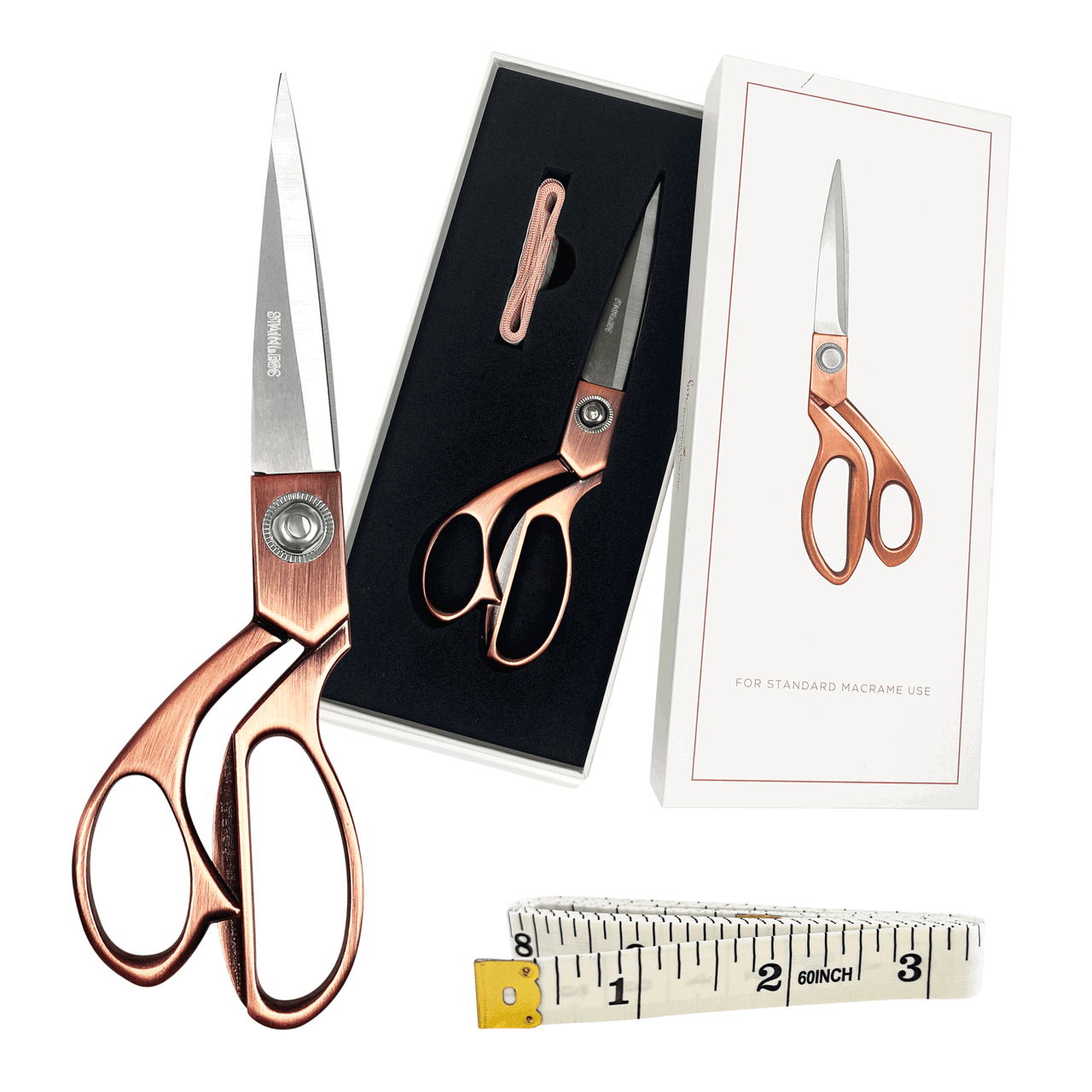
- Rose Gold Macramé Scissors — clean cuts so the cord ends don't fray
- Macramé measuring tape — accurate 120 cm strands
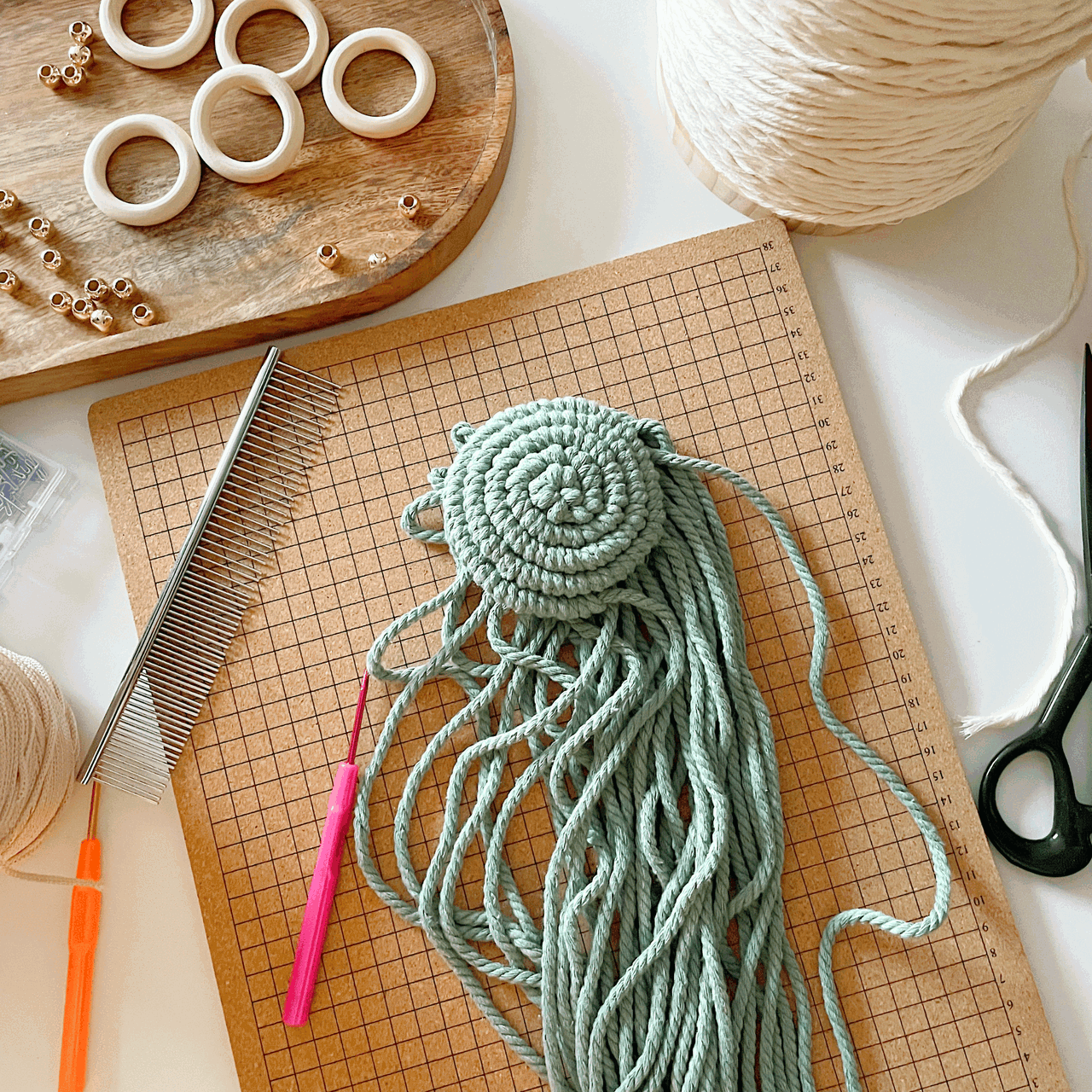
- Metal fringe comb — straightens cords before tightening each daisy
- Pins or painter's tape to secure the work to a clipboard or cork board
Cord Lengths & Cost Breakdown
| Component | Quantity | Length | Notes |
|---|---|---|---|
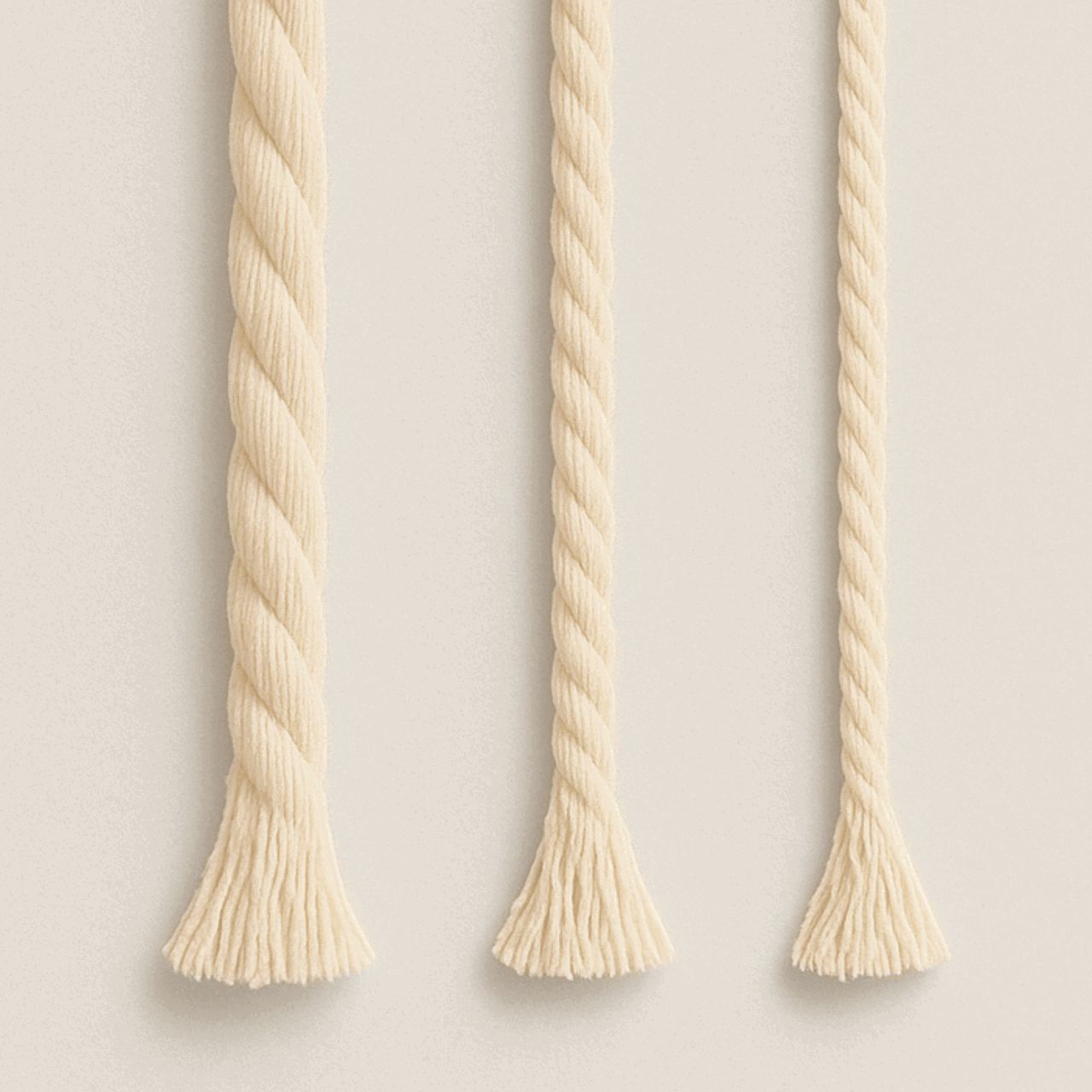
| Main daisy-handle cords | 4 | 120 cm (47") each | organic cotton macramé cord |
| Gathering knot cord | 1 | 50 cm (20") | Saved from trimmed bottom ends |
| Wooden teether rings | 2 | 2" diameter each | Untreated beech wood |
| Material | Quantity | Estimated cost |
|---|---|---|
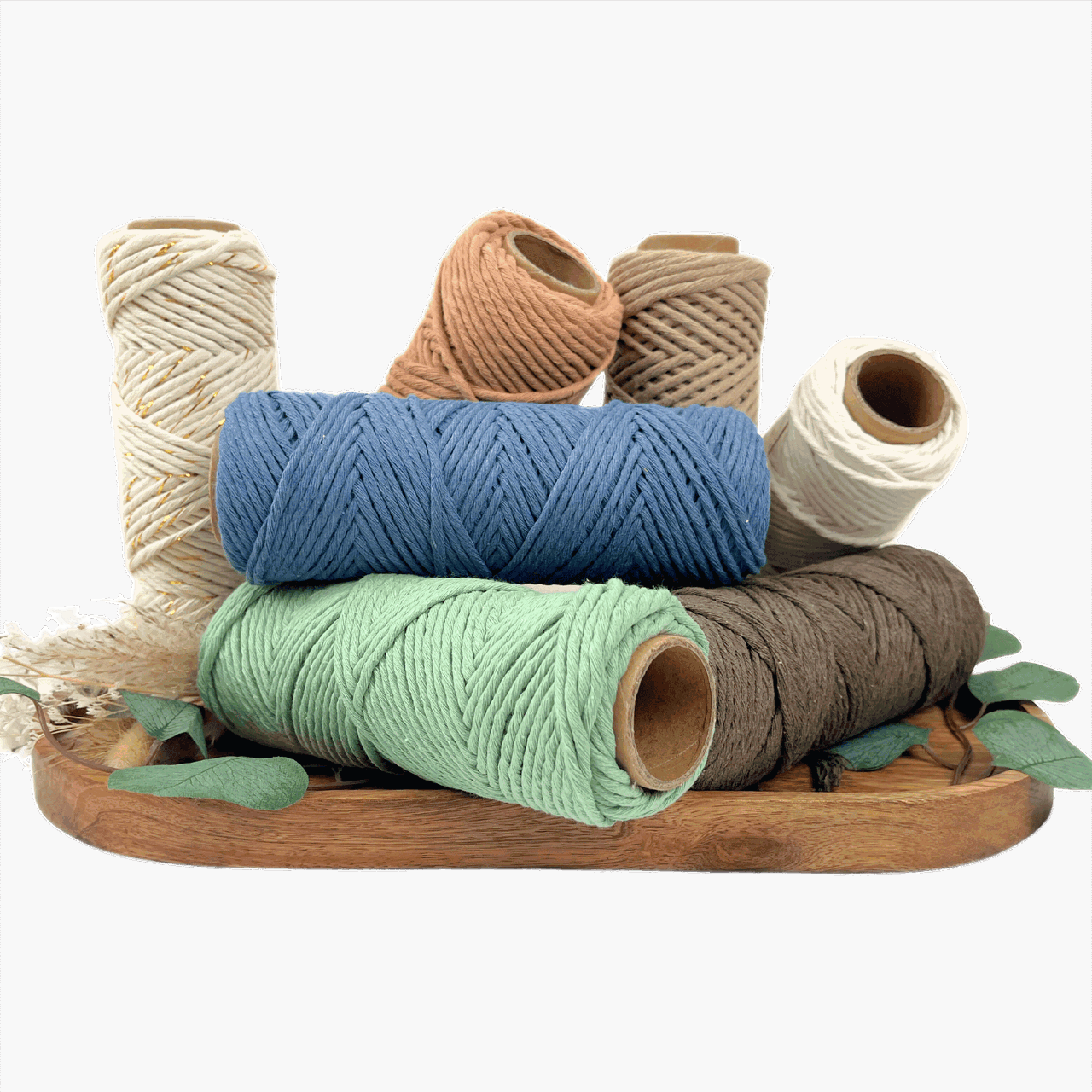
| organic cotton macramé cord | ~5 m total | ~$2–3 |
| 2-inch beech wooden rings | 2 | ~$1.50–2 |
| Total per teether | Under $5 |
| Phase | Time (first try) | Time (with practice) |
|---|---|---|
| Phase 1 — Cut cords + overhand knot (Step 1) | ~10 min | ~5 min |
| Phase 2 — Daisy handle, 10 daisies (Steps 2–5) | ~60 min | ~30 min |
| Phase 3 — Trim + add wooden rings (Steps 6–7) | ~10 min | ~5 min |
| Phase 4 — Gathering knot + finish (Steps 8–9) | ~20 min | ~10 min |
| Total build time | ~100 min (~1 h 40 min) | ~50 min |

Baby Safety Checklist
Before giving your finished teether to a baby, run through this checklist:
- 100% natural cotton cord. Unbleached, undyed, no synthetic fibers. Avoid cords with metallic threads or polyester blends.
- Untreated wooden rings. No varnish, no synthetic sealants. Food-grade beeswax or coconut oil is fine if you want any finish.
- No detachable small parts. The wooden rings should slide along the cord but not slip off the closed loop. Test by pulling firmly.
- Gathering knot is tight. Tug both sides of the gathering knot — it should not loosen or slip.
- No frayed ends. Trim cord ends cleanly. Re-trim if fraying appears after washing.
- Inspect weekly. Check for loosened wraps, frayed cord, or any sign of wood splintering.
- Hand wash only. Spot clean with mild soap and water. Air dry flat. Do not machine wash.
Age Guide
Video Walkthrough
How to Make a DIY Macramé Baby Teether (Step-by-Step)
Follow the 9 steps below. Each step has photos and clear bullet instructions. If you get stuck on any step, the video above walks through every step in real time.
Step 1: Secure the cords with an overhand knot
- Start by gathering the four 120 cm cords together evenly at one end.
- Tie an overhand knot near the top to hold all the cords in place. This knot is mainly there for control — it helps prevent shifting while you work the repeated knot pattern below.
- From there, pin or tape the overhand knot to your work surface.


Step 2: Begin the daisy pattern with double half hitch knots
- Separate the cords into four strands. Using the two middle cords, make a diagonal double half hitch knot to the left.
- Take the far-left cord and make another double half hitch knot to the left to form the left side of the first daisy.
- Adjust and straighten each knot as you go to keep the pattern neat and even.


Step 3: Mirror the shape on the right side
- Take the far-right cord and make a double half hitch knot to the right.
- This forms the top half of the first daisy, creating a petal-like opening in the center.

Step 4: Close off the first daisy
- On the right side, make a double half hitch knot back toward the center. Keep the tension snug but not too tight so the daisy keeps its curved shape.
- On the left side, use the far-left anchor cord and make a double half hitch knot toward the center to close that side inward.
- Finish with one more diagonal double half hitch knot using the middle cords, then adjust the knots as needed to complete the first daisy.

Step 5: Repeat the daisy pattern down the length of the handle
- Continue repeating the same daisy sequence downward: form the left and right sides with double half hitch knots, bring both sides to the center, then finish with the diagonal knot.
- Start with eight daisies and test the size. If needed, extend the pattern for a better fit once the gathering knot is added.
- The final version uses 10 daisy patterns, creating a balanced handle shape with about 1 inch of space between the ends before gathering.


Step 6: Remove the temporary knot and trim the bottom cords
- Once all 10 daisies are finished, untie the original overhand knot at the top and trim most of the excess from the longer bottom cords.
- Save one trimmed strand about 50 cm long to use later for the gathering knot.

Step 7: Add the wooden rings to create the rattle feature
- Before forming the final loop, thread the two wooden rings onto the knotted section to create the teether and rattle combination.
- Overlap the two ends by about 1 to 1.5 inches. This overlapped section will be secured with the gathering knot.


Step 8: Finish with a large gathering knot
- Use the 50 cm cord to make a large gathering knot around the overlapped section. Form a loop with the short end and place it past the overlap area.
- Wrap the long end tightly from top to bottom, then thread it through the bottom loop.
- Pull the top tail to hide the loop and cord end under the wraps for a clean, secure finish.

Step 9: Tighten, straighten, and trim
- Before trimming the final ends, pull gently on the anchor cords on both sides of the gathered section.
- Once everything looks aligned, trim off the excess cord ends from the gathering knot.
- At that point, your DIY macramé baby teether is complete.


Pro Tips & Troubleshooting
- Keep tension consistent. Each daisy should look the same size as the one before it. Snug, but not so tight the cord can't slide into place.
- Comb your cords often. A quick pass with a metal comb between daisies keeps fibers straight and the daisies symmetrical.
- Use a corkboard or pinning surface. Pinning the overhand knot makes it much easier to maintain tension and adjust each daisy.
- Eight daisies vs. ten. Make eight first, then test fit before deciding whether to add two more. The right count depends on your tension.
- Save your trimmed strand. Don't trim too aggressively in Step 6 — that 50 cm gathering-knot strand has to come from somewhere.
- Hide the gathering-knot tails fully. If the top tail won't disappear, gently work it under the wraps with a tapestry needle before final tightening.
- Pre-clean wooden rings. Wipe with a damp cloth before threading. Apply a tiny amount of food-grade coconut oil to keep the surface smooth.
- Make in batches. Once your hands learn the rhythm, batching 3–5 teethers in one sitting is highly efficient.
Common Mistakes & Fixes
| Problem | Likely cause | Fix |
|---|---|---|
| Daisies look lopsided | Inconsistent tension on left vs. right side | Pull each double half hitch the same number of times before moving on; mirror it visually |
| Handle is too short to loop | Only 7–8 daisies, or daisies are too tight | Add 1–2 more daisies, or redo with slightly looser tension |
| Wooden rings won't slide | Cord swelled or rings too small | Use 2-inch rings (not 1.5"); thread before final overlap |
| Gathering knot keeps loosening | Tails not pulled tight enough; wraps too few | Add 2–3 more wraps; pull the top tail firmly before trimming |
| Cord ends fray after first wash | Cut on the bias or cotton low quality | Cut straight across with sharp scissors; choose unbleached organic cotton macramé cord |
| Visible loop after gathering knot | Short tail too long or not pulled through | Tug the top tail to retract the bottom loop under the wraps; trim flush |
Color Variations
The natural cream + beech version is the classic, but a handful of soft palettes look beautiful in modern nurseries:
Natural Cream
Unbleached cotton + raw beech — the classic baby shower gift look
Soft Blush
Dusty pink cord + beech — sweet for baby-girl gifts and pastel nurseries
Sage Green
Botanical-friendly muted sage cord + beech — gender-neutral and modern
Rust
Warm terracotta cord + beech — boho nursery favorite
Mustard
Soft mustard yellow cord + beech — cheerful Scandi style
Soft Gray
Heather gray cord + beech — minimalist and gender-neutral
Macramé Baby Teether FAQ
What materials are used for this DIY macramé baby teether?
This DIY macramé baby teether uses 100% natural organic cotton macramé cord and two 2-inch beech wood rings. The cotton cord is unbleached and made without harmful chemicals, and the beech wood is durable, smooth, and well suited for baby toys.
How many cords do I need to make this macramé baby teether?
You'll need four strands of cord cut to 120 cm each for the main pattern. You'll also use one extra piece about 50 cm long for the gathering knot, usually saved from the trimmed ends.
What knot is used in this DIY macramé baby teether?
The main knot used throughout the pattern is the double half hitch knot. The handle is made by repeating a daisy-style formation built from that knot, and the finish uses a gathering knot.
How many daisy sections should I make?
The finished version uses 10 daisy patterns. Eight were tested first, but two more were added to create a better final handle size once folded and gathered.
Does this macrame teether also work as a rattle?
Yes. The two wooden rings threaded onto the handle create the rattle feature, so the finished piece functions as both a teether and a baby rattle toy.
What is the finished size of the DIY macramé baby teether?
The completed piece is approximately 3.5 inches wide by 3.5 inches long — a comfortable grasp size for babies 3 months and up.
How do you clean the wooden rings?
Wipe the wooden rings with a damp cloth, then apply a small amount of food-grade coconut oil to help maintain their smooth, polished surface.
Is this a good beginner project?
Yes. This DIY macramé baby teether is a strong beginner project because it relies on repeating the same double half hitch knot, which helps build consistency and confidence without requiring lots of advanced techniques.
Is macramé safe for babies to chew on?
Yes, provided the teether is made from 100% natural unbleached cotton cord, untreated wooden rings, and contains no glue, plastic, or detachable small parts. Always supervise during use, hand-wash regularly, and inspect for fraying before each play session. Retire any teether showing significant wear.
What age can babies use a macramé teether?
Macramé teethers are best for babies aged 3 months and up — when they begin mouthing toys and exploring textures, but before they have strong enough teeth to bite through cord. They are a supervised sensory toy, not a chew toy for older children with full bite force.
How do I wash a macramé teether?
Hand wash only. Spot-clean with a soft cloth, mild baby-safe soap, and warm water. Squeeze (don't wring) the excess water out and air dry flat on a towel. Avoid machine washing or dryers, which can shrink the cotton and loosen the gathering knot.
Can I sell handmade baby teethers?
In most regions, yes — handmade baby teethers can be sold on platforms like Etsy. Be sure to comply with local children's-product safety regulations (in the US that's CPSIA testing or small-batch exemptions). List your materials clearly, label "adult supervision required," and price between $15–$30 retail.
What's the difference between a teether and a rattle?
A teether is designed for baby to mouth and chew to soothe sore gums. A rattle makes a soft sound when shaken to stimulate auditory development. This macramé piece is a combination of both: the soft cotton handle and wooden rings work as a teether, while the two clacking wooden rings create the rattle sound.

Keep Learning with Bochiknot

Macramé Baby Play Gym
The wooden frame your finished teether toys hang from — a sister project
View tutorial


Macramé Coasters Collection
Practice your daisy and double half hitch on bear, diamond, and floral coasters
Browse coasters
About Nicole Woo
Nicole is the founder of Bochiknot Macramé and has been teaching macramé for over 5 years. She's helped thousands of beginners take their first knot through her tutorials, YouTube channel, Patreon community, and best-selling DIY patterns on Etsy. When she's not knotting, she's photographing every step so you don't have to guess.

Leave a comment