




Silhouette Macramé Art: How to Turn Any Design Into a Wall Hanging

One knot, and any drawing you can simplify. This is the technique for turning a photo, a sketch or a silhouette into rows of knots — including the arithmetic almost nobody explains.

Last updated: August 21, 2026
Some links in this post are affiliate links, which means Bochiknot may earn a small commission if you buy through them, at no extra cost to you. We only ever link to things we use ourselves.
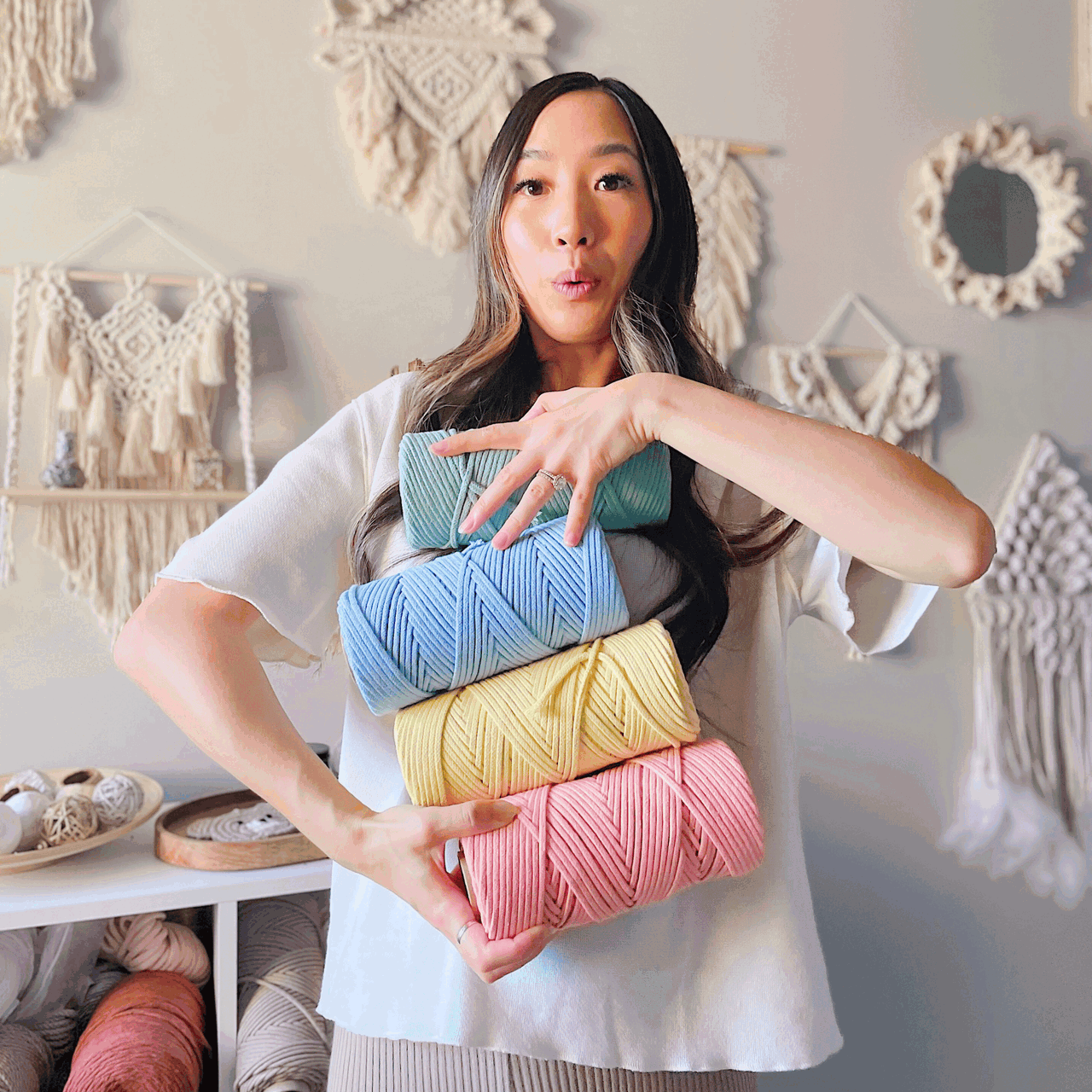
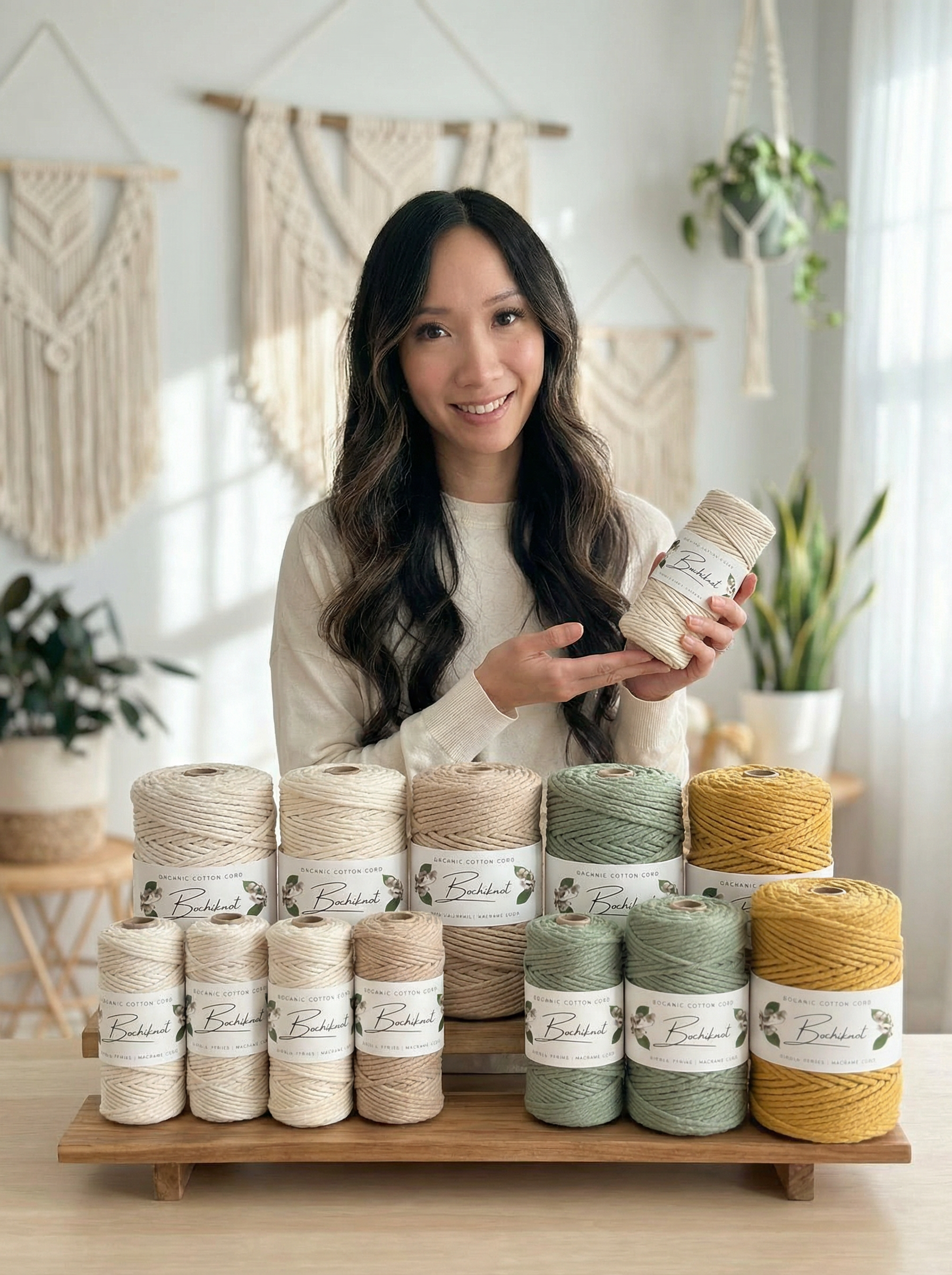
A Note from Nicole
Every other pattern on this site tells you what to make. This one tells you how to make anything.
Silhouette macrame is the only technique I teach where the pattern comes from you. You bring a drawing — a bird, a cat, a face, your dog — and the knots translate it. There is one knot involved, the double half hitch, and you very likely already know it.
What people find hard is not the knotting. It is the translation: looking at a picture and working out how many cords it needs, where a curve should start, and how a shape on paper becomes rows on a dowel. That is a different skill from following a pattern, and it is the one I have written this guide around.
If you would rather follow a worked example before designing your own, there is one further down. Most people go that way round, and it works well.
Silhouette macrame is a wall art technique in which rows of double half hitch knots are worked across a grid of vertical anchor cords to reproduce the outline of a bold shape — a portrait, an animal, a leaf or a letter. The design comes from a reference image rather than a repeating pattern: each row is placed slightly higher or lower than the one above to bend the line, and the knots are then shifted together to sharpen the edge. It uses one knot throughout, works best with braided 4mm cord, and is sometimes called tapestry macrame — though silhouette work specifically means rendering a single bold outline rather than a full pictorial design.
Quick Answer
- Knots: One — the double half hitch, worked at every angle.
- Cord: Braided 4mm gives the sharpest edges. 3-ply works but softens them.
- Skill: Beginner-friendly technique, intermediate judgement ★★★☆☆
- How curves work: Place each knot slightly higher or lower than the row above, then shift the knots together.
- Design source: Any high-contrast image with a strong outline and little interior detail.
- Also inside: how to turn a photo into a macrame pattern — gridding, cord counts and sizing.
- Want a pattern instead? The portrait wall hanging is this technique applied to one design, in 12 steps.

Want a pattern to follow instead?
This guide teaches the method. The Macrame Portrait Wall Hanging applies every bit of it to one specific design — a woman in a sun hat, 12 steps, exact cord lengths, and a full guide to adding cords mid-project.
Most people make that one first, then come back here to design their own.
See the portrait pattern →🎥 Watch the video alongside the steps. Curving a row of double half hitch is one of those things that takes one viewing and a thousand words.
What's in this guide
- Materials, and why cord choice matters here
- Choosing a design that will actually work
- How to turn a photo into a macrame pattern
- Watch the video guide
- The method, step by step
- Pro tips for cleaner edges
- Design ideas, from simple to advanced
- Troubleshooting
- What to make next month
- FAQ
Materials, and Why Cord Choice Matters Here
Very little kit. But this is one project where the cord genuinely changes the result, so it is worth a paragraph rather than a bullet.

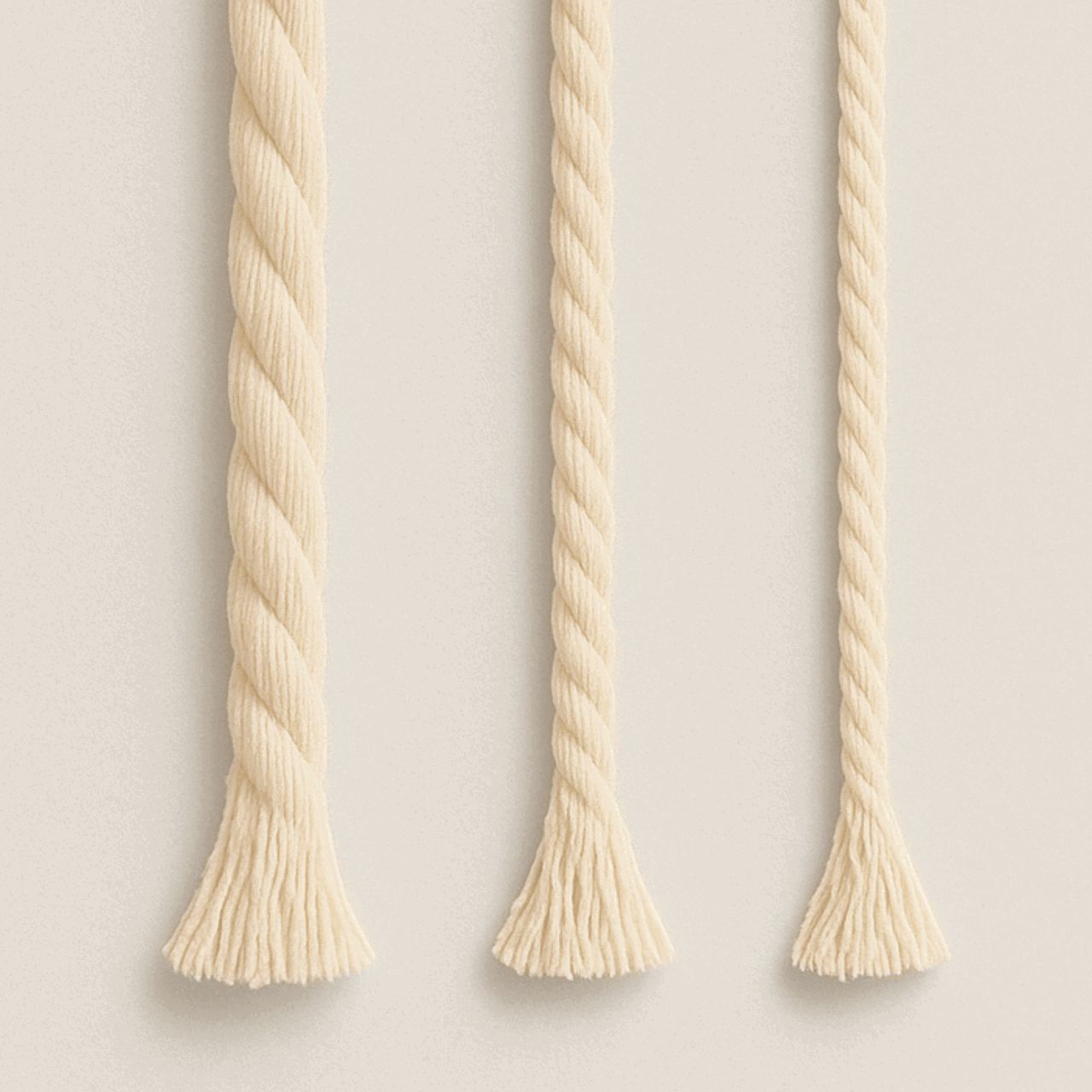
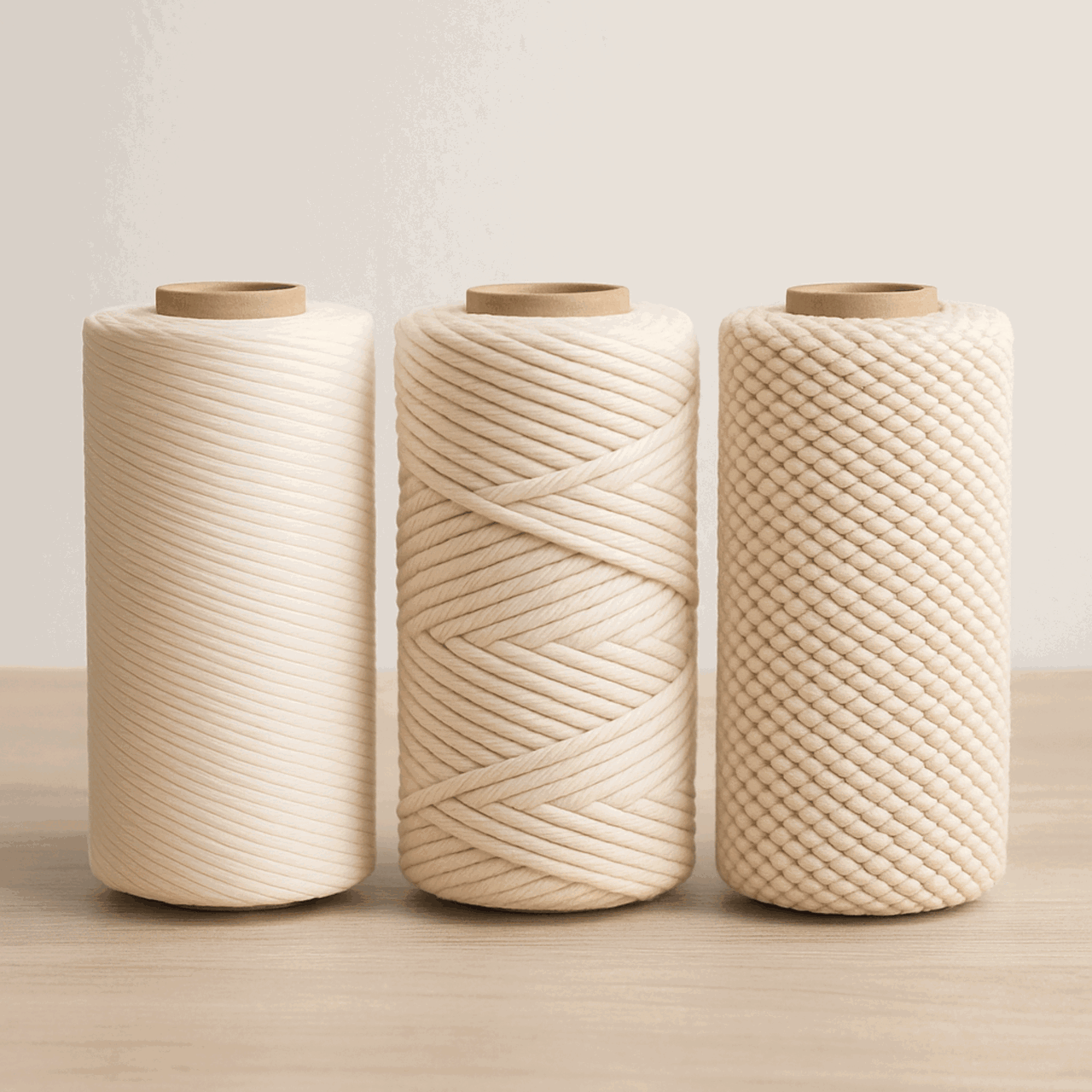
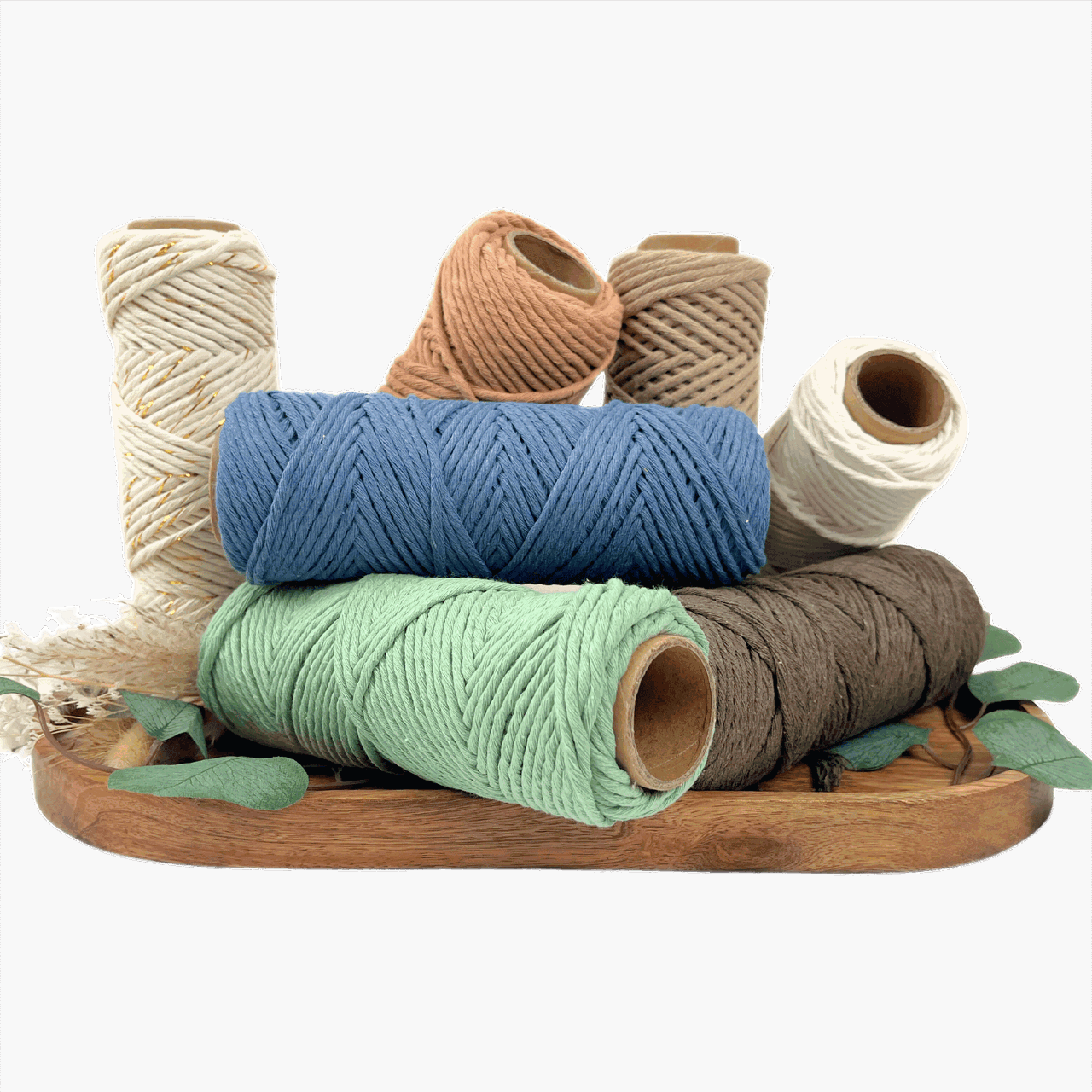
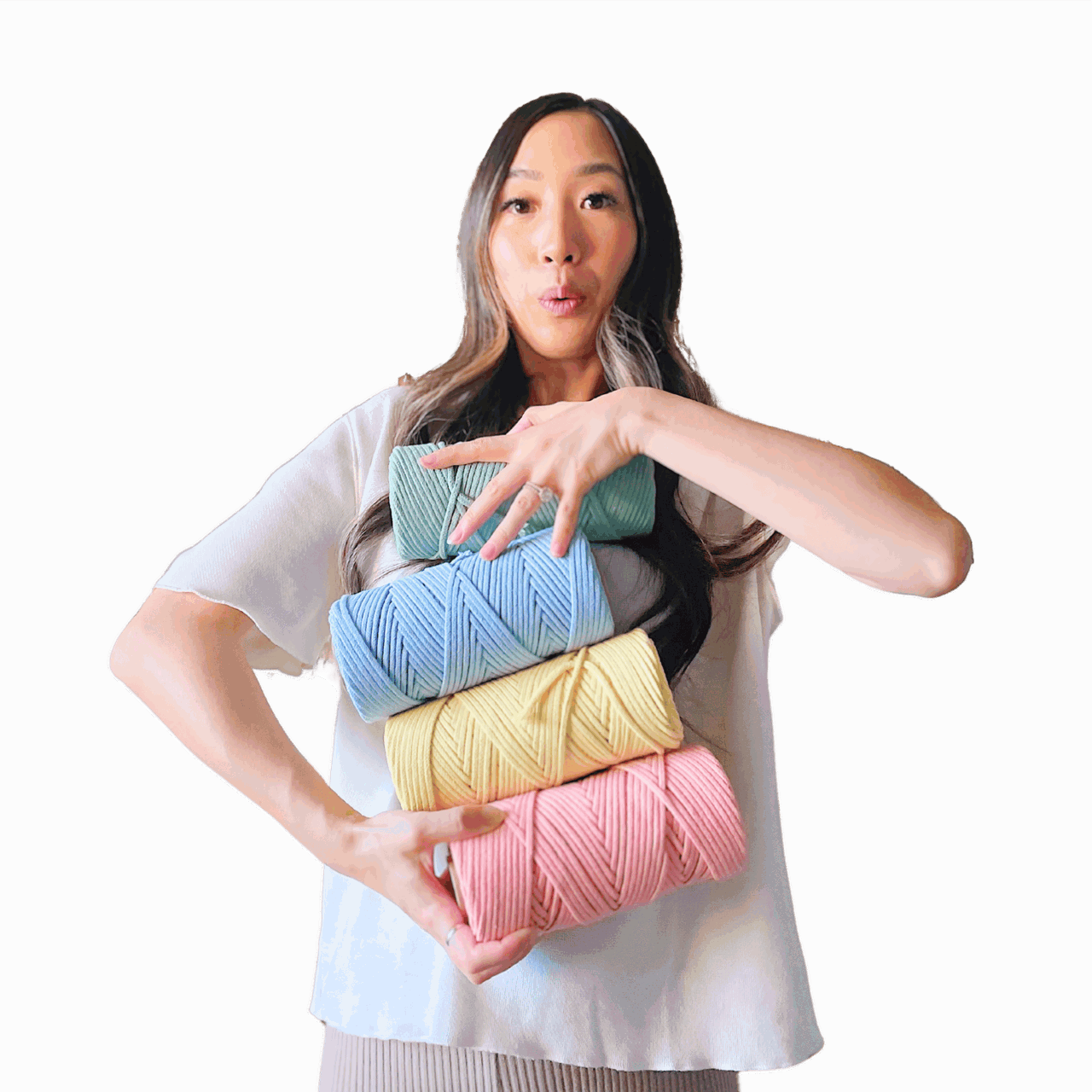
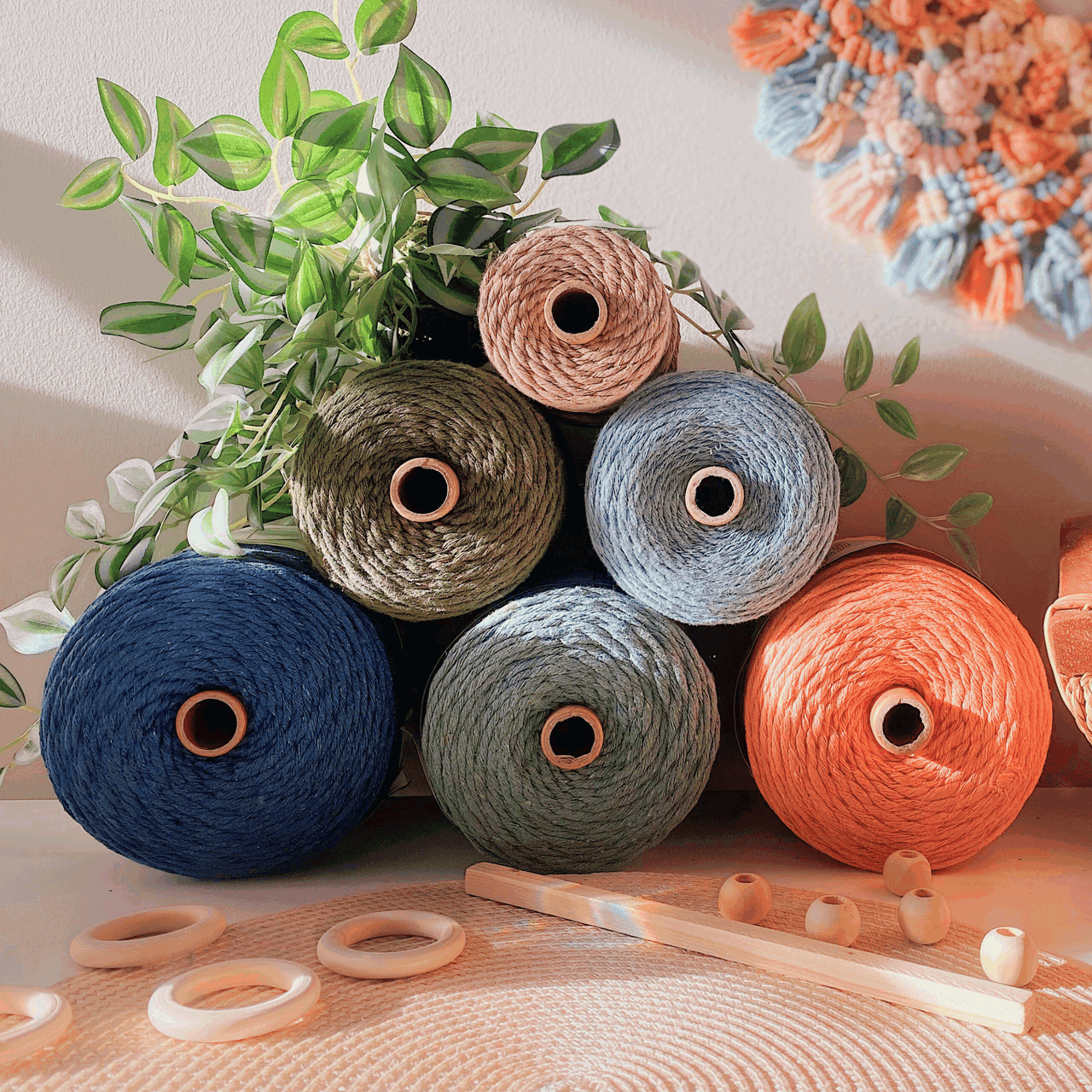
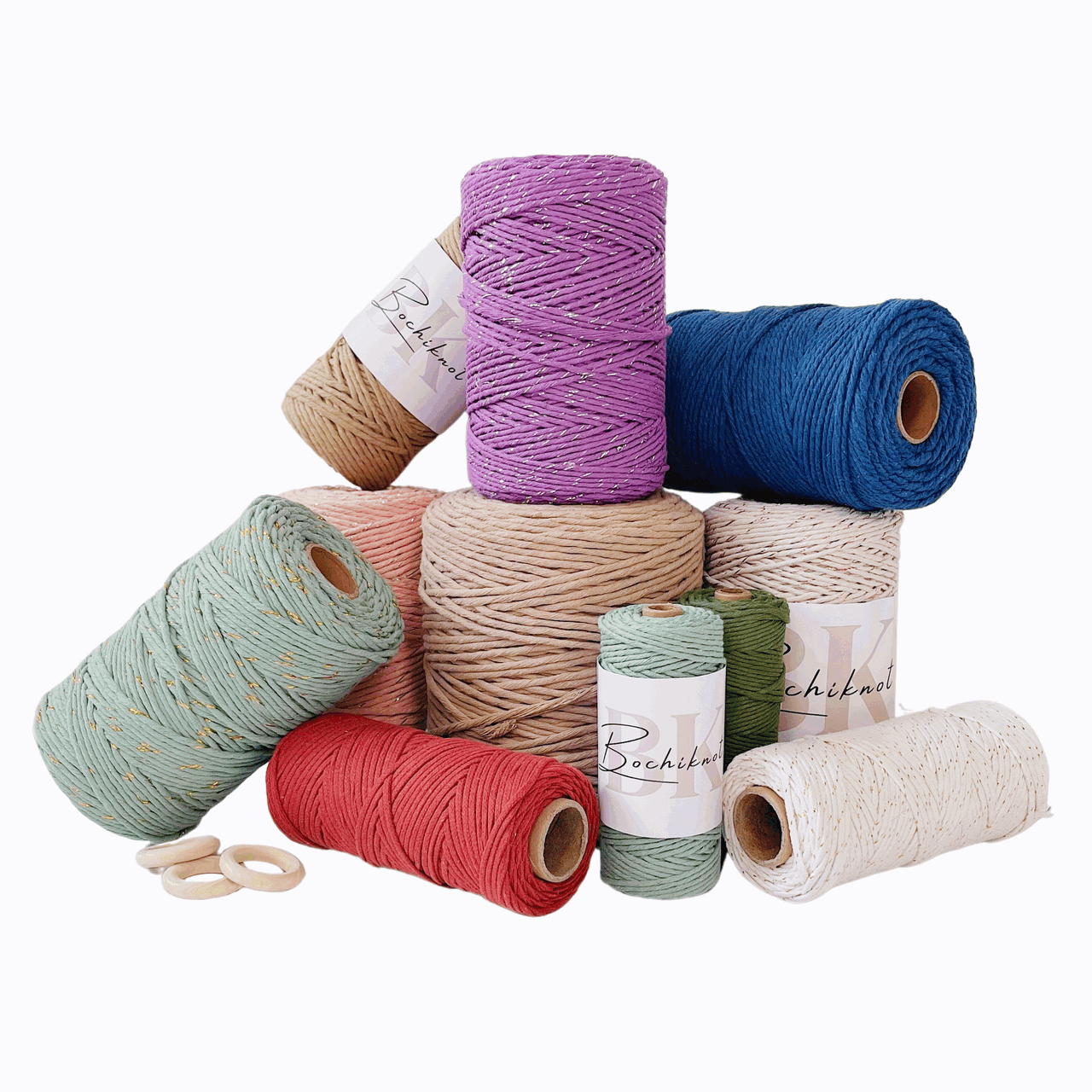
Braided 4mm Cord
Recommended. The compact, non-fuzzy surface is what gives a silhouette its sharp edge.


| Cord type | Good for silhouette work? | Why |
|---|---|---|
| Braided, 4mm | Recommended | Compact, non-fuzzy surface gives sharp, clean edges when double half hitch rows are shifted together |
| Twisted 3-ply, 4mm | Works, with care | Slightly softer edge, but springs back if you undo a row — kinder for a first attempt |
| Single-strand, 3mm | Usable | Finer detail per row, but holds a crease once undone and frays more at the edge |
🧵 The trade-off in one line: braided gives you the crispest silhouette; 3-ply forgives your mistakes. If this is your first silhouette, that forgiveness may be worth more than the sharpness. More in the complete guide to selecting macrame cord, and our supplies also ship from Amazon US and Amazon Canada.
Choosing a Design That Will Actually Work
The success of a silhouette starts before you tie anything. Your knots define the outline, not the fill — so interior detail is simply lost, and an image that depends on it will never read.
What makes a good silhouette design
- Bold, recognisable shapes — animals in profile, human portraits, leaves, birds, bare trees.
- High contrast — the design reads clearly as a dark shape on a light ground, or the reverse.
- Smooth or gently curved edges — jagged, highly detailed outlines are far harder to reproduce in knots.
- Simple composition — one central subject, no busy background.
The thumbnail test. Shrink your image until it is about the size of a postage stamp. If you can still tell what it is, it will work in macrame. If it turns to mush, it will turn to mush in cord too — and you will not find out until three hours in.
How to Turn a Photo Into a Macrame Pattern

This is the step almost every silhouette tutorial skips, and it is the reason people give up. Choosing an image is easy. Translating it into cords — knowing how many you need, how wide the piece will be, and which knot corresponds to which part of the picture — is where it gets vague.
Here is the whole process, with the arithmetic.
Step 1 — Flatten the image
Convert your reference to a high-contrast black-and-white silhouette. Any phone photo editor will do it: push contrast to maximum, drop saturation to zero, then raise the black point until the interior detail disappears and you are left with a solid shape.
What you want at the end is a shape you could cut out of paper. If you can still see a nose or an eye inside the outline, keep going — those will not survive the translation anyway.
Step 2 — Decide how wide the piece will be
Width comes from the number of anchor cords, not their length. So this decision comes first, and everything else follows from it.
| Cord | Working strands per inch | Cords for a 12″ piece | Cords for an 18″ piece |
|---|---|---|---|
| 3mm single-strand | 3–3.5 | 18–21 cords | 27–32 cords |
| 4mm braided | 2.5–3 | 15–18 cords | 23–27 cords |
| 4mm 3-ply | 2.5–3 | 15–18 cords | 23–27 cords |
Count in working strands, not cords — each cord mounted with a Lark's Head gives you two. So 20 cords becomes 40 strands, and 40 strands across a 12″ piece is a little over three per inch. That is the density silhouette work needs: enough columns to draw a readable edge without the piece turning solid.
Worked example: the portrait wall hanging mounts 20 cords of 3mm and finishes at 12″ wide. That is 40 strands — your grid is 40 columns wide, and every one of them is a place a knot can go.
These figures are for full-grid silhouette work — where every cord is mounted on the dowel before you start drawing. Patterns that build outward from a centre point, like a half mandala, mount only a few cords at the start and add the rest as the shape grows, so their cord counts won't match this table.
Step 3 — Grid the image to match
Print your flattened silhouette at the finished size, then draw a grid over it with as many columns as you have anchor cords. Rows can be roughly square — each row of double half hitch is about as tall as it is wide, so square grid cells map cleanly to knots.
Now each grid square is one knot decision: inside the shape, or outside it. That is the entire translation.
Step 4 — Simplify to the grid
Redraw the outline so it follows grid lines rather than cutting through squares. Curves become small steps. That looks wrong on paper and correct in cord, because a shifted row of double half hitch smooths those steps out on its own.
This is the point where a detailed image reveals itself as too detailed. If a feature is narrower than two grid squares, it will not appear in the finished piece — delete it now rather than discovering it later.
Step 5 — Work out cord lengths
Anchor cords want to be 2–3× the intended finished height, folded — so a 20″ tall piece wants cords of roughly 40–60″ before folding. Working cords that travel horizontally need about four times the width they cross, because each double half hitch wraps twice.
Our free cord calculator handles the length side of this if you would rather not do the arithmetic.
Step 6 — Tape it up and start
Print the gridded version at full size and pin it to the wall directly behind your work, at eye level. Not on a phone — a screen that keeps sleeping is a genuine obstacle over three hours.
📐 See this applied: the portrait wall hanging is exactly this process carried through to a finished piece — 20 anchor cords, a 12″ width, and a woman in a sun hat rendered in 12 steps. If the gridding above feels abstract, that post makes it concrete.
Watch the Video Guide
▶ Watch full-screen on YouTube →
The Method, Step by Step
Six stages. They apply to any design — the drawing changes, the method does not.
Mount the anchor cords
- Measure and attach as many anchor cords as your design needs — these act as the vertical "columns" that your horizontal double half-hitch rows will connect to. Lark's head knots on a dowel are fast and secure.

Start at the top-centre
- Identify the top-center of your silhouette (this is where most smooth designs begin).
- Use a working cord to form a horizontal row of double half-hitch knots across the middle anchors. This first row sets the heading for the shape.


Build rows and bend them into curves
- Make a row of double half-hitch knots across several adjacent anchor cords.
- To curve a row, lower (or raise) the position where you place the knot relative to the row above — even a small shift nudges the line into a curve.


Step back three metres
Three rows in is the first honest test. Silhouettes do not read up close — walk away from it, then compare against your reference from the same distance.
Adjust now while a row still costs five minutes.
Shift the knots together for a clean edge
- After tying, slide (shift) the double half-hitch knots together so they sit snugly in a straight or smoothly curved line. This helps the silhouette read clearly instead of looking ragged.

Add new working cords as you go down
- When a row finishes, either continue the same anchor cord as a lead for the next row or swap to a new working cord.
- The key is to keep the rows stacked and maintain the intended curve as you move vertically.


Trim, tidy and mount
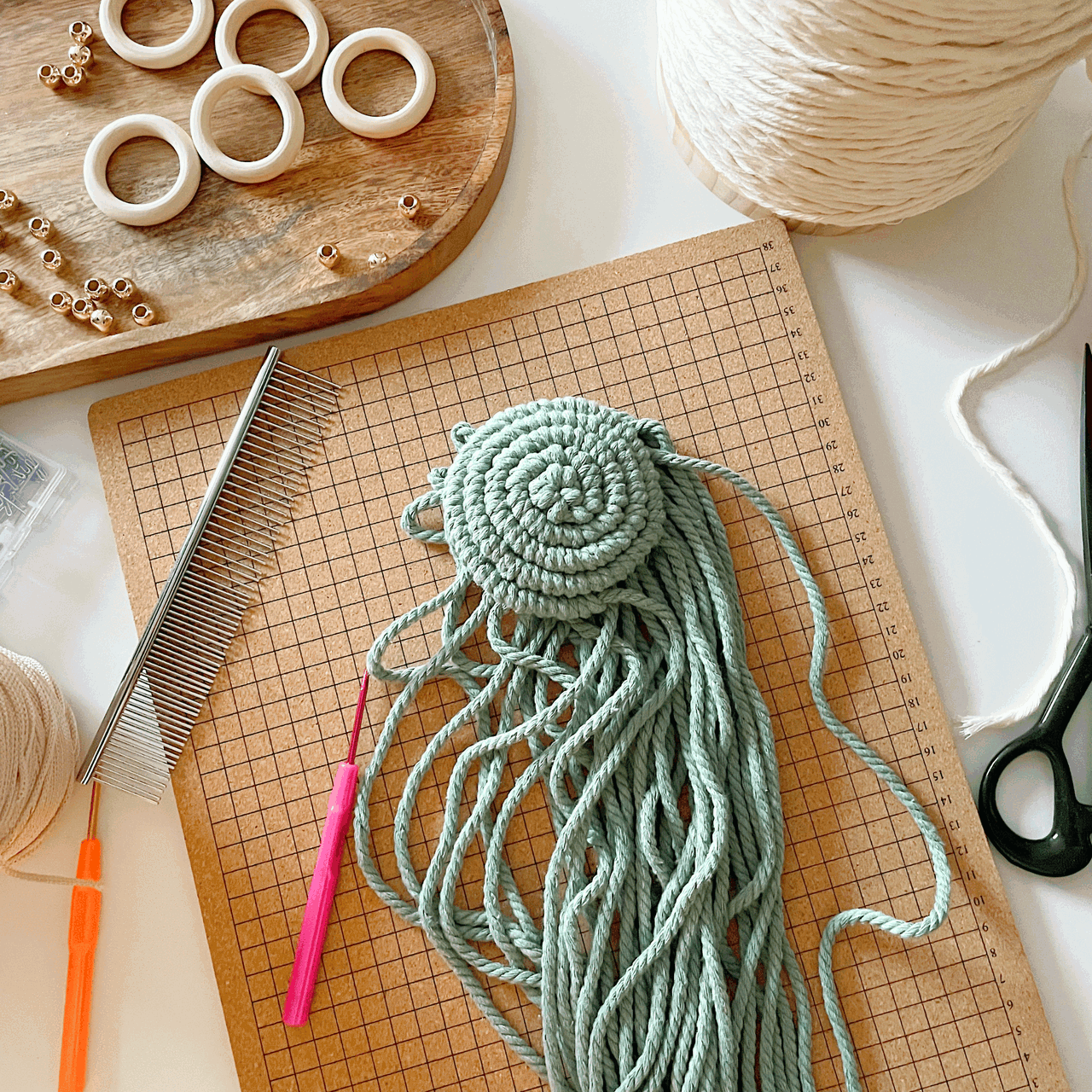
- Once the silhouette is complete, trim and tidy the fringe, add backing if you like, and mount. If you want softer edges, comb or brush the background cords lightly to blend.
You drew that with one knot
Hang it, walk to the far side of the room, and look again.
Tag #BochiknotSilhouette on Instagram — and post your reference image beside it. Seeing what people choose to make is the best part.
Pro Tips for Cleaner Edges
- Always work top-to-bottom. This keeps your leading cords manageable and makes the silhouette stack correctly.
- Use separate working cords for distinct sections (hair, shoulders, background) to avoid bulky knots in one cord.
- Pixelate complex images — simplify the silhouette into broad, readable shapes before knotting.
- Practice curved double half-hitch rows on scrap cord before starting the final piece.
- Step back from your work after every 3–4 rows. Distance reveals shape in a way that close-up knotting never will.
- Keep a reference print taped to the wall at eye level throughout the entire project — not just at the start.
Design Ideas, From Simple to Advanced
Once the technique makes sense, the only limit is your reference image. These are good places to start, ordered by how forgiving they are.
| Design | Difficulty | Why it works in macrame |
|---|---|---|
| Leaf or feather | Beginner | Simple symmetrical curves, forgiving at the edges — a great first attempt |
| Bird in flight | Beginner | Bold wing arcs translate beautifully with row shifts, and the shape reads instantly |
| Side-profile portrait | Intermediate | Strong curved silhouette with no internal detail needed — the outline does all the work |
| Cat sitting | Intermediate | Rounded ears and a curved back are excellent double half hitch practice |
| Tree or bare branches | Intermediate | Branching shapes teach multi-section cord management |
| Two-colour portrait | Advanced | Dark silhouette cord against light background cord — striking, high-contrast wall art |
Troubleshooting
| What happens | Why, and how to fix it |
|---|---|
| My curves look jagged, not smooth | This almost always comes down to shift spacing. After tying each row, slide all the knots together so they sit snug against each other. Then step back — a row that looks jagged up close usually reads smoothly from a distance. If it still looks off, try smaller shift increments: move just 1–2 anchor cords per row instead of 3–4. |
| My rows keep drifting out of line | This happens when anchor cords aren't held taut while knotting. Use a macrame board, a corkboard, or clip the bottom of anchor cords to a weighted base to keep them straight as you work. |
| The silhouette edge looks blurry or undefined | Usually caused by inconsistent knot tension. Every double half-hitch should be tied at the same tension — too loose and the silhouette edge loses definition. Practice a row of even tension on scrap cord before starting the final piece. |
| I ran out of working cord mid-silhouette | Add a new cord by tying it onto the last anchor cord with a double half-hitch, leaving a short tail at the back. Continue knotting with the new cord and trim the tail when finishing. |
| The background cords look messy behind the silhouette | This is part of the aesthetic — but if you want a cleaner look, comb out the loose background cords and trim to a uniform fringe length. Alternatively, add a backing fabric (linen or felt) behind the piece to hide loose ends and give the wall hanging a clean, gallery-frame finish. |
| My silhouette shape isn't recognisable from a distance | The design is likely too detailed for the cord count you're working with. Go back to your reference image and simplify further — remove internal lines, widen narrow sections, and ensure the outer edge is bold enough to read at arm's length. A silhouette macrame portrait should be readable in under one second from across the room. |
Want a pattern to follow instead?
This guide teaches the method. The Macrame Portrait Wall Hanging applies every bit of it to one specific design — a woman in a sun hat, 12 steps, exact cord lengths, and a full guide to adding cords mid-project.
Most people make that one first, then come back here to design their own.
See the portrait pattern →What Will You Make Next?
There's a particular moment that arrives about ten minutes after you finish a piece. It's on the wall, you've stepped back to look at it properly, and you're already scrolling for the next image you could translate.
That moment is worth paying attention to, because it's usually where things stall — and almost never for the reason people assume. It isn't that the interest fades. You've just spent an afternoon proving otherwise. It's that deciding what to make next turns out to be harder than making it. So the cord goes back in the drawer, and three months later it's still in the drawer.
I built the Bochiknot community to close that gap. Every month there's a new pattern and a full video tutorial already waiting for you, alongside everything published before it. The deciding is done. You just turn up and make.
Tier 1: Mini-Macrame Creations
or $6.40 a month paid annually
A new project waiting for you at the start of every month.
- A new #MakingMacrame pattern and full video tutorial, monthly
- The complete pattern archive, open whenever inspiration strikes
- Cancel or change tier at any time
For: makers who simply want to keep going, without spending an evening hunting for what's next.
Tier 2: Mastering Macrame Skills
or $10.40 a month paid annually
The month you stop following patterns and start reading them.
- Everything in Tier 1
- A 300+ video library of lessons, guidance and challenges
- Technique breakdowns that explain why a knot behaves as it does
For: makers who've noticed they can follow a pattern but couldn't yet write one. This is where that changes — and it's the tier most people choose.
Tier 3: Macrame Masterpiece Lite
or $23.20 a month paid annually
Everything above, and the cord arrives at your door.
- Everything in Tier 2
- A curated, ready-to-make kit delivered every third month
- No sourcing, no half-used rolls piling up
For: makers who love the making and have quietly grown tired of the shopping for it.
Which one, honestly?
If what you want is a next project each month, Tier 1 does exactly that and nothing more — and there is nothing wrong with wanting only that.
Tier 2 is for a different itch. Silhouette work already puts you halfway into designing rather than following — if you want the rest of that, understanding why knots behave as they do across every technique, the video library is built around exactly that. It's the tier most people settle on.
Tier 3 is for the maker who has done enough projects to know that sourcing cord is the part they like least.
All three can be paid annually for around 20% less, and Patreon lets you change tier or leave whenever you like — there's nothing to cancel by email and no minimum term.
Frequently Asked Questions
What is silhouette macramé?
Silhouette macrame is a wall art technique where rows of double half-hitch knots are used to reproduce the outline of a bold shape — a portrait, animal, or any high-contrast design — in a macrame wall hanging. The dense knotted area forms the silhouette against a lighter or looser background.
What knot is used for silhouette macramé?
The double half-hitch knot is the go-to. It's compact, stacks well row-to-row, and — when shifted — forms smooth curved lines ideal for silhouettes. Anchor cords are mounted using a Lark's Head knot.
What cord is best for silhouette macramé?
Braided 4mm macrame cord gives the cleanest results. Its smooth, compact surface produces sharp edges when double half-hitch rows are shifted together. Twisted cord works too but creates slightly softer edges — which can suit organic, nature-based designs. Browse Bochiknot's cord collection to find the right weight and texture for your project.
Do I need to pixelate my reference image?
Simplifying (or pixelating) complex images into broad shapes makes them far easier to translate into knot rows. Start with simple silhouettes — faces, profiles, or single objects — then progress to more detail as your skills grow.
How do I get smooth curves in silhouette macramé?
Curves come from subtle shifts in where you place each double half-hitch knot relative to the row above. Lower a few knots at the edges to bend a line downward, or raise them to curve upward. Shift knots together after tying for a clean, defined edge.
Is silhouette macramé beginner-friendly?
Yes — silhouette macrame is beginner-friendly with practice. Start with a small piece to learn knot tension and row placement before attempting larger wall hangings. A leaf or bird silhouette is a great first project for any silhouette macrame beginner.
What is the difference between silhouette macramé and tapestry macramé?
Tapestry macrame is the broader technique of using knotting to create pictorial or geometric designs — essentially "painting" with knots. Silhouette macrame is a specific style within tapestry macrame where the focus is on reproducing a high-contrast outline or shadow shape. Both techniques rely heavily on double half-hitch knots worked in horizontal rows.
Can I make a silhouette macramé piece on a hoop?
Yes — hoops add a circular frame that makes silhouette designs feel more like gallery art. Mount anchor cords across the hoop using lark's head knots and work your double half-hitch rows inside the frame. Round or oval silhouettes work especially well on hoops. See Bochiknot's macrame rings and hoops for the right frame size.
How do I make a two-colour silhouette macramé?
Mount cords in both colours from the start. As you work across each row, knot with the dark cord where the silhouette falls and switch to the light cord for the background sections. Tuck unused cords behind the work until needed on the next row. This technique creates the sharpest, highest-contrast result.
What images work best for a macramé portrait?
Side-profile portraits work best because they produce a strong, readable outline without requiring internal facial detail. High-contrast black-and-white photos make the outline clear before you start. A macrame portrait reads as an outline, not a photograph — bold edges matter far more than fine detail.
How do I transfer my design onto the macramé?
Print your design at the intended finished size, pin it to the wall directly behind your work, and use it as a visual guide row by row. Some makers lightly chalk-mark the outline onto the background cords before knotting. There's no need to physically transfer lines — the reference image behind the work is sufficient if you check it frequently as you build each row.
How long should my cords be?
Cut anchor cords to 2–3× the intended height of the finished piece. When in doubt, cut longer and trim the fringe afterward. For more detail, see the guide on how to measure cord for macrame.
How do I turn a photo into a macramé pattern?
Flatten it to a high-contrast black-and-white silhouette, decide your finished width, then work out the cord count from that — silhouette work wants roughly three working strands per inch, and each cord gives two strands. Print at full size, grid it with as many columns as you have cords, and redraw the outline so it follows grid lines. Each grid square then becomes one knot decision: inside the shape or outside it.
How many cords do I need for a silhouette macramé wall hanging?
Count working strands rather than cords — each cord mounted with a Lark's Head gives you two. Silhouette work wants roughly three strands per inch, so a 12-inch piece needs about 40 strands, which is 20 cords of 3mm. In 4mm the cord is thicker, so 15–18 cords covers the same width. Note these figures are for full-grid pieces where every cord is mounted before you start; patterns that build outward from a centre point work differently.
How wide will my macramé piece be?
Count working strands rather than cords: each mounted cord gives two. At about three strands per inch, 40 strands — 20 cords of 3mm — gives you 12 inches. Decide the width first and derive the cord count from it, rather than the other way round — everything else in the design follows from that number.
Do I need graph paper to plan a silhouette?
It helps a great deal but isn't essential. Print the silhouette at finished size and draw a grid with as many columns as you have anchor cords. Square-ish cells work because a row of double half hitch is roughly as tall as it is wide, so one cell maps neatly to one knot.
How detailed can a macramé silhouette be?
Anything narrower than about two grid squares won't appear in the finished piece. A useful test: shrink your reference until it's the size of a postage stamp — if you can still tell what it is, it will read in cord. If it turns to mush at that size, it will in macrame too.
Is there a pattern I can follow instead of designing my own?
Yes — the macrame portrait wall hanging applies this exact technique to one design, a woman in a sun hat, across 12 steps with exact cord lengths. Most people make that one first to get the feel of curving rows, then come back here to translate their own image.
Can I sell silhouette macramé wall hangings?
Yes. The double half hitch is a traditional technique and anything you design is yours to sell. If you use a reference image you didn't create, check its licensing — that's a copyright question about the source image rather than about macrame.
Keep Learning with Bochiknot
Macrame Portrait Wall Hanging
This technique applied to one design — 12 steps, exact cord lengths, plus a full guide to adding cords mid-project.
See the portrait pattern
Double Half Hitch Tutorial
The only knot in silhouette work, shown horizontal, diagonal and vertical. Worth a refresher before you start.
Learn the double half hitch
Half Mandala Wall Hanging
The same knot arranged geometrically rather than freehand — a gentler way to practise curved rows.
See the mandala pattern
7 Ways to Start & End a Wall Hanging
Alternatives to a dowel mount, and how to finish a bottom edge so it looks deliberate.
See all 7 methods
How to Add Layers
A silhouette is flat by design. Layering gives a wall hanging depth without making it larger.
Learn to add layers
Cord Measuring Calculator
Work out anchor and working cord lengths once you've settled on a size.
Open the calculatorYou Might Also Be Interested In
Braided 4mm Cord
Recommended for silhouettes. The compact surface is what produces a sharp, readable edge.
Shop braided cord
3-Ply Cord
Softer edges, but springs back if you undo a row — kinder for a first silhouette.
Shop 3-ply cord
Fringe Comb
For combing out the loose background cords behind a finished silhouette.
Shop the fringe comb
Pattern Library
Downloadable PDF patterns to print and keep beside you while you work.
Browse the pattern library
About Nicole Woo
Nicole is the founder of Bochiknot and has been teaching macrame for 5+ years to a community of 100,000+ makers across YouTube, Instagram and Patreon. She specialises in beginner-friendly cotton cord projects that feel approachable no matter your skill level.
Join her on Patreon for exclusive patterns, or explore individual ebook patterns.

Leave a comment