




The One-of-a-Kind Macramé Flower Coaster That Doubles as Table Décor


Last updated: July 20, 2026
A Note from Nicole
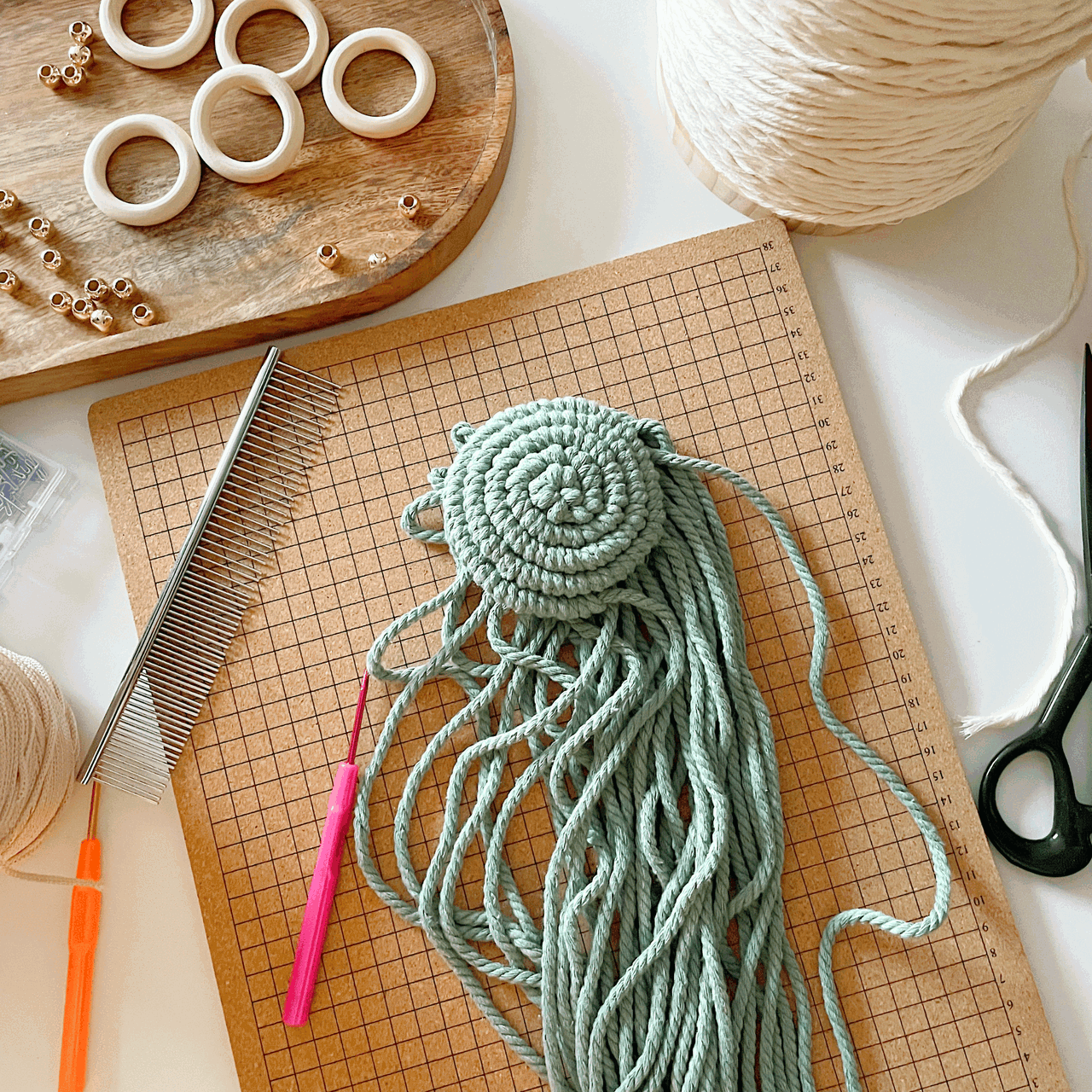
Most macramé coasters you'll find online are plain squares or basic rounds — functional but forgettable. This one is different. This is a coaster shaped like an actual flower, with 8 petals radiating from a stem-and-leaf detail, made by combining three different colors of braided macramé cord. It's the kind of coaster that gets picked up, admired, and asked about.
The pattern uses just 3 beginner knots — the Lark's Head, Double Half Hitch, and Square Knot — but the way they combine creates something that reads as intricate and thoughtful. Ideal if you want a small handmade piece that doubles as table décor: protecting your surfaces AND making your coffee table look styled.
13 steps grouped into 3 phases, about 45 minutes once you get into rhythm. Let's build this together.
A macramé flower coaster (also called a floral macramé coaster, flower-shaped drink coaster, or boho flower mat) is a small decorative coaster hand-knotted into the shape of a flower with a stem and leaf detail, made from three colors of braided cotton macramé cord. Unlike plain square or round coasters, the flower coaster is intentionally designed as dual-purpose — it protects your table surfaces from drinks AND adds a sculptural, boho-styled décor element. This tutorial builds the pattern in 3 phases (Foundation, Petals, Stem & Leaf) across 13 steps, uses 3 foundational knots (Lark's Head + Double Half Hitch + Square Knot), and produces a one-of-a-kind coaster perfect for coffee tables, dining sets, hostess gifts, and boho home styling.
Quick Answer
- What you'll make: A one-of-a-kind flower-shaped macramé coaster with 8 petals + a stem-and-leaf detail. Not a plain square — real table décor.
- Skill level: Beginner-friendly. Uses just 3 foundational knots (Lark's Head + Double Half Hitch + Square Knot). No prior macramé experience needed.
- Time: ~45–60 minutes for your first coaster. Faster with each one.
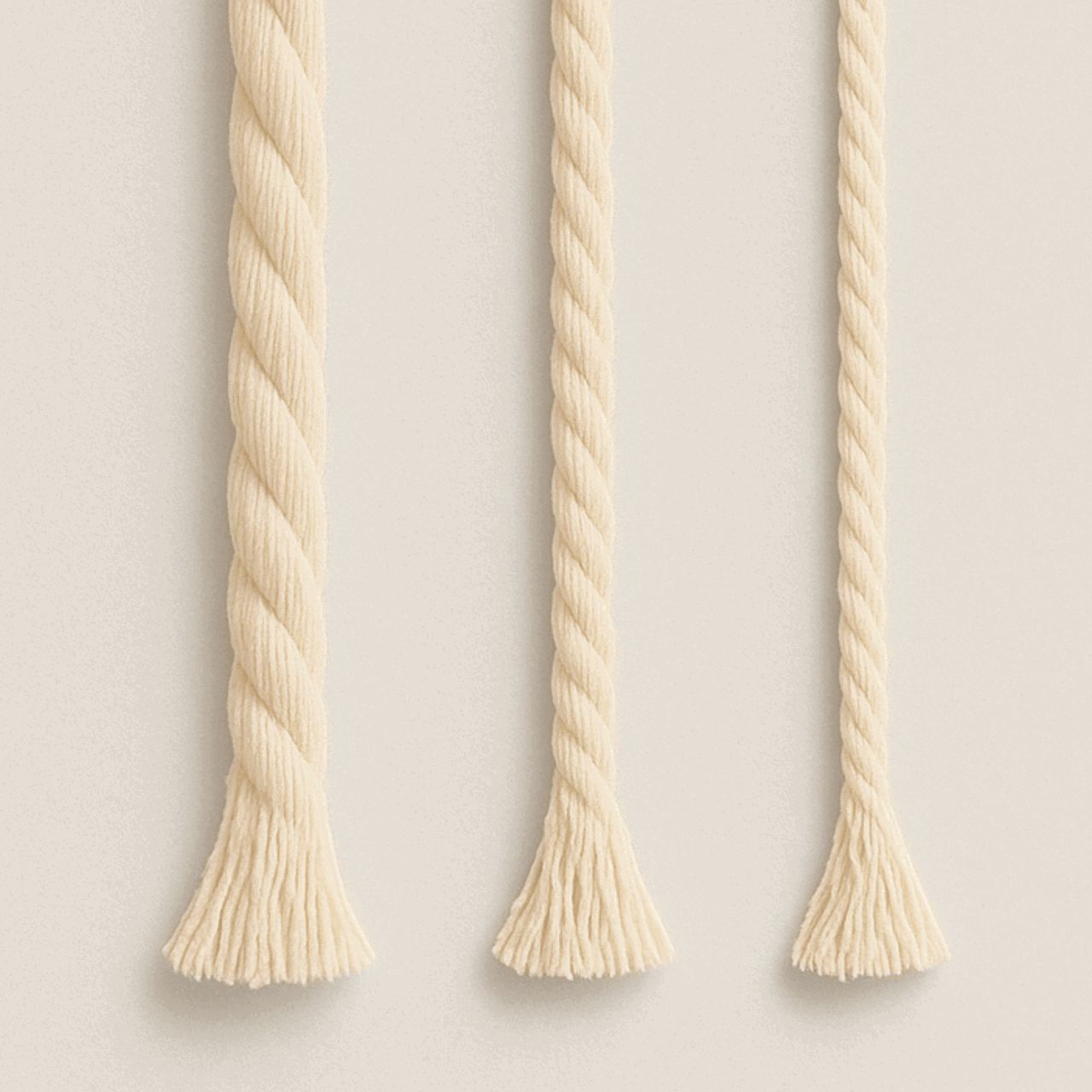
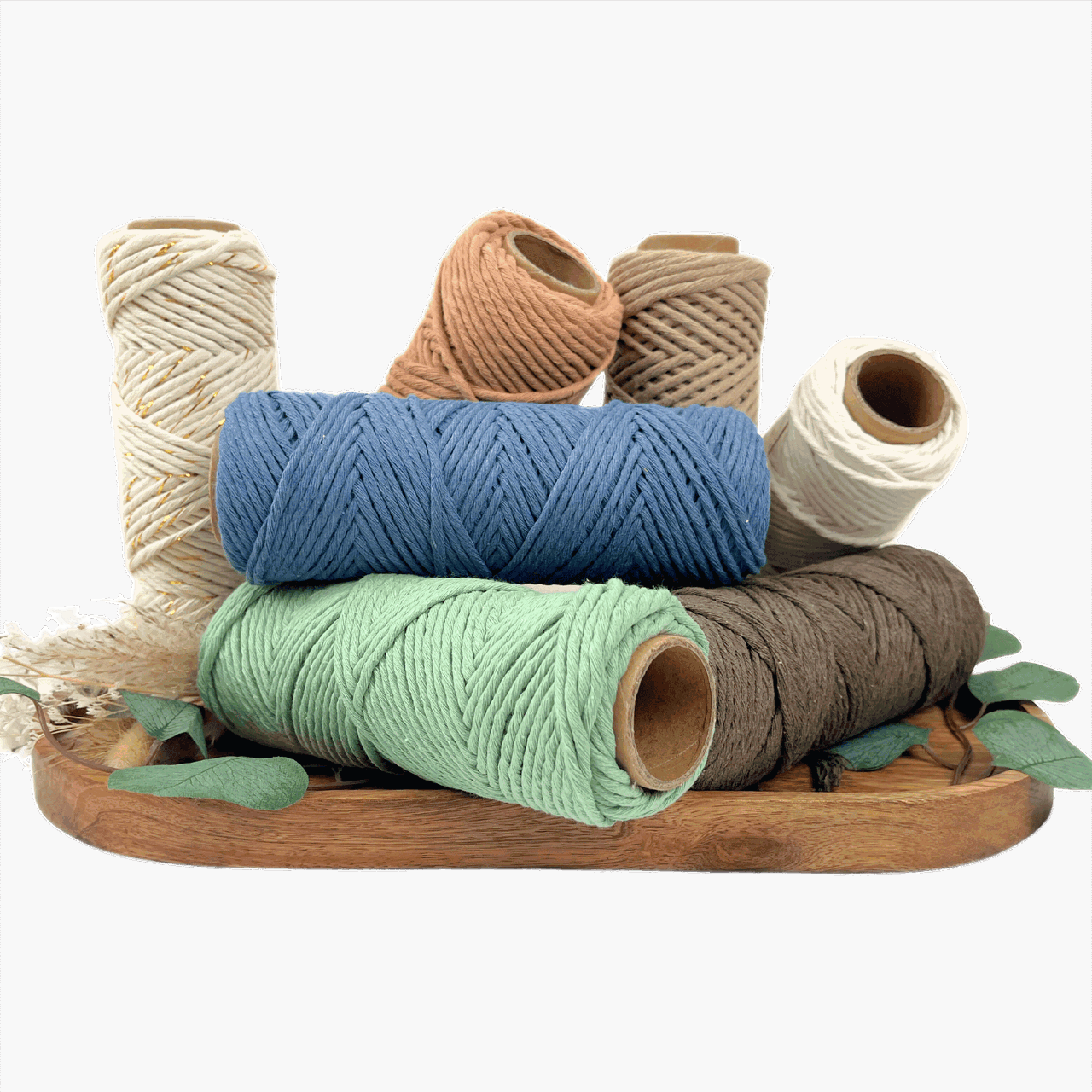
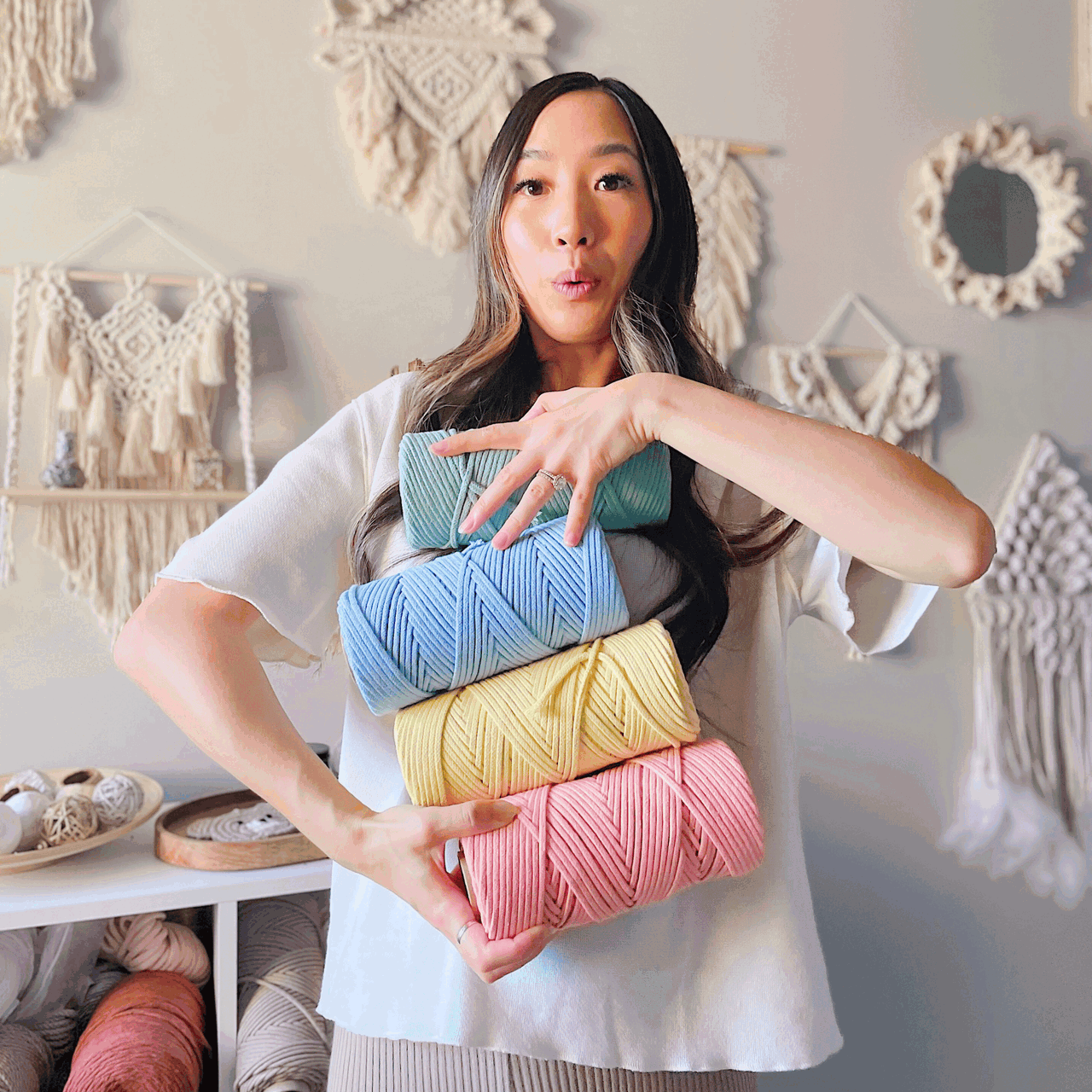
- Cord: 3-4mm braided macramé cord in 3 colors — one color for the base, one for the accent petals, one for the stem & leaf. Braided cord (not single-strand) is what gives this coaster its structured, defined shape.
- Perfect for: Coffee tables, dining sets, hostess gifts, housewarming gifts, boho home styling, and matching-set coaster gifts (make 4-6 in coordinating colors).
🎥 Watch the video first. The petal-forming sequence in Steps 5-9 is much easier to see than to read — Nicole demonstrates the anchor-cord direction change every time so you can follow along visually.
What's in this tutorial
- What is a Macramé Flower Coaster?
- Materials You'll Need
- Knots You'll Use
- Project Details at a Glance
- Cord Cut Lengths
- Watch the Video Tutorial
- Phase 1: Foundation (Steps 1-4)
- Phase 2: Flower Petals (Steps 5-9)
- Phase 3: Stem & Leaf (Steps 10-13)
- Where to Use Your Flower Coaster
- Best Color Combinations
- Common Mistakes (and How to Fix Them)
- Try These Next
- FAQ
What is a Macramé Flower Coaster?

A macramé flower coaster is a hand-knotted drink coaster designed in the shape of a flower — complete with 8 radiating petals, a woven stem, and a leaf detail. Unlike the plain square or round coasters you'll find in most macramé beginner tutorials, this coaster is intentionally sculptural — the flower shape is the entire point.
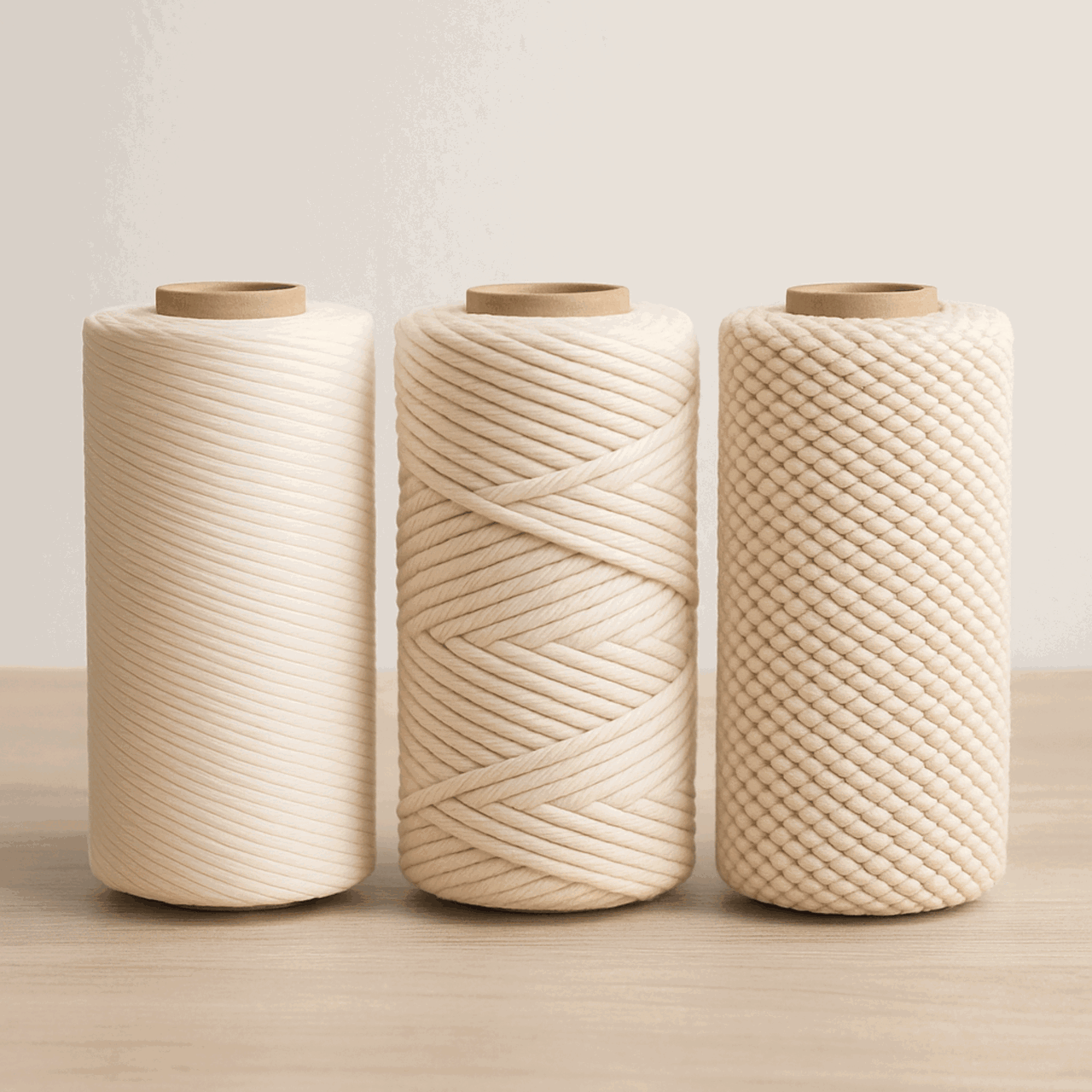
The pattern is built from three colors of braided macramé cord: one color for the base foundation, one color for the accent petals, and one color for the stem-and-leaf detail. Braided cord (as opposed to single-strand or 3-ply twisted cord) is what gives this coaster its clean, structured lines — the braided texture holds the flower shape sharply instead of getting fuzzy or floppy.
The design uses just three beginner knots (Lark's Head, Double Half Hitch, and Square Knot), which means anyone who's tied a shoelace can make one. But the way those knots combine — 8 petals plus a stem and leaf — produces a piece that reads as advanced macramé to anyone who sees it on your table.
Materials You'll Need

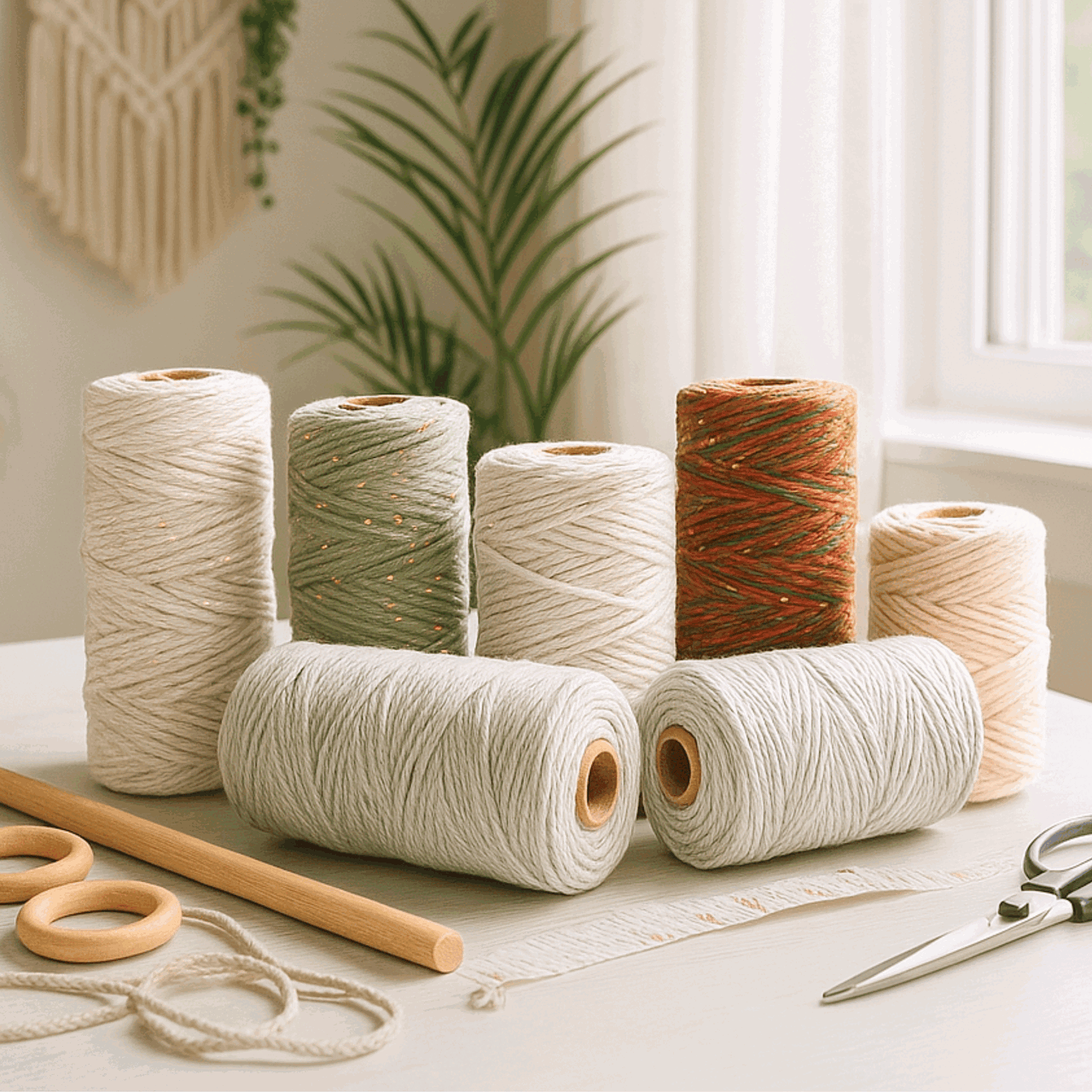
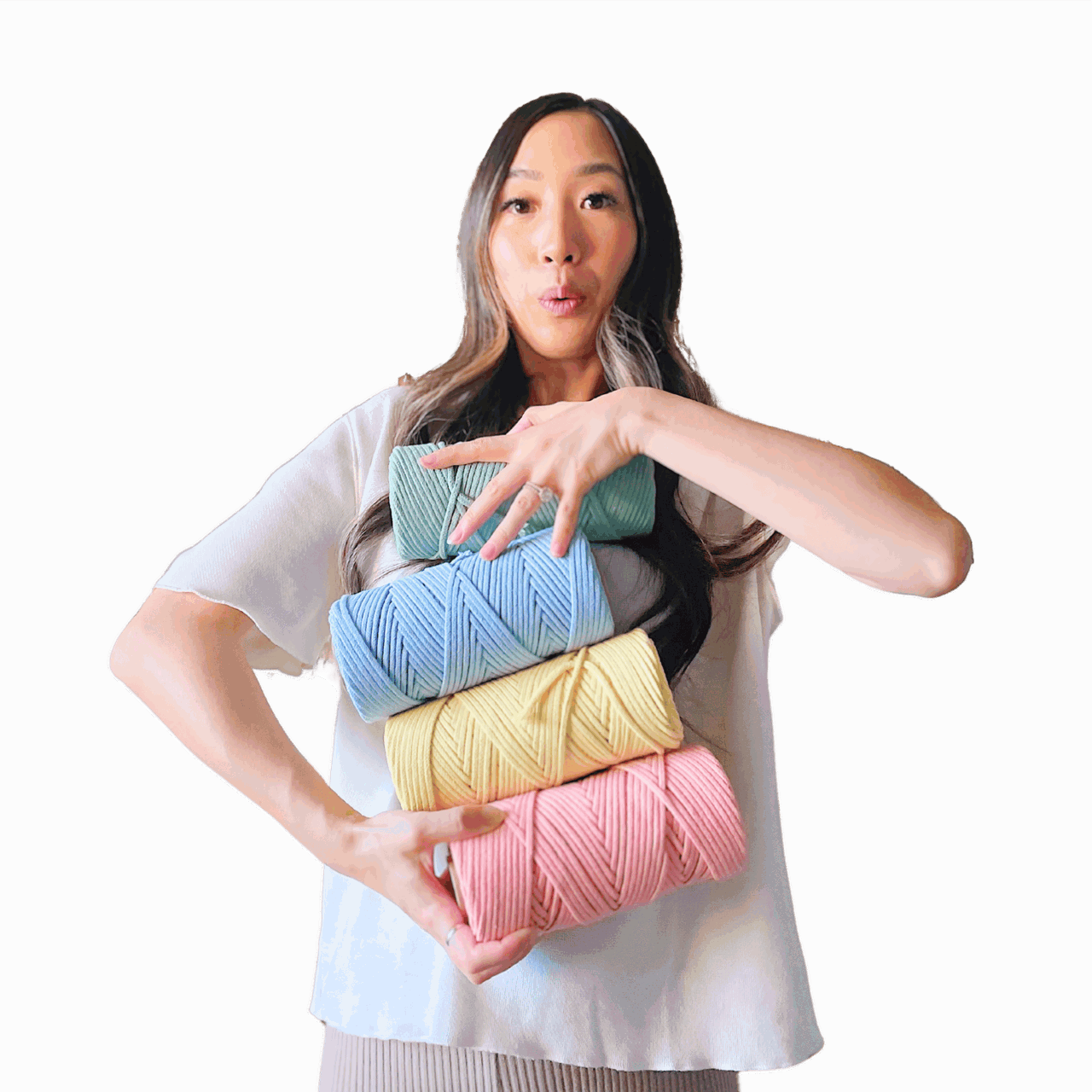
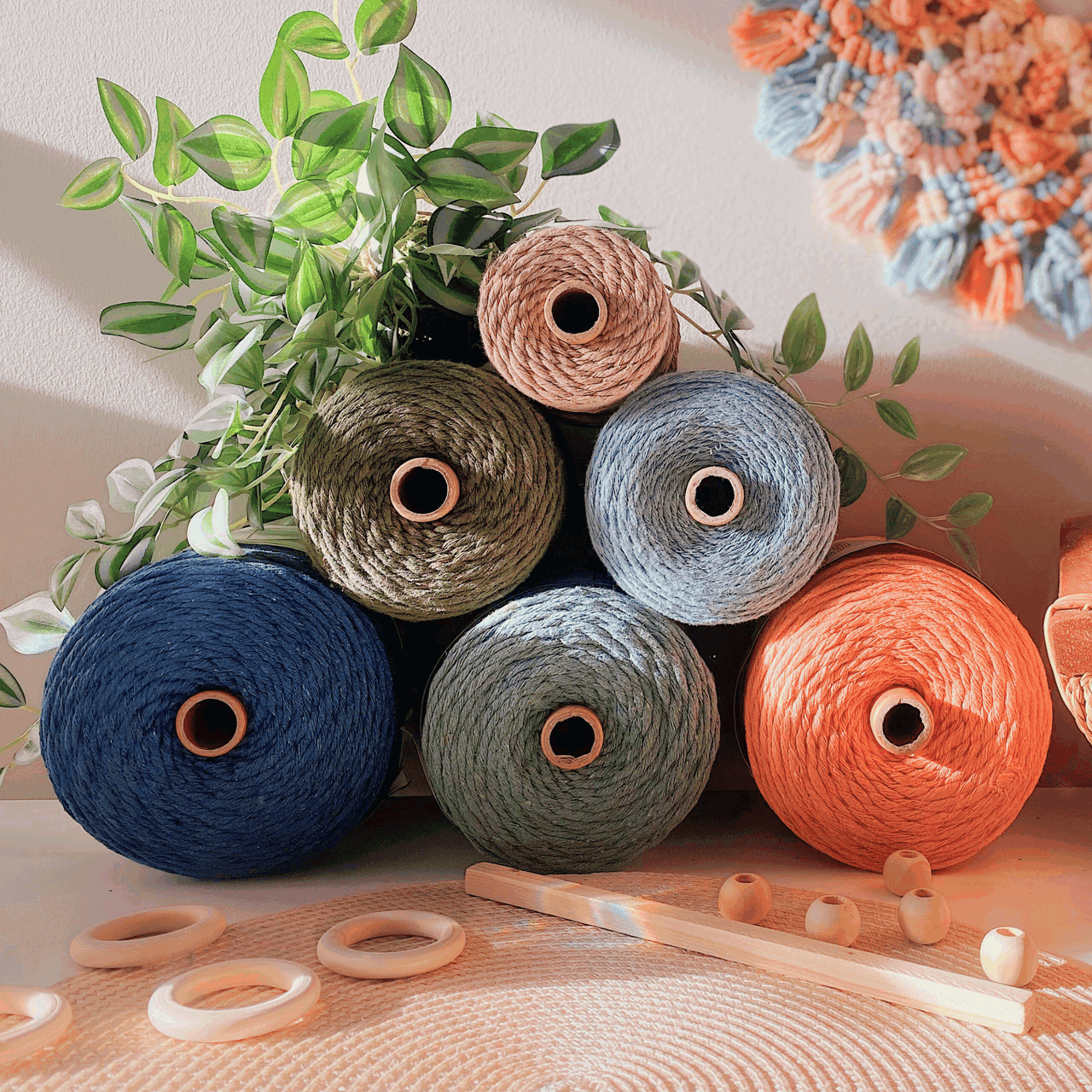
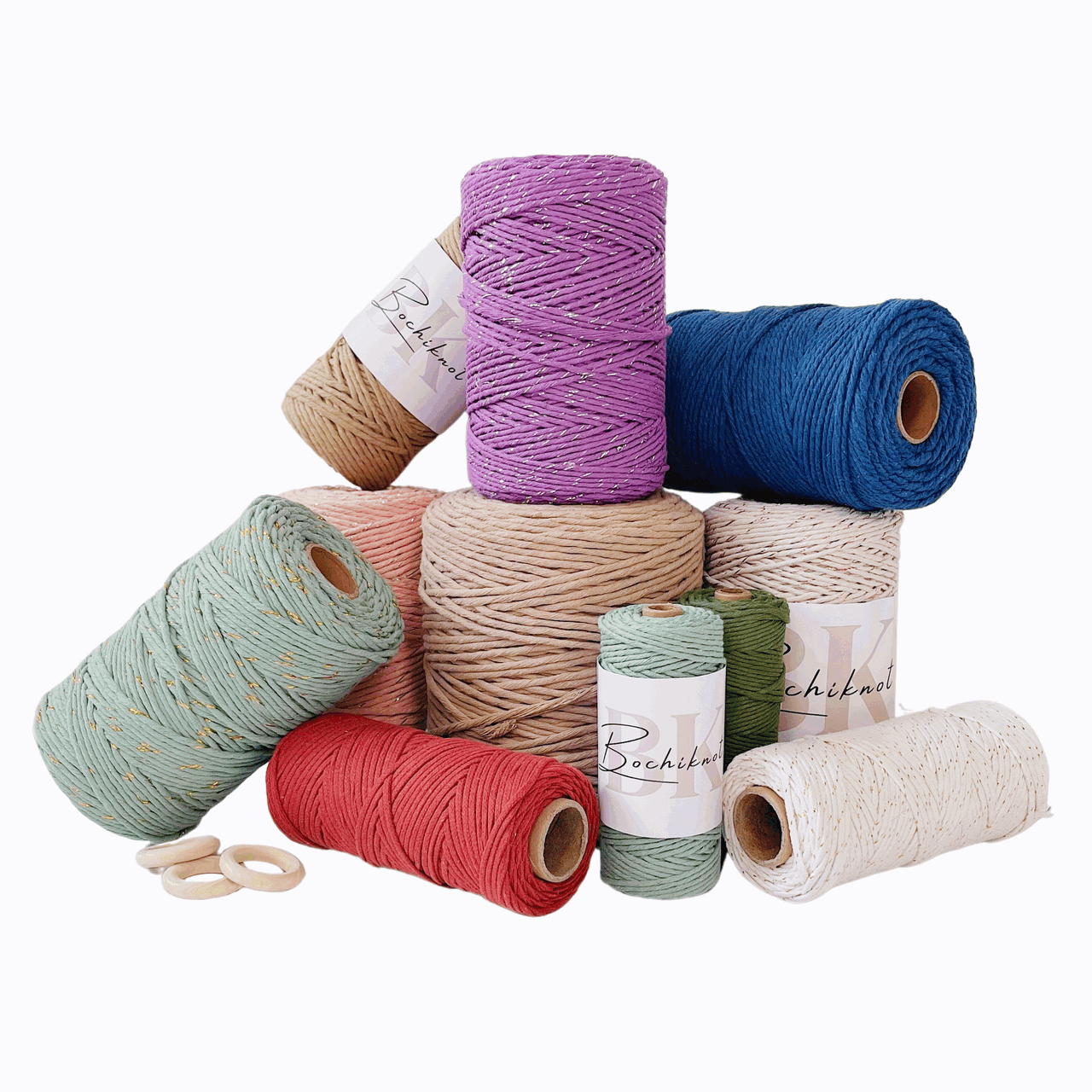
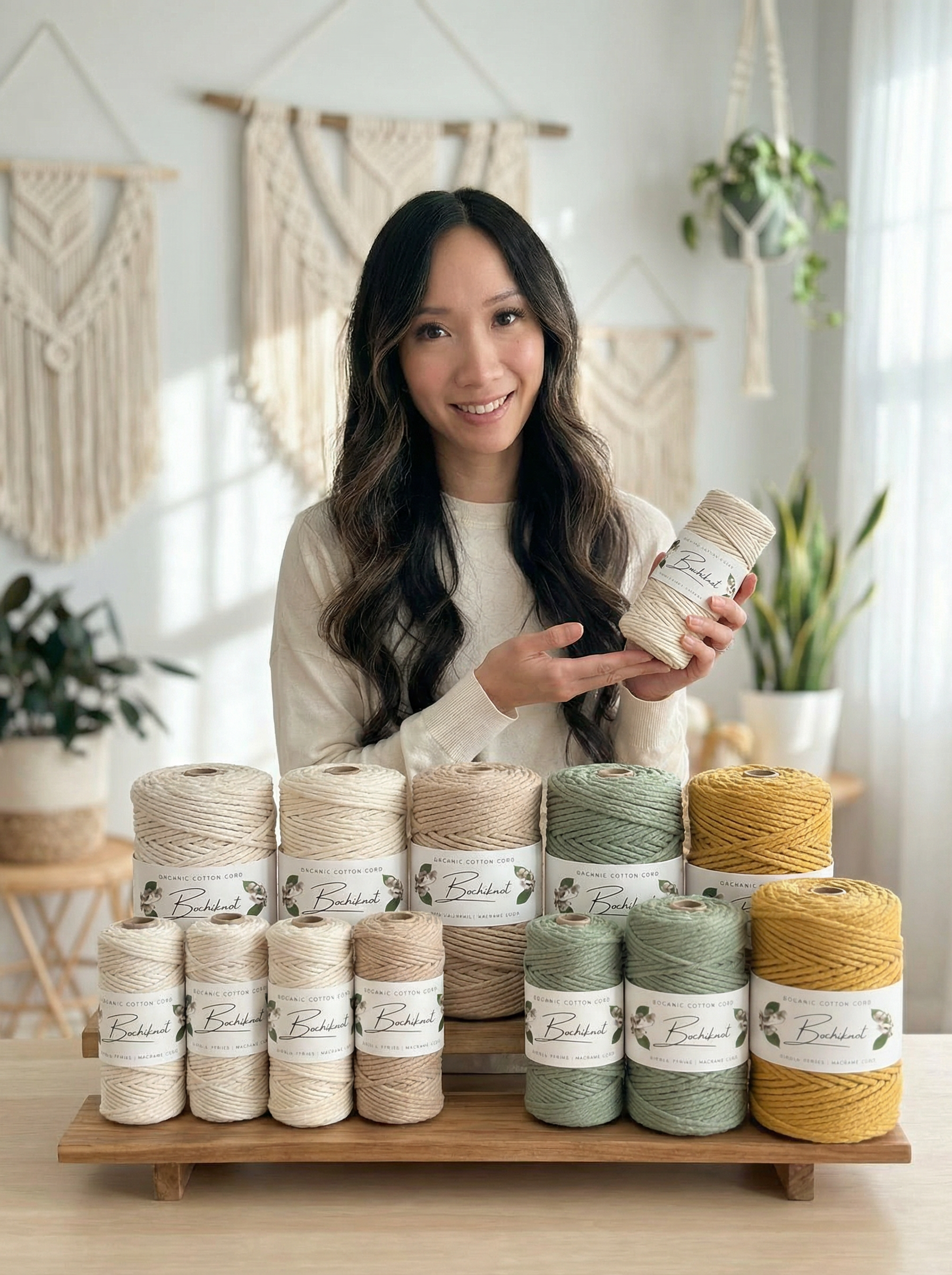
3-4mm Braided Cord (3 colors)
One 100m roll makes about 8-10 coasters. Choose 3 colors for the base, petals, and stem/leaf.
Shop braided cord
Why braided cord? Braided macramé cord has a cleaner, more defined finish than single-strand or twisted cord — perfect for structured pieces like coasters where you want the shape to hold crisp lines. Read our complete guide to selecting macramé cord for the full breakdown of when to use each type.
All materials are also on the Bochiknot Amazon storefront if you prefer Prime shipping.
Knots You'll Use (With Tutorial Links)
Just 3 foundational knots build this entire coaster. If you're new to any of them, the tutorials below cover them from scratch:
- Reverse Lark's Head Knot + Vertical Lark's Head — attaches cords to anchors and forms the flower petals. Learn this knot →
- Double Half Hitch (DHH) — creates the top and bottom edges of each petal. Learn this knot →
- Square Knot — builds the center stem and attaches the leaf. Learn this knot →
Project Details at a Glance
| Detail | Value |
|---|---|
| Skill level | Beginner ★★☆☆☆ |
| Time to complete | ~45–60 minutes (once experienced: 30 min) |
| Finished size | ~4–5 inches diameter (perfect for mugs, glasses, small bowls) |
| Cord needed | 3-4mm braided cord in 3 colors (see cut lengths below) |
| Structure | 3 phases · 13 steps · 8 flower petals + stem + leaf |
| Knots used | Reverse/Vertical Lark's Head, Double Half Hitch, Square Knot |
Cord Cut Lengths (Cut These Before You Start)
Cut all your cords first — measuring mid-project is one of the biggest reasons beginners abandon coasters halfway through. 5 minutes of prep saves 45 minutes of frustration.
| Color | Length | Quantity | Purpose |
|---|---|---|---|
| Color #1 (base) | 320 cm | 1 strand | Main working cord (Step 1) |
| Color #1 (base) | 130 cm | 1 strand | First DHH anchor (Step 3) |
| Color #2 (accent) | 120 cm | 1 strand | Horizontal foundation (Step 1) |
| Color #2 (accent) | 130 cm | 1 strand | Second DHH accent (Step 4) |
| Color #3 (leaf/stem) | 50 cm | 1 strand | Leaf working cord (Step 10) |
| Color #3 (leaf/stem) | 30 cm | 1 strand | Leaf anchor cord (Step 10) |
| Color #3 (leaf/stem) | 100 cm | 1 strand | Stem & leaf attachment (Steps 11-12) |
Total cord used: ~880 cm across 3 colors. One 100m braided roll makes 8-10 coasters comfortably.
Watch the Video Tutorial
Watch the walkthrough first — the flower-forming sequence in Phase 2 is much easier to follow visually:
▶ Watch this tutorial full-screen on YouTube →
Step-by-Step Photo Tutorial
All 13 steps are grouped into three phases. Take your time on Phase 2 (Petals) — you'll be forming 8 petals in total using the same technique, and consistency between petals is what gives the finished coaster its symmetrical flower shape.
Foundation — Setting Up the Base
Steps 1-4 build the horizontal foundation that everything else attaches to. All 3 cord colors get anchored in this phase.
Set Up the Base with Reverse Lark's Head
- Take one 120 cm strand of your Color #2 cord and place it down horizontally on your work surface. This will be your first anchor cord.
- Attach a 320 cm strand of Color #1 cord onto the horizontal cord with a Reverse Lark's Head knot — this centers your working cord in the middle.
- You should end up with two equal working strands of Color #1 hanging down from the anchor.


Add 4 Vertical Lark's Head Knots on Both Sides
- Take the right-side working cord of Color #1 and tie 2 Vertical Lark's Head knots onto the horizontal anchor cord, working outward to the right.
- Repeat on the left side — tie 2 Vertical Lark's Head knots working outward to the left.
- You'll now have a small horizontal bar of knots with two cord tails coming down from the center.


Fold and Anchor with Double Half Hitch Knots
- Fold your pattern in half so the two Color #2 anchor tails hang vertically side by side — these become your working anchor cords going forward.
- Take a 130 cm strand of Color #1 cord and attach it onto the 2 vertical anchor cords using Double Half Hitch (DHH) knots.
- Pull the DHH knots snug so the pattern holds its folded shape.


Attach the Second Color with DHH Knots
- Take a 130 cm strand of Color #2 cord and attach it onto the same 2 vertical anchor cords with DHH knots.
- You now have all your foundation cords in place — Color #1 and Color #2 attached to the anchors, ready to form the flower petals.


Foundation built!
Steps 1-4 done. All three colors are anchored, and the base structure is folded into place — ready for petal work.
Take a moment to check tension on your anchor cords. Loose here = floppy coaster. Firm foundation = crisp petals in Phase 2.
Flower Petals — Building the Flower Shape
Steps 5-9 form the 8 flower petals. This is where the flat foundation becomes recognizably flower-shaped.
Begin the First Flower Petal (Right Side)
- Bring the right anchor cord across to the right and tie 2 DHH knots onto it using the neighboring working cord.
- This creates the top edge of your first flower petal — the base line that the vertical Lark's Head knots will attach onto.


Form the Petal with 5 Vertical Lark's Head Knots
- Take the third working cord (Color #1) and tie 5 consecutive Vertical Lark's Head knots onto the anchor cord running to the right.
- These 5 vertical knots form the rounded, textured face of the petal — this is what gives the flower coaster its distinctive shape.


Close the Petal with DHH Knots
- Bring the anchor cord back across to the left and tie 2 DHH knots to close the bottom edge of the petal.
- You now have one complete flower petal — a small teardrop shape defined by the 5 vertical Lark's Head knots between two DHH edges.


Repeat for 3 More Petals on the Right
- Repeat Steps 5-7 for 3 more petals on the right side of the pattern.
- You'll end up with 4 petals total on the right — each with the same 5-knot construction. This is where the flower shape emerges.


Mirror the Petal Pattern on the Left
- Now mirror the whole process on the left side of the pattern — 4 petals to the left, each built the same way.
- When both sides are complete, you'll have 8 petals radiating out from the center — the full flower shape is now visible.


Flower shape complete!
Steps 5-9 done. 8 petals radiating from the center — the flower shape is now unmistakable.
Almost there. Just the stem & leaf remaining — the finishing touches that turn this from a flower into a flower-with-personality.
Stem & Leaf — Finishing the Coaster
Steps 10-13 add the stem-and-leaf detail using Color #3, then finish the coaster with clean trimmed ends.
Start the Leaf with Vertical Lark's Head Knots
- Using Color #3 cord, take a 50 cm working cord and tie 5 consecutive Vertical Lark's Head knots onto a 30 cm anchor cord.
- This creates the small leaf shape — a mini version of the petal technique. Set this piece aside once complete.


Build the Stem with Square Knots
- Take a 100 cm strand of Color #3 cord. Tie 2 Square knots onto the middle 4 vertical cords of the flower base.
- Then tie another 2 Square knots using all the vertical cords as anchor cords — this locks the center of the flower and starts building the stem downward.


Attach the Leaf to the Flower Base
- Position half of the leaf pattern in front of the stem and half behind — the leaf should nest against the right side of the stem.
- Tie 3 consecutive Square knots that gather all the cords together in the middle. This attaches the leaf to the stem and closes off the coaster body.


Finish + Tuck the Ends
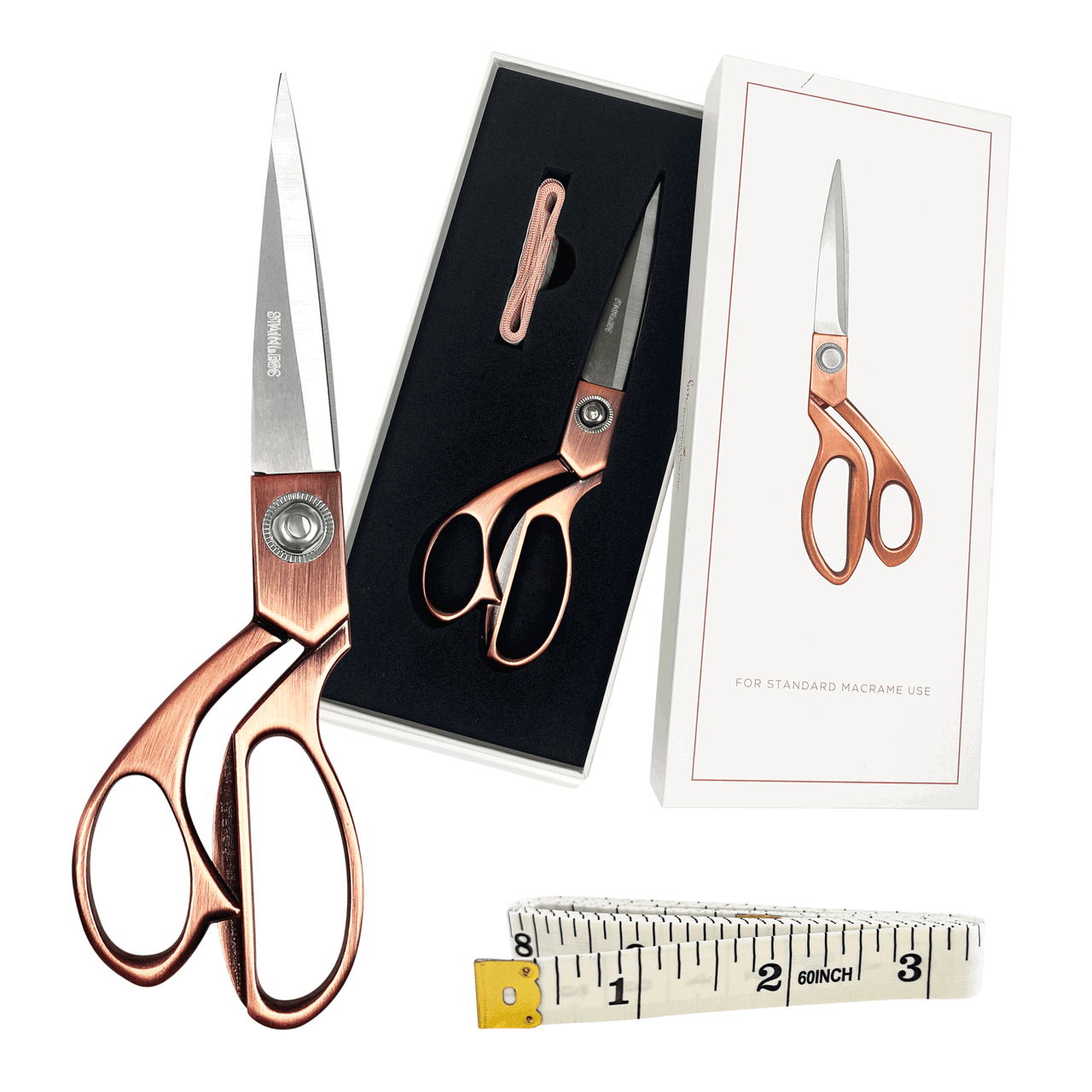
- Trim the excess cord ends with sharp scissors, leaving about 1 cm of tail.
- Tuck the working cord ends through the Square knots at the back to hide them cleanly.
- Give the coaster a gentle press with your hands to help it lay flat — and you're done! One-of-a-kind flower coaster ready to grace your table.


You did it!
Your one-of-a-kind macramé flower coaster is ready. Not a plain square or round — a piece that doubles as table décor.
Snap a photo and tag #BochiknotCoaster on Instagram — Nicole loves seeing what makers create in their color combos.

Where to Use Your Flower Coaster
Once the pattern is in your hands, the flower coaster works far beyond the coffee table. 8 places Nicole loves using them:
Best Color Combinations
The 3-color palette is where this coaster gets its personality. Here are 5 combinations Nicole recommends by the aesthetic you're going for:
| Aesthetic | Color #1 (Base) | Color #2 (Accent) | Color #3 (Stem/Leaf) |
|---|---|---|---|
| Classic Boho | Natural / cream | Terracotta | Sage green |
| Modern Minimal | Off-white | Dusty pink | Charcoal grey |
| Autumn / Fall | Cream | Rust orange | Deep olive |
| Spring / Easter | Ivory | Blush pink | Mint green |
| Coastal / Beachy | Sand beige | Sky blue | Sage green |
Tip: The stem/leaf color should always be the "grounding" color — it visually anchors the flower. Save your favorite bright/light color for the petal accents (Color #2) where it gets the most visible surface area.
Common Mistakes (and How to Fix Them)
| Mistake | Fix |
|---|---|
| Petals look uneven / mismatched sizes | Count your Vertical Lark's Head knots per petal — it should be exactly 5 every time. Any variation shows up in the finished shape. Rip out and redo the affected petal. |
| Coaster is floppy and won't lay flat | Foundation cord tension is too loose. In Phase 1, pull the DHH knots firmly — this is what gives the coaster its structure. Loose foundation = floppy coaster. |
| Left and right sides look asymmetrical | Count petals: 4 on each side, 8 total. If one side has 3 or 5, undo and rebalance. Symmetry is what makes the flower shape read clearly. |
| The stem gets too long or unbalances the flower | Stick to exactly 2 rounds of Square knots for the stem (Step 11). More rounds = longer stem = flower looks like it's floating on a stalk instead of grounded. |
| Ends look messy after trimming | Tuck all working cord ends through the back Square knots BEFORE final trim. Cutting first leaves stubby loose tails that fray over time. |
| Coaster is too small for a mug | Use 4mm braided cord instead of 3mm — bumps the finished size from ~4" to ~5" diameter. Same knot count, larger cord. |
| Flower shape gets lost with too-similar colors | Contrast matters. If Color #1 and Color #2 are too close in shade (e.g. cream + off-white), the petals disappear. Aim for at least one strong contrast between base and accent. |
Try These Next
🔗 Loved this technique? Learn more decorative macramé knots:
- The 4 Boho Daisy Knots Every Macramé Maker Should Know — floral decorative knots for wall hangings, keychains, and accents
- The Diamond Lace Pattern Every Macramé Wall Hanging Needs — the delicate openwork pattern for elegant boho wall art
🎨 Ready for a project? Browse our complete macramé pattern library for downloadable PDF patterns.
Want a finished piece instead? Handmade Bochiknot coasters and macramé décor are on our Etsy shop.
Frequently Asked Questions
How long does it take to make one macramé flower coaster?
About 45-60 minutes for your first coaster. Once you've made 2-3, you'll drop to about 30 minutes per coaster. A set of 4 for a dining table takes about 2-2.5 hours total once you're in rhythm.
What kind of cord should I use for a macramé coaster?
Use 3-4mm braided macramé cord. Braided cord (as opposed to single-strand or 3-ply twisted) holds the flower shape crisply and doesn't fuzz out around the edges. For finer detail, use 3mm; for a slightly larger coaster, use 4mm.
Why braided cord instead of single-strand cord?
Braided cord has a cleaner, tighter twist that keeps knots defined and edges crisp. Single-strand cord is soft and fuzzy — great for wall hangings where you want texture, but wrong for coasters where you want structured shape. The choice of cord matters more than the knots for this pattern.
How much cord do I need for one coaster?
About 880 cm total across 3 colors — approximately 570 cm of Color #1, 250 cm of Color #2, and 180 cm of Color #3. One 100m roll of braided cord makes 8-10 coasters comfortably.
Can I make this coaster in one color instead of three?
Yes, but you lose the flower-shape visual definition. Three colors are what makes the petals, stem, and leaf read as distinct elements. If you use one color, the design becomes more abstract — still pretty, but less recognizably floral.
What size is the finished coaster?
About 4-5 inches in diameter — perfect for standard coffee mugs, wine glasses, water tumblers, and small bowls. Use 4mm cord instead of 3mm to make a slightly larger 5-inch version for oversized mugs.
Can beginners really make this coaster?
Yes — this pattern uses just 3 beginner knots (Lark's Head, Double Half Hitch, Square Knot). The challenge is consistency across 8 petals, not knot complexity. If you've made a keychain or wall hanging before, you're ready for this.
Can I put a hot mug on a macramé coaster?
Cotton macramé coasters handle warm mugs of tea, coffee, and hot chocolate perfectly well — cotton is heat-tolerant up to about 400°F before scorching. For very hot cookware (freshly boiled pots), use a thicker trivet instead.
How do I wash a macramé flower coaster?
Spot clean with a damp cloth for daily spills. For deeper cleaning, hand wash in cold water with mild soap, reshape while damp, and lay flat to dry. Don't machine wash — the agitation distorts the flower shape.
What's the difference between this and a plain round coaster?
A plain round or square coaster is functional only — protection, nothing else. This flower coaster is intentionally designed as table décor first, coaster second. The flower shape + stem-and-leaf detail make it a piece that stays out on the table as styling even when you're not using it.
Can I sell macramé coasters I make from this pattern?
Yes — you're welcome to sell finished handmade coasters. The flower coaster is our pattern, but making and selling your own finished pieces is fully allowed. Please don't share or resell this tutorial itself.
Where can I buy the exact braided cord Nicole uses?
The braided cord Nicole uses is on Bochiknot.com — a 100m roll of 3-4mm braided cotton macramé cord. You can also find it on the Bochiknot Amazon storefront. Prefer a ready-made coaster? Handmade Bochiknot coasters are on our Etsy shop.
Can I make a matching set for a full dining table?
Yes — a set of 4-6 in coordinating colors is one of the best applications of this pattern. Tie the set together with a piece of twine or ribbon and it becomes a beautiful housewarming or wedding gift.
What if I only have 2 colors of cord?
You can still make the coaster — use one color for both the base and the stem/leaf, and one color for the petals. The flower shape will still read clearly, just with less contrast. The 3-color version has the strongest visual impact.
Are macramé coasters durable?
Yes — braided cotton macramé coasters last for years with normal use. Cotton is naturally durable and doesn't fray easily. Just avoid soaking them or machine washing, and they'll hold their shape indefinitely.
Can I use this pattern for wedding favors?
Absolutely — this is one of the most popular boho wedding favor patterns because it's cheap per unit (~$1 in cord), meaningful, personalized (color-matched to wedding palette), and functional (guests actually use them at home).
What if my flower shape looks lopsided?
The most common cause is uneven petal counts (some petals have 4 or 6 Vertical Lark's Head knots instead of 5). Count each petal — if any are off, undo and redo that petal. Symmetry between all 8 petals is what makes the flower shape read clearly.
Keep Learning with Bochiknot


You Might Also Be Interested In


Pattern Library
Downloadable pattern PDFs — coasters, wall hangings, keychains, and more.
Browse patterns📸 Made a flower coaster? Show us.
Tag #BochiknotCoaster on Instagram — Nicole loves seeing the color combos makers choose. Set of 4 for a housewarming? Single showstopper for the coffee table? Show it off.
About Nicole Woo
Nicole is the founder of Bochiknot and has been teaching macramé for 5+ years to a community of 100,000+ makers across YouTube, Instagram, and Patreon. She specializes in beginner-friendly cotton cord projects that feel approachable no matter your skill level.
Join her on Patreon for exclusive patterns, or explore individual ebook patterns.

Leave a comment