












Five Macramé Leaf & Vine Patterns (Step-by-Step Tutorial)


Updated June 15, 2026 · ~18 min read
If beginner knots felt like the warm-up, macramé leaf and vine patterns are where your work starts to look like art. These flowing, organic motifs — curved leaves, mini-leaves, heart waves, and long leaves climbing a central vine — are built almost entirely from one knot you already know: the diagonal double half hitch. That is the secret behind every intricate macramé knot pattern you have admired online. In this tutorial I will walk you through five named leaf and vine patterns step by step, show you the exact knot counts and directions, then teach you how to design your own. No new knots required — just better angles, even tension, and a little patience.
Whether you are dressing up a wall hanging, adding detail to a plant-hanger panel, or knotting a tiny leaf onto a card, these macramé leaf patterns scale beautifully. Let us get into it.
What Is a Macramé Leaf (and Vine) Pattern?

Macramé leaf and vine patterns are built almost entirely from the diagonal double half hitch — you angle rows of DHH knots to form leaf shapes along a central vine, then mirror and repeat to grow the design.
Tutorial Contents
- What you'll learn
- Knots you need first (prerequisites)
- The tension trick for crisp leaves
- Materials & tools you'll need
- Video walkthrough
- 1. Curved leaf pattern
- 2. Mini-leaf pattern
- 3. Heart wave pattern
- 4. Regular leaf pattern
- 5. Long leaf pattern
- Design your own leaf & vine patterns
- Pro tips & troubleshooting
- Common mistakes & fixes
- Where to use these patterns
- Color combinations to try
- Frequently asked questions
- Get the free 50 macramé knots guide
- More macramé guides to try
- Join the Bochiknot community
Jump to a pattern
What You'll Learn
By the end of this tutorial you will be able to:
- Recognize how every macramé leaf and vine pattern is built from the diagonal double half hitch.
- Knot five named patterns — curved leaf, mini-leaf, heart wave, regular leaf, and long leaf — step by step.
- Mirror each leaf cleanly so your vine stays symmetrical on both sides.
- Adjust rows, directions, and color to design your own original vine and leaf motifs.
- Keep your tension even so the leaf edges stay sharp instead of loose or lumpy.
- Apply these patterns to wall hangings, plant hangers, garlands, and cards.
Knots You Need First (Prerequisites)
The good news about intricate macramé knot patterns is that they reuse the basic knots you have already practiced. Before you start a leaf, make sure you are comfortable with these three:
- Larks head knot. This is how you mount your working cords onto a dowel or holding cord at the very start. A reverse larks head sits a touch flatter, but either works to set up your cords for a vine.
- Square knot. You will not knot a leaf with square knots, but they are useful for stems, accents, and the panels you often frame a vine inside. Knowing them keeps your options open when you design.
- Diagonal double half hitch (DHH). This is the star of the show. Also called the clove hitch, it is the single knot that forms every leaf in this guide. You set one cord as the anchor (holding) cord, lay it at the angle you want the leaf edge to follow, then wrap each neighboring working cord around it twice. Angle the anchor down-and-out and you get a leaf edge; angle it back in and the leaf closes.
- Diagonal Double Half Hitch — the main knot; every leaf in this guide is built from it.
- Reverse Lark's Head — used to mount your cords onto the dowel or holding cord.
- Square Knot — optional, for stems and accents.
New to these? See the basic knots & techniques guide.
If any of these feel shaky, start with our guide to macramé knots and techniques and the beginner's guide to macramé. Spend ten minutes drilling the diagonal double half hitch in particular — once it is automatic, every pattern below comes together quickly.
The Tension Trick for Crisp Leaves
After years of teaching these patterns, the single biggest difference between a leaf that looks crisp and one that looks lumpy is tension. The motifs themselves are not hard — but loose, uneven knots blur the leaf shape and throw off the symmetry. Here is what I tell every student:
1. Keep the anchor cord taut. The anchor (holding) cord defines the edge of your leaf. If it sags or shifts mid-row, the leaf edge waves and the two sides will not match. Hold it firm at the exact angle you want and do not let it drift while you knot around it.
2. Pull every diagonal double half hitch with the same tension. Each leaf is the same number of knots as its mirror on the other side, so the only thing that makes one side look bigger is how hard you pull. Snug each DHH to the same firmness — not loose, not strangled — and the two halves come out identical.
3. Re-snug each row before moving on. Work in good light, and after every row run your finger along the leaf edge and re-tighten any knot that looks softer than its neighbors. Catching drift one row at a time is far easier than fixing a whole lopsided leaf later. Set the piece down, look at it straight on, and reset your hands if you notice yourself pulling harder as you tire.
Materials & Tools You'll Need
You do not need much to practice leaf and vine patterns — a dowel and two cords will get you knotting. Here is the kit I reach for.

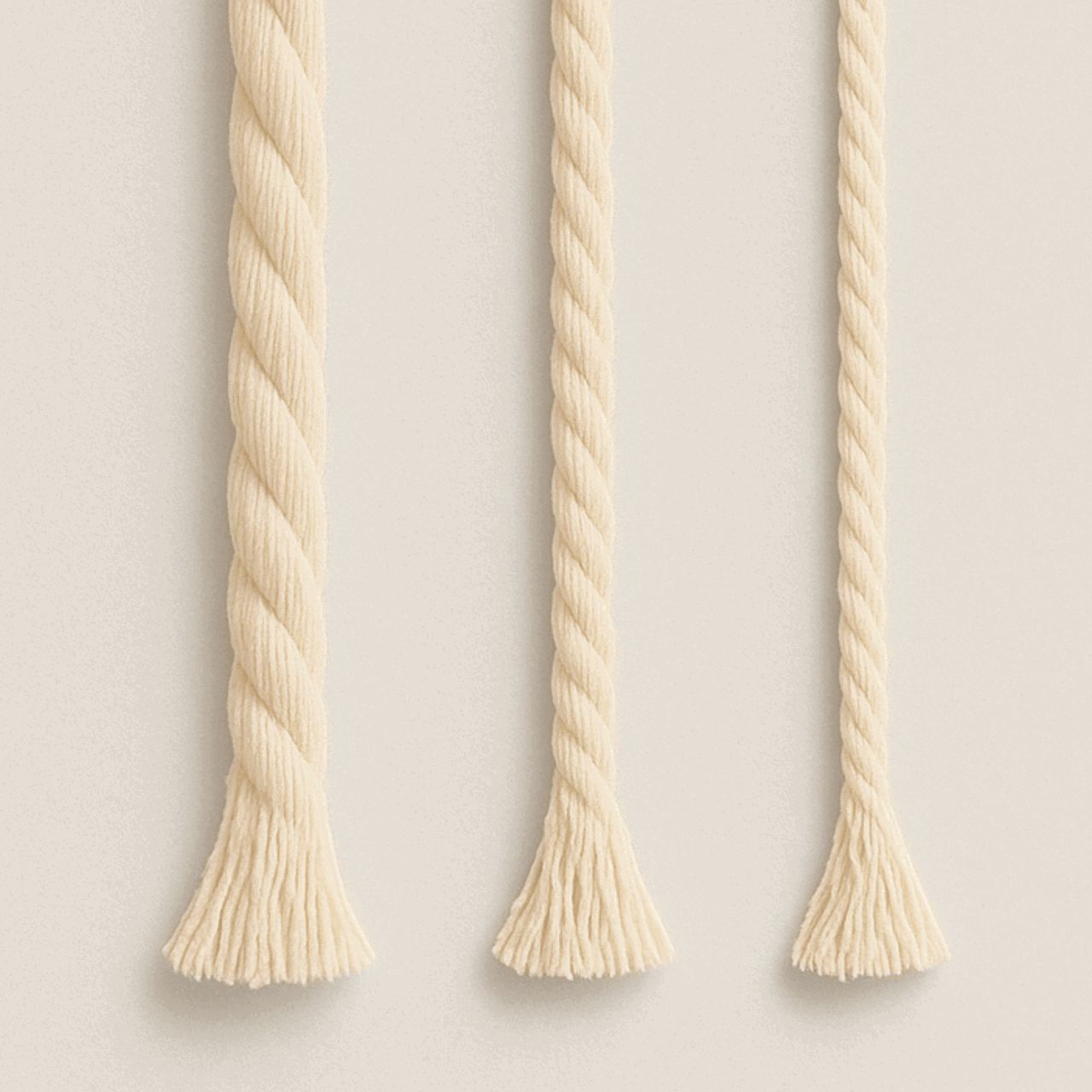
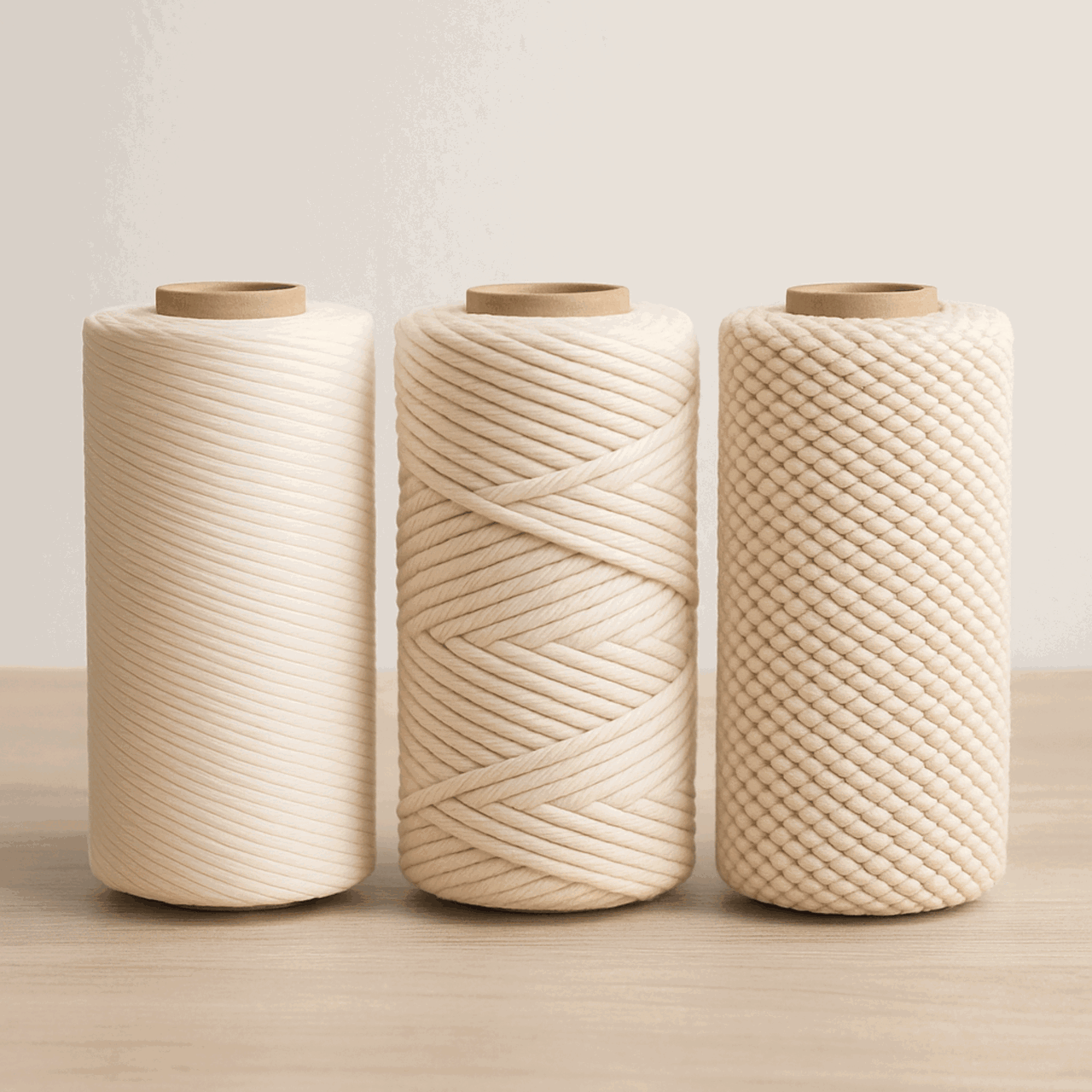
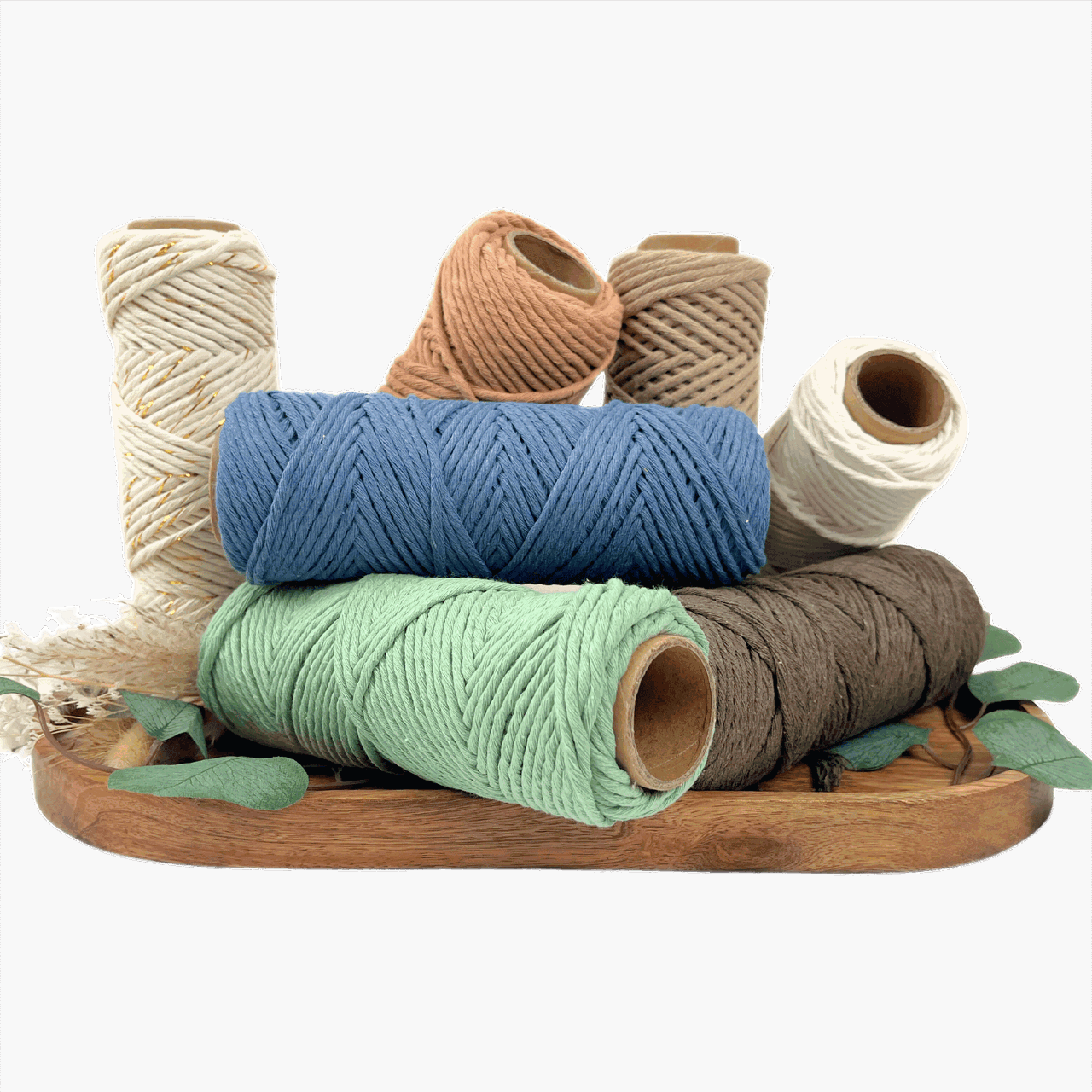
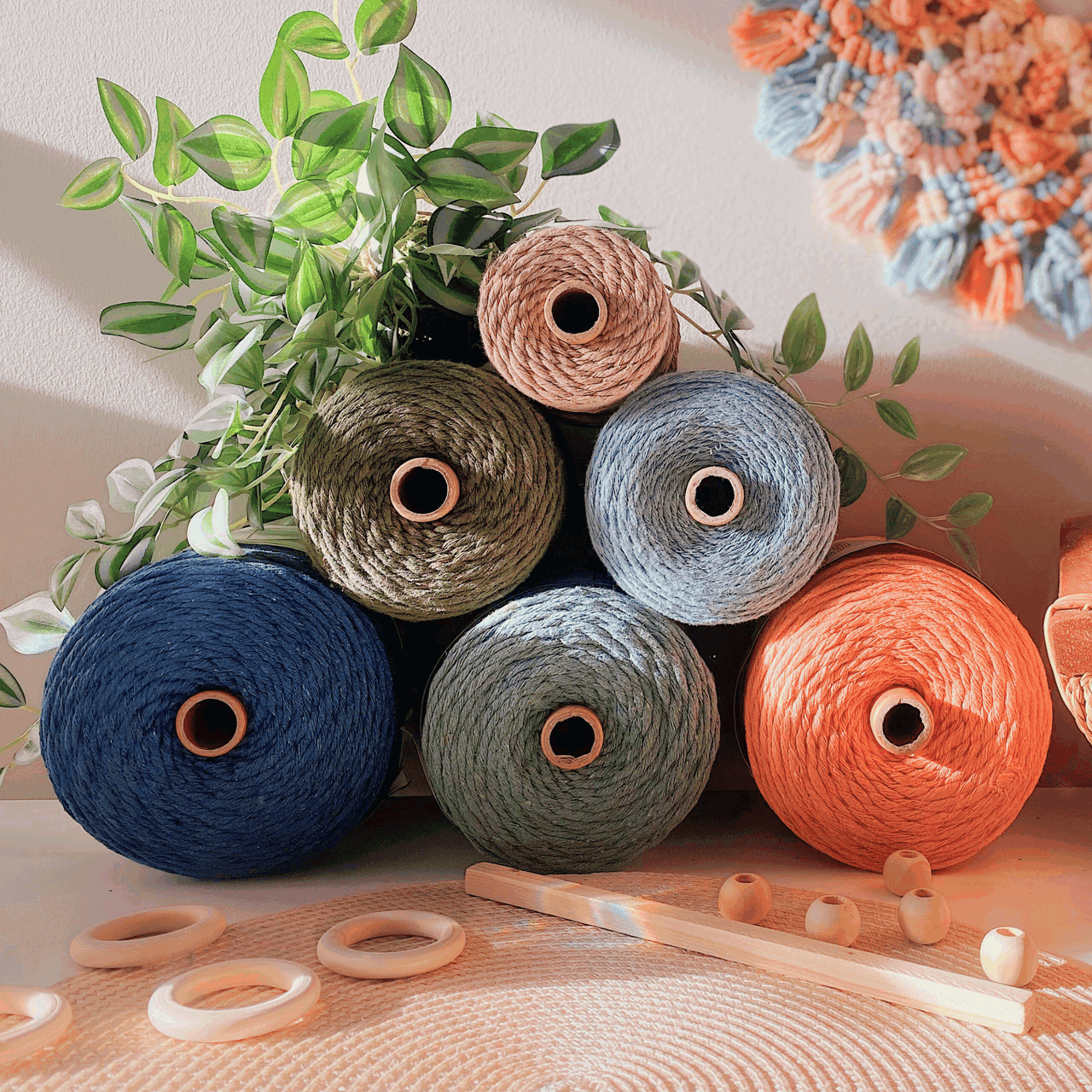
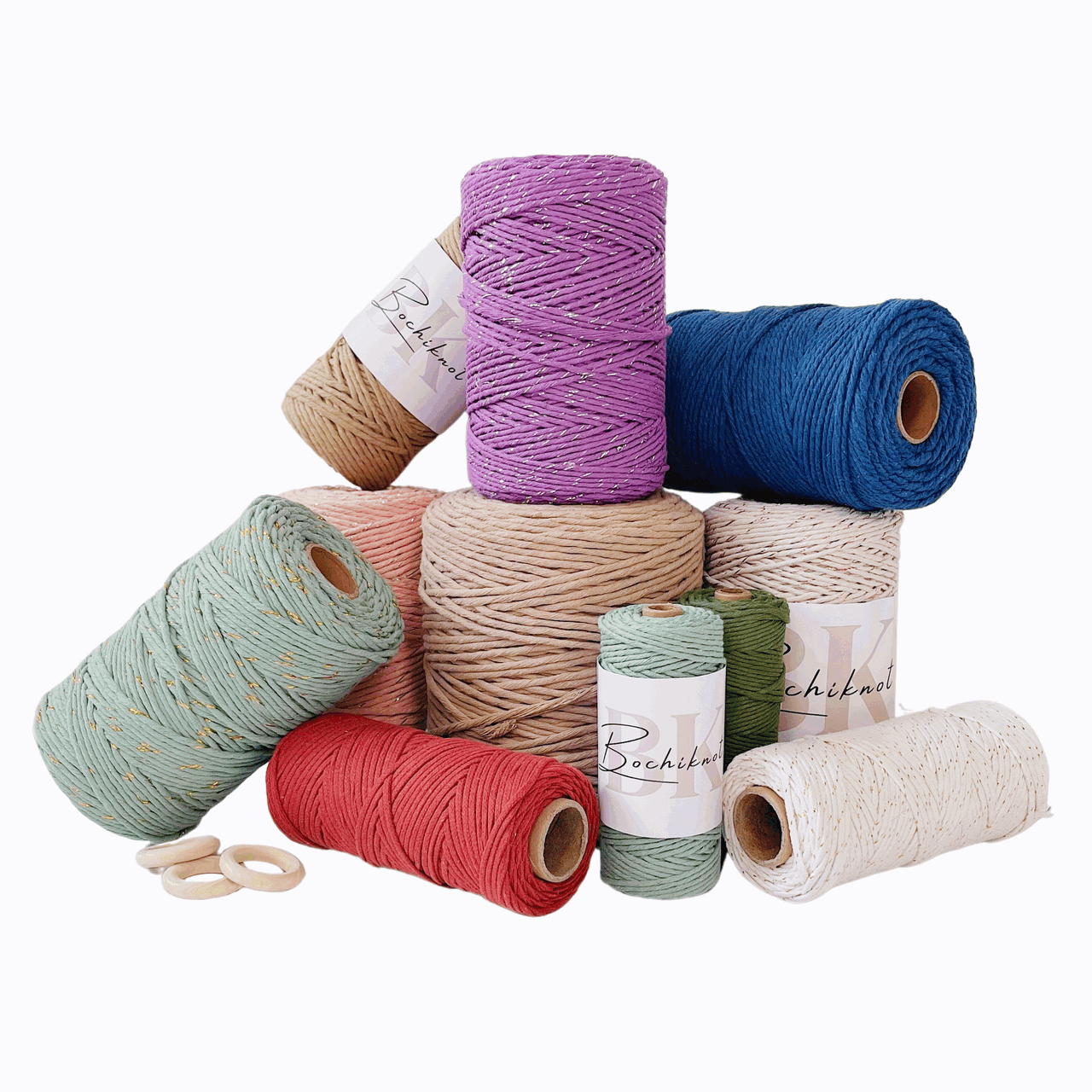
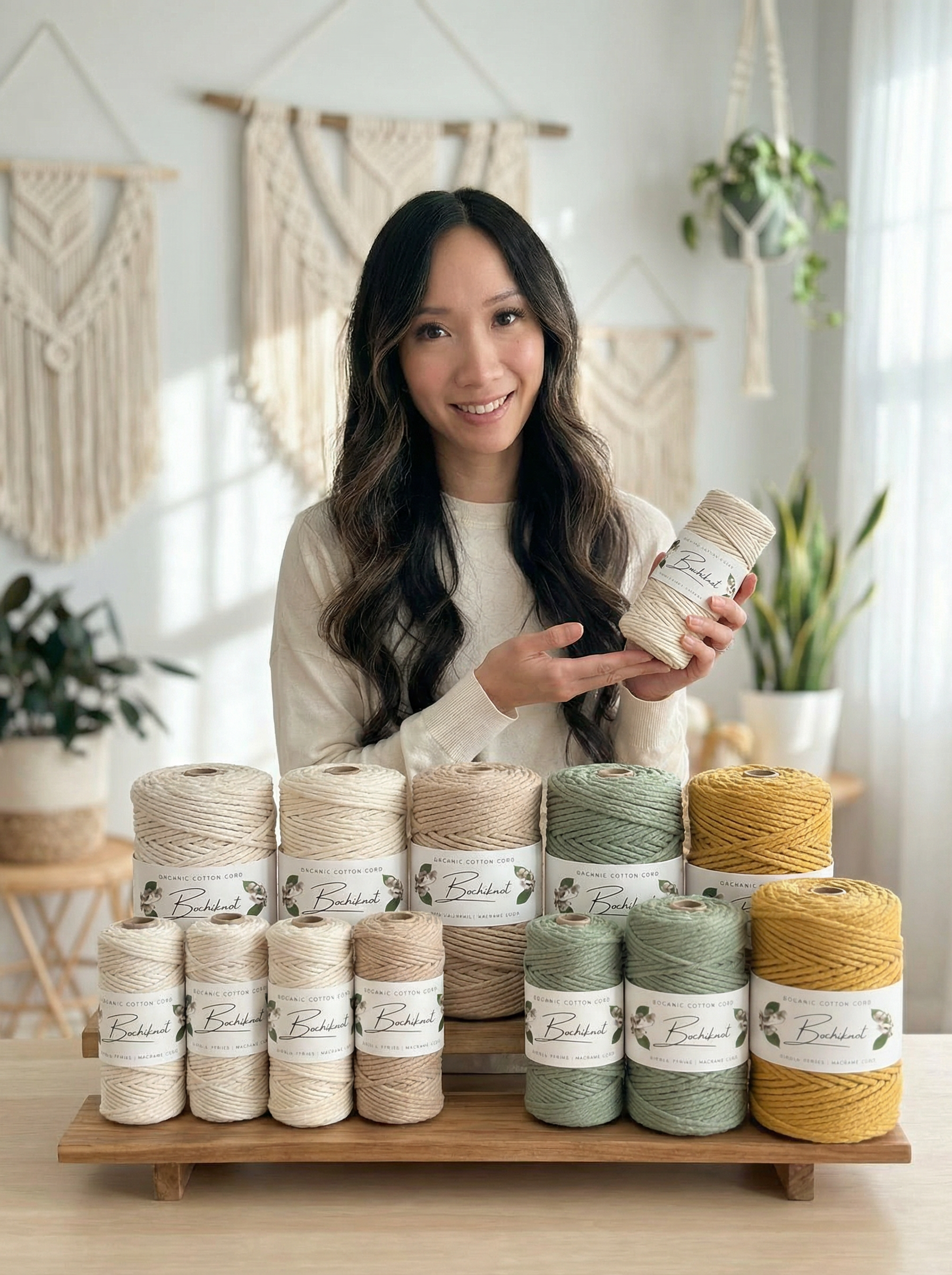
3-4 mm Single-Strand Cotton Cord
Single-strand cotton holds a crisp diagonal double half hitch, so the fine leaf detail reads clearly. 3 mm shows the most detail and stays easy to handle; 4 mm gives a bolder, slightly larger leaf.
Shop single-strand cord
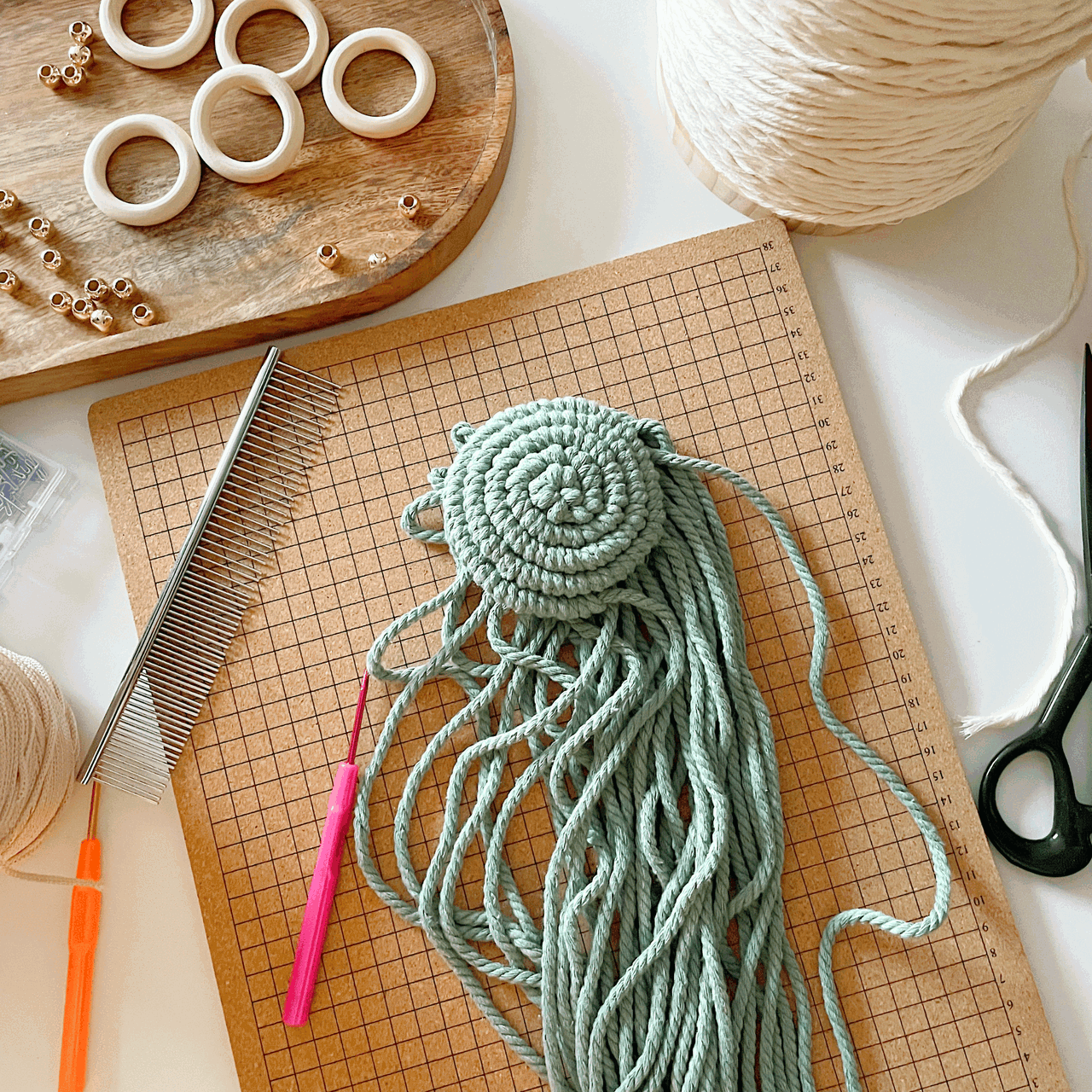
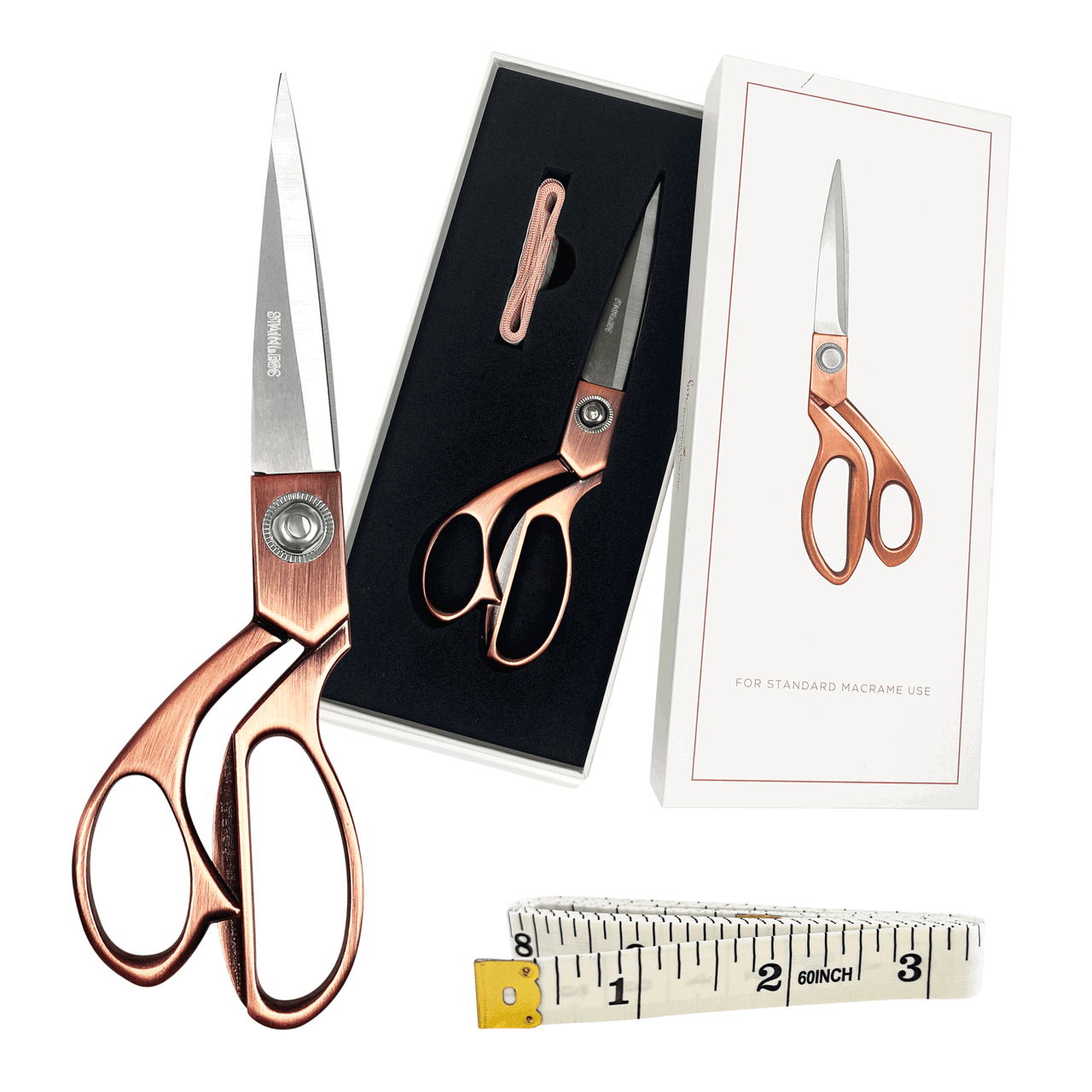
Scissors, Comb & Measuring Tape
Sharp precision scissors, a measuring tape, and a metal comb keep your cuts clean and your fringe tidy.
Shop scissors
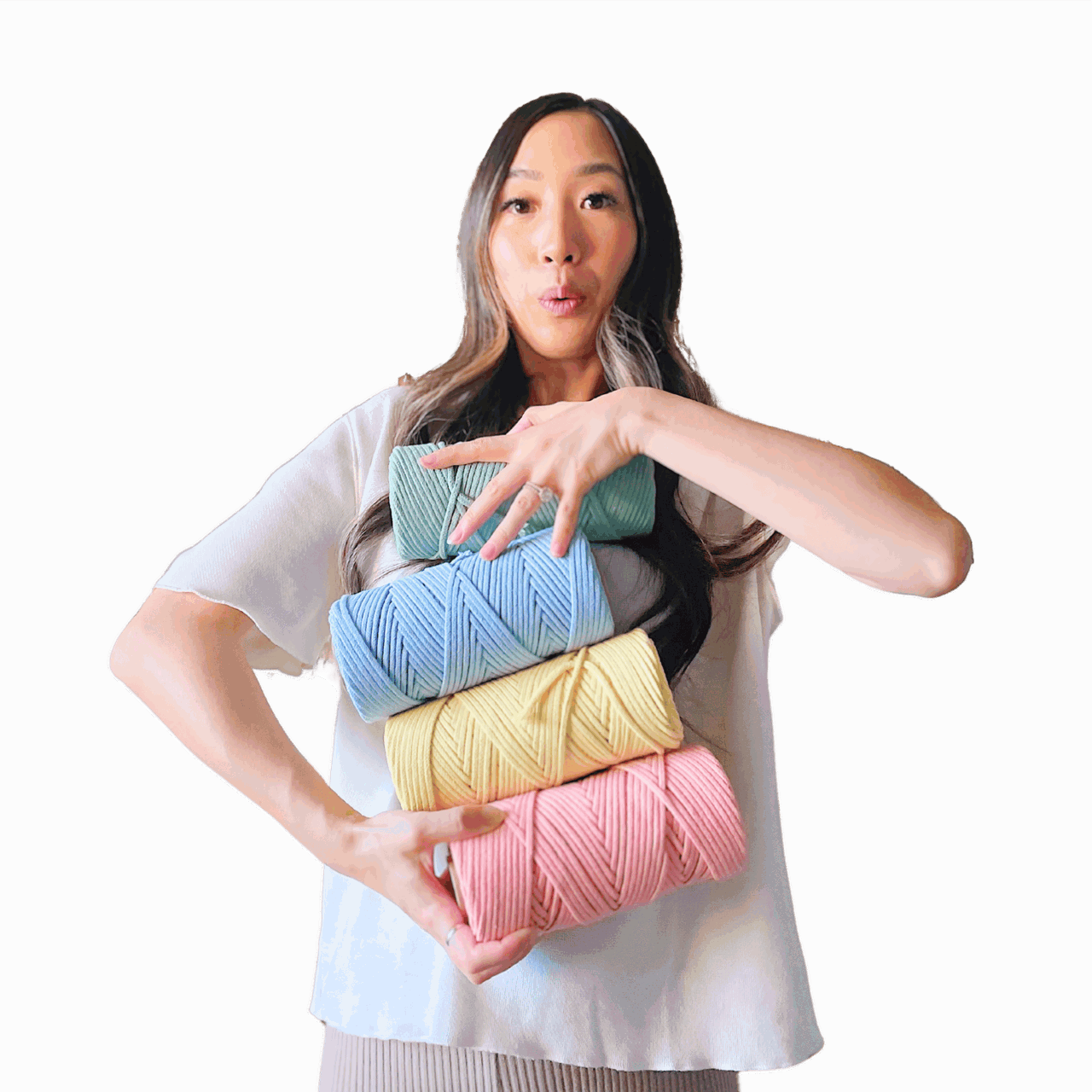
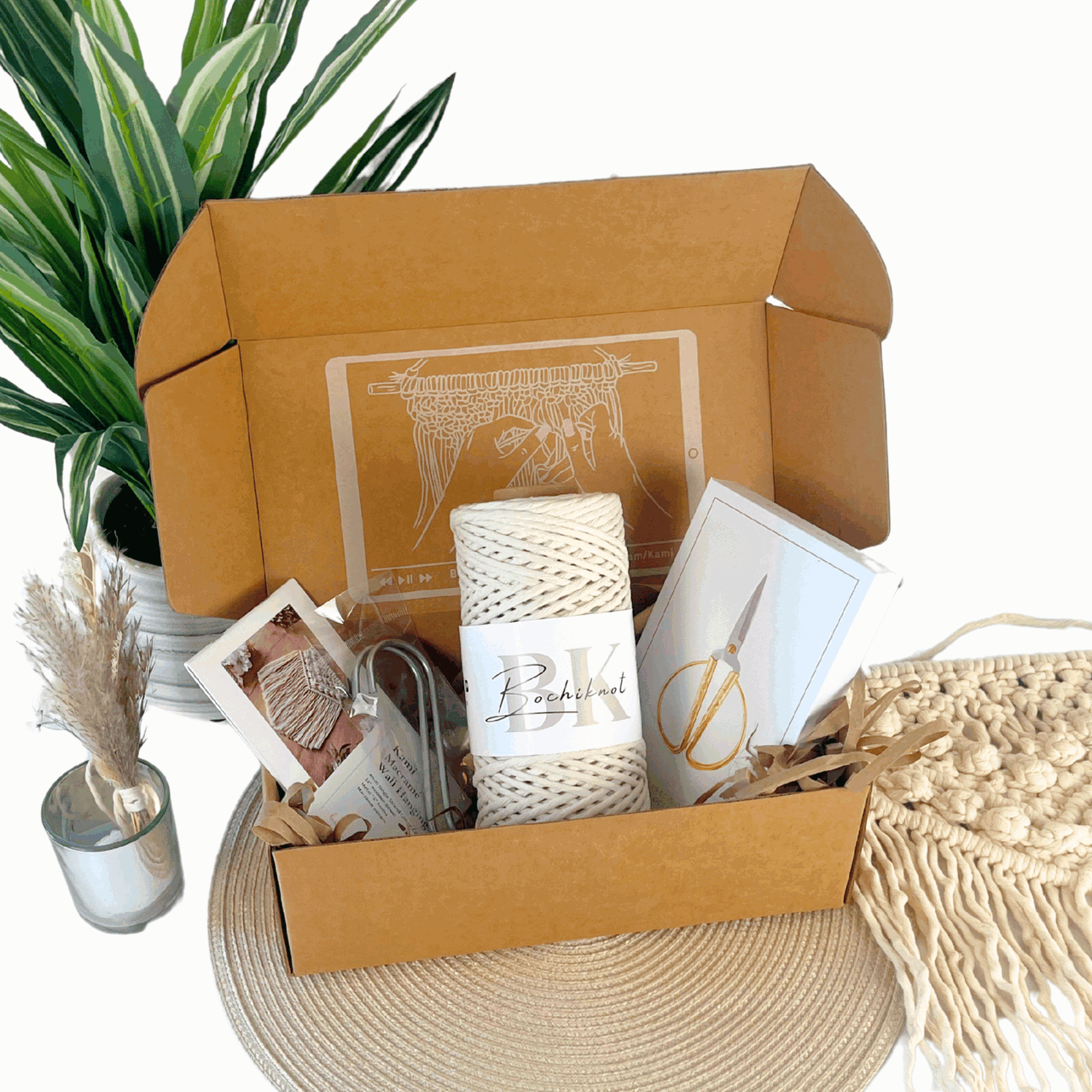
Beginner Welcome Kit
New to this? The macramé welcome kit bundles cord and the essentials so you can start practicing leaf and vine patterns right away.
Shop the welcome kitFull materials list:
- 3-4 mm single-strand cotton cord — 2 cords at about 150 cm each to practice a vine
- 1 wooden dowel to mount your cords
- Beginner welcome kit (cord plus essentials in one)
- Precision scissors
- Measuring tape
- Metal comb
Shop single-strand cord Shop the welcome kit
Free shipping on orders over $100 USD (US) or $75 CAD (Canada). This post contains affiliate links. We may earn a small commission at no extra cost to you. Also on Amazon and Etsy: browse our Amazon storefront or shop patterns and cord on Etsy.
Video Walkthrough
Note: We recommend following the tutorial video for more detailed instructions and the best results. It gives extra guidance and clarity as you work through each leaf and vine pattern.
Jump to a pattern in the video
The Five Macramé Leaf & Vine Patterns
To practice each of these vine and leaf patterns you only need a wooden dowel and two 150 cm macramé cords (3 mm or 4 mm). Each pattern is worked on one side of the vine and then mirrored, so the finished leaf is symmetrical. Take the steps slowly the first time — once the rhythm clicks, you will knot leaves without thinking.
Compare the 5 leaf & vine patterns
| Pattern | Difficulty | Leaf shape | Size | Best for |
|---|---|---|---|---|
| Mini-Leaf | Beginner | small, simple leaf | smallest | fillers, borders, earrings |
| Regular Leaf | Beginner | classic pointed leaf | medium | the all-purpose leaf; wall hangings |
| Curved Leaf | Intermediate | gently curved, mirrored | medium | vines and symmetrical motifs |
| Long Leaf | Intermediate | elongated leaf | longest | dramatic accents, plant-hanger trails |
| Heart Wave | Intermediate | heart-shaped wave | medium | romantic and statement pieces |
1. Curved Leaf Pattern Intermediate
1Knot the curved leaf, then mirror it
The first pattern is the curved leaf on a vine. We will work it on both sides so you can see exactly how to mirror the steps and keep the vine symmetrical. This pattern uses the diagonal double half hitch to create a curving vine with soft, organic leaf shapes — it adds a real sense of fluidity and movement to any design.

- Step 1: Take the far-left cord as the anchor cord and the remaining cords to the right as working cords. Make a diagonal double half hitch (DHH) knot row to the right.
- Step 2: Take the second cord from the left as the anchor cord and the far-left cord as the working cord, and make a horizontal DHH knot to the left.
- Step 3: Take the third cord from the left as the anchor cord and make two DHH knots to the left.
- Step 4: Bring that same anchor cord from Step 3 back to the right for two DHH knots.
- Step 5: Bring the right cord over to the left side and make a row of diagonal DHH knots to the left.
- Step 6: Repeat Steps 1-5 on the opposite side to mirror the leaf.

The curved leaf adds an organic, natural element, which makes it a fundamental choice for all kinds of projects — and a great first leaf to master.
Save this pattern2. Mini-Leaf Pattern Beginner
2Knot a compact mini-leaf
The second pattern is the mini-leaf, made with a single curve of diagonal double half hitch knots. It is perfect for fine detailing within a limited space, adding small, delicate leaves that boost the intricacy of a vine without crowding it.

- Step 1: Use the far-left cord as the anchor cord and make a row of diagonal double half hitch (DHH) knots to the right.
- Step 2: Take the third cord from the left and use it as the anchor cord for two DHH knots to the left. Then fold that same anchor cord to the right for two DHH knots.
- Step 3: Bring the right cord over to the left side and make diagonal DHH knots to the left.
- Step 4: Repeat Steps 1-3 on the opposite side to mirror the mini-leaf.

Because the mini-leaf is so compact, it is ideal for tight spaces, leaf tips, and filling gaps between larger motifs on a vine.
Save this pattern3. Heart Wave Pattern Intermediate
3Knot a heart-shaped leaf
The third pattern is the heart wave — named because each leaf is shaped like a heart. It is a lovely macramé heart pattern that shows how the diagonal double half hitch can form more complex, romantic shapes, and it adds a soft point of interest along a vine.

- Step 1: Use the far-left cord as the anchor cord and make three diagonal double half hitch (DHH) knots to the right.
- Step 2: Take the third cord from the left as the anchor cord and make two DHH knots to the left.
- Step 3: Use the same anchor cord and fold it over to the right to make one DHH knot. Then fold the anchor cord back over to the left and make another DHH knot.
- Step 4: Fold the anchor cord back over to the right and make two DHH knots.
- Step 5: Bring the right cord over to the left side and make a row of diagonal DHH knots to the left.
- Step 6: Repeat Steps 1-5 on the opposite side to mirror the heart.

The heart-wave leaf adds a touch of romance and shows off just how versatile the double half hitch really is — a favorite for cards, bookmarks, and anniversary pieces.
Save this pattern4. Regular Leaf Pattern Beginner
4Knot the classic leaf
The fourth pattern is the regular leaf, again worked with diagonal double half hitch knots. This is the standard, balanced leaf shape — the one that teaches symmetry and gives you a reliable foundation for more complex vines.

- Step 1: Use the far-left cord as the anchor cord and make a row of diagonal double half hitch (DHH) knots to the right.
- Step 2: Take the third cord from the left as the anchor cord and make two DHH knots to the left.
- Step 3: Using the third cord from the left as the anchor cord, make two more horizontal DHH knots to the left.
- Step 4: Fold the anchor cord over to the right and make two horizontal DHH knots to the right. Repeat once more underneath.
- Step 5: Bring the right cord over to the left side and make a row of diagonal DHH knots to the left.
- Step 6: Repeat Steps 1-5 on the opposite side to mirror the leaf.

Because it demonstrates clean symmetry and balance, the regular leaf is the pattern I recommend mastering before you start mixing motifs into your own designs.
Save this pattern5. Long Leaf Pattern Intermediate
5Knot an elongated leaf
The fifth pattern is the long leaf, which sticks out a little further on the left and right sides of the vine. It showcases the diagonal double half hitch's versatility by creating elongated leaves with extra length and dimension for a striking visual effect.

- Step 1: Starting with the far-left cord as the anchor cord, make three diagonal double half hitch (DHH) knots to the right.
- Step 2: Take the third cord from the left as the anchor cord for two DHH knots to the left. Repeat once more underneath.
- Step 3: Take the second cord from the left as the anchor cord for one DHH knot to the left. Fold the anchor cord back over to the right for one DHH knot.
- Step 4: Use the far-left cord as the anchor cord for two DHH knots to the right. Repeat once more underneath.
- Step 5: Bring the right cord over to the left side and make a row of diagonal DHH knots to the left.
- Step 6: Repeat Steps 1-5 on the opposite side to mirror the leaf.

These five patterns highlight the versatility of the diagonal double half hitch — its ability to form a wide range of shapes and textures. Master them and you can build intricate, eye-catching macramé leaf and vine designs of your own.
Save this patternDesign Your Own Leaf & Vine Patterns
The patterns above are fantastic starting points, but the real magic of macramé happens when you start crafting your own. Vine and leaf patterns are endlessly customizable — you simply experiment with the number of rows of diagonal double half hitch knots and the directions you angle them. Here are four ways to get started.
1. Adjust the Number of Rows
Vary the length. By increasing or decreasing the number of rows of DHH knots, you control the length and structure of your vine. More rows make a longer vine; fewer rows create a compact look.
Layer your leaves. Experiment with different row counts for the leaves themselves. A single row makes a small leaf, while several rows form a larger, more intricate one.
2. Alter the Directions
Curve and twist. Change the direction of your DHH knots to create new shapes. Bending the vine or leaves one way produces a unique, asymmetrical design. Try curving one leaf to the left and the next to the right for contrast and movement.
3. Mix & Match
Blend patterns. Combine elements from different motifs to develop your signature style — pair the curving vine from the curved leaf pattern with heart-shaped leaves from the heart wave pattern, or invent your own combinations.
Play with texture. Vary your cord thickness and material to add depth. Thicker cords build more substantial vines; thinner cords are excellent for fine leaf detailing.
4. Personalize Your Color Palette
Choose colors that feel like you. Cord color plays a big role in the final look. Pick a palette that resonates with your style — macramé has no strict rules, so let it express your individuality. As you play with rows, directions, motifs, and color, you will discover vine and leaf patterns that are entirely your own.
Pro Tips & Troubleshooting
- Keep the anchor cord taut. The holding cord defines your leaf edge. Hold it firm at the exact angle you want so the edge does not wave.
- Pull every diagonal double half hitch evenly. Even tension is the single biggest factor in symmetrical leaves. Snug each knot to the same firmness.
- Re-snug each row before moving on. Run your finger along the leaf edge after each row and tighten any softer knot before it sets the shape.
- Work in good light. Clear angles and clean knots are everything in detailed work — you cannot fix what you cannot see.
- Mirror as you go, not at the end. Knot one side, then immediately mirror it while the count is fresh, so both halves match.
- Check against a reference. Keep the step photos or the video open and compare your leaf to it row by row.
- Start small. Knot a single mini-leaf before committing to a full vine of long leaves; it builds confidence fast.
Common Mistakes & Fixes
| Mistake | What happens | The fix |
|---|---|---|
| Uneven knot tension | The two sides of the leaf come out different sizes and the vine looks lopsided | Snug every diagonal double half hitch to the same firmness; reset your hands if you start pulling harder |
| Anchor cord sags mid-row | The leaf edge waves instead of running clean | Hold the anchor cord taut at a fixed angle the whole way across the row |
| Wrong knot count on one side | The mirror does not match and the leaf looks crooked | Mirror each side right after you knot it, counting knots as you go |
| Knots left loose | The leaf looks lumpy and the detail blurs | Re-snug each row before moving on and work in good light |
| Cord cut too short | You run out partway through a dense leaf | Cut each cord generously — at least 4× the finished length — for dense knotting |
| Starting with a complex leaf | Frustration before the rhythm clicks | Begin with a single mini-leaf or regular leaf, then work up to long leaves and vines |
Where to Use These Patterns
Once you can knot a leaf, these patterns turn up everywhere. A few favorite ways to use them:

- Wall hangings. A vine of leaves down the center or framing the sides instantly elevates a statement wall hanging.
- Plant-hanger accents. Knot a small vine onto a plant-hanger panel so the leaves echo the real foliage above.
- Garlands. Repeat curved or mini-leaves along a long cord for a knotted leaf garland or banner.
- Cards & bookmarks. A single heart-wave or mini-leaf makes a delicate, handmade card front or a flat bookmark.
- Gift toppers. Tie one leaf onto a wrapped present as a reusable, handmade flourish.
Color Combinations to Try
The same leaf pattern reads completely differently depending on your palette. Six combinations to consider:
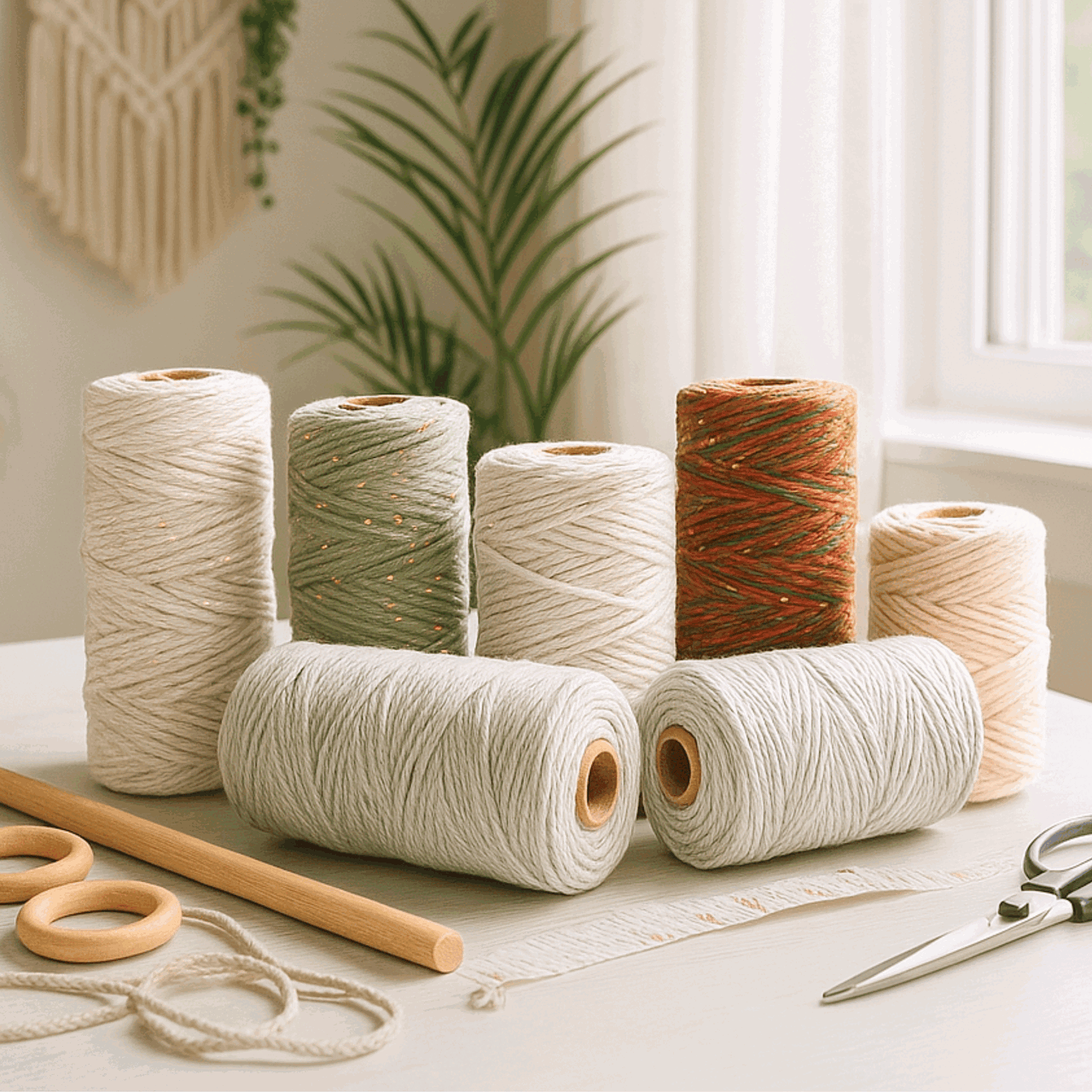
- Natural. Undyed natural organic cotton for a timeless, botanical leaf.
- Sage & cream. A soft green vine on a cream backdrop for a true leaf-and-vine feel.
- Earthy two-tone. A terracotta vine with cream leaves for warmth and contrast.
- Pastel. Blush or lilac leaves for a soft, romantic heart-wave piece.
- Monochrome. A single bold color — mustard, teal, or deep rust — for a graphic, modern vine.
- Tonal greens. Two or three shades of green along one vine for depth and realism.
Browse cord colors in our recycled cotton and natural organic cotton collections.
Frequently Asked Questions
What knot are macramé leaf patterns made of?
Macramé leaf and vine patterns are built mainly from the diagonal double half hitch (also called the clove hitch), with square knots used for stems and accents. The intricacy comes from how you angle and layer the knots, not from learning new ones.
Are macramé leaf patterns hard for beginners?
They are an approachable intermediate step. If you are solid on the diagonal double half hitch and the square knot, you can work up to leaf and vine patterns. Start with a single mini-leaf before attempting a full vine.
What is the difference between a curved leaf and a regular leaf pattern?
A curved leaf angles its double half hitches to create a gentle bend, while a regular leaf runs straighter and more symmetrical. Both use the same knot — the difference is simply the angle of the anchor (holding) cord.
How do I make a heart-wave pattern?
The heart-wave pattern shapes diagonal double half hitches into linked curves that read as hearts. It is one of the five motifs in this guide, built by folding the anchor cord back and forth to round out each side of the heart, then mirroring it.
How do I design my own vine and leaf patterns?
Begin with one leaf, then change the number of rows, alter the direction you angle the knots, and mix motifs to build a vine. Adjusting your color palette personalizes it further — the four steps are covered in this guide.
What cord is best for intricate leaf and vine patterns?
3 mm single-strand cotton shows fine knot detail clearly and stays easy to handle, which makes it the best choice for leaf and vine work. 4 mm gives a slightly bolder leaf; save thicker cord for bold, simple designs.
Can I combine different leaf patterns in one piece?
Yes — mixing and matching motifs is exactly how you design original work. Try a vine of alternating curved and mini-leaves, or frame a heart-wave with regular leaves.
How do I keep intricate patterns from looking messy?
Consistent tension and clean angles are everything in detailed work. Keep the anchor cord taut, go slowly, re-snug each knot before moving on, and check your design against a reference photo as you build.
How much cord do I need for a leaf pattern?
Dense leaf knotting uses more cord per area than open designs, so cut each cord generously — at least 4× the finished length. Two 150 cm cords are plenty to practice a small vine of leaves.
Can I use these patterns in a wall hanging?
Absolutely. Leaf and vine patterns shine on statement wall hangings and plant-hanger panels where the detail can stand out. Run a vine down the center or frame the piece with mirrored leaves on each side.
What knots do I need first for leaf patterns?
You need the larks head (to mount your cords), the square knot (for stems and accents), and especially the diagonal double half hitch, which forms every leaf in this guide. Practice the DHH until it is automatic and the patterns come together quickly.
What should I make after learning these patterns?
Apply them to a statement wall hanging or a plant-hanger panel where the detail can shine. From there, design your own vine by mixing motifs and adjusting rows, directions, and color.
Get the Free 50 Macramé Knots Guide
Want to add more knots to your macramé designs? Grab my free resource, the 50 Macramé Knots & Sennit Guide. It is packed with easy, step-by-step instructions to help you improve your skills and try new creative projects.

More Macramé Guides to Try
- Macramé Knots & Techniques Guide — the basic knots that power every pattern here.
- A Beginner's Guide to Macramé — start here if you are brand new.
- Cord Selection Guide — choose the right cord for detailed leaf work.
- 12 Free Macramé Projects — beginner projects to practice your knots.
- Guide to Macramé Design — turn knots and motifs into finished pieces.
- 2 Unique Macramé Knot Patterns — more decorative patterns to try next.

Pin this leaf & vine tutorial
Save these five macramé leaf and vine patterns to your macramé or DIY board so you can find the full step-by-step tutorial again. Beginner-friendly, built entirely from the diagonal double half hitch, and made with 3-4 mm single-strand cotton cord. (A pin graphic is coming soon — for now, save the post to come back to it.)
Save to PinterestJoin the Bochiknot Community
Knot along with thousands of makers, share your finished vines, and get help when a leaf does not cooperate.
Keep learning: the knots & techniques guide, the beginner's guide, and the free 50 Macramé Knots guide.
About Nicole Woo
Hi, I'm Nicole — the founder of Bochiknot Macramé. I started Bochiknot in 2021 to teach macramé the way I wish I'd learned it: one knot at a time, with clear steps and honest guidance. I've spent 5+ years teaching makers everything from their first larks head to intricate leaf and vine patterns like these. My goal is to help you move from beginner to confident designer.
Where to find Bochiknot: YouTube · Instagram · Pinterest · TikTok · Facebook · Facebook group · Patreon · Etsy
Last updated: June 15, 2026.

Estoy entusiasmada por hacer algun trabajo con la tecnica de macrame. Soy principiante, estoy jubilada, tengo 80 anos y muchas ganas de hacer pequenos trabajos para la casa como son individuales, portavasos, llaveros y mas. Saludos desde Guayaquil, Ecuador.
Leave a comment