






How to Make a Macramé Bear Coaster (Round, No-Fringe Tutorial)


Updated 2026 · 9 min read
🔖 Save for later
How to Make a Macramé Bear Coaster (Round, No-Fringe Tutorial)
- Phase 1 — Build the center (Steps 1–3): Form a center loop, attach cords with reverse lark's heads, and work 5 rounds of double half hitch knots, alternating between "add cord" and "no add cord" rows to keep the coaster flat.
- Phase 2 — Shape the ears (Step 4): Identify the 4 ear cords on each side, tie temporary overhand knots, and prep them so they don't get trimmed during the closing row.
- Phase 3 — Close the edge (Steps 5–6): Use the closing-edge double half hitch method — fold the previous working cord into the next anchor group, trim the short tail — for a clean no-fringe finish.
- Phase 4 — Add bear details & finish (Steps 7–8): Tie a contrast-color reverse lark's head + half hitch onto each ear for the inner ear detail, then weave loose cord ends into the back with a crochet hook and trim.
Total time: 1–2 hours · Finished size: 4" × 5" · Skill level: confident beginner to intermediate · Main knot: double half hitch

📌 Pin this tutorial for later
Save this macramé bear coaster tutorial to your Pinterest board.
Save to PinterestWhat You'll Learn
Tutorial Contents
- What is a macramé bear coaster?
- Project details (skill, size, time)
- Materials & tools you'll need
- Cord lengths to cut
- Step-by-step tutorial (8 steps)
- How long does it take?
- How much does it cost?
- Pro tips for a flat, professional coaster
- Common mistakes & how to fix them
- Variations & color ideas
- Ways to use your finished bear coaster
- Macramé bear coaster FAQ
- Your next macramé project
- Keep learning with Bochiknot
What Is a Macramé Bear Coaster?
A macramé bear coaster is a small handmade circular drink coaster shaped to look like a tiny bear. Two short cord sections form the ears, and a contrast-color knot at the top of each ear creates the inner-ear detail that gives the coaster its bear-like character. The body is built entirely from double half hitch knots tied in expanding rounds.
What sets this coaster apart from a typical fringed macramé coaster:
- No-fringe finish. Instead of leaving loose cord tails around the edge, you close the outer edge by folding each working cord into the next anchor group as you knot. The result is a polished, structured rim with no tassels.
- Round-without-warping construction. You alternate "add cord" rounds with "no add cord" rounds to keep the coaster perfectly flat as it grows.
- Cute, giftable scale. At 4" × 5" the finished piece is the size of a real drinkware coaster — small enough to make in bulk, big enough to actually use.
- Single-knot construction. The entire body uses only the double half hitch knot, so it's a perfect project to deepen mastery of that one knot.
Project Details
Materials & Tools You'll Need
Materials
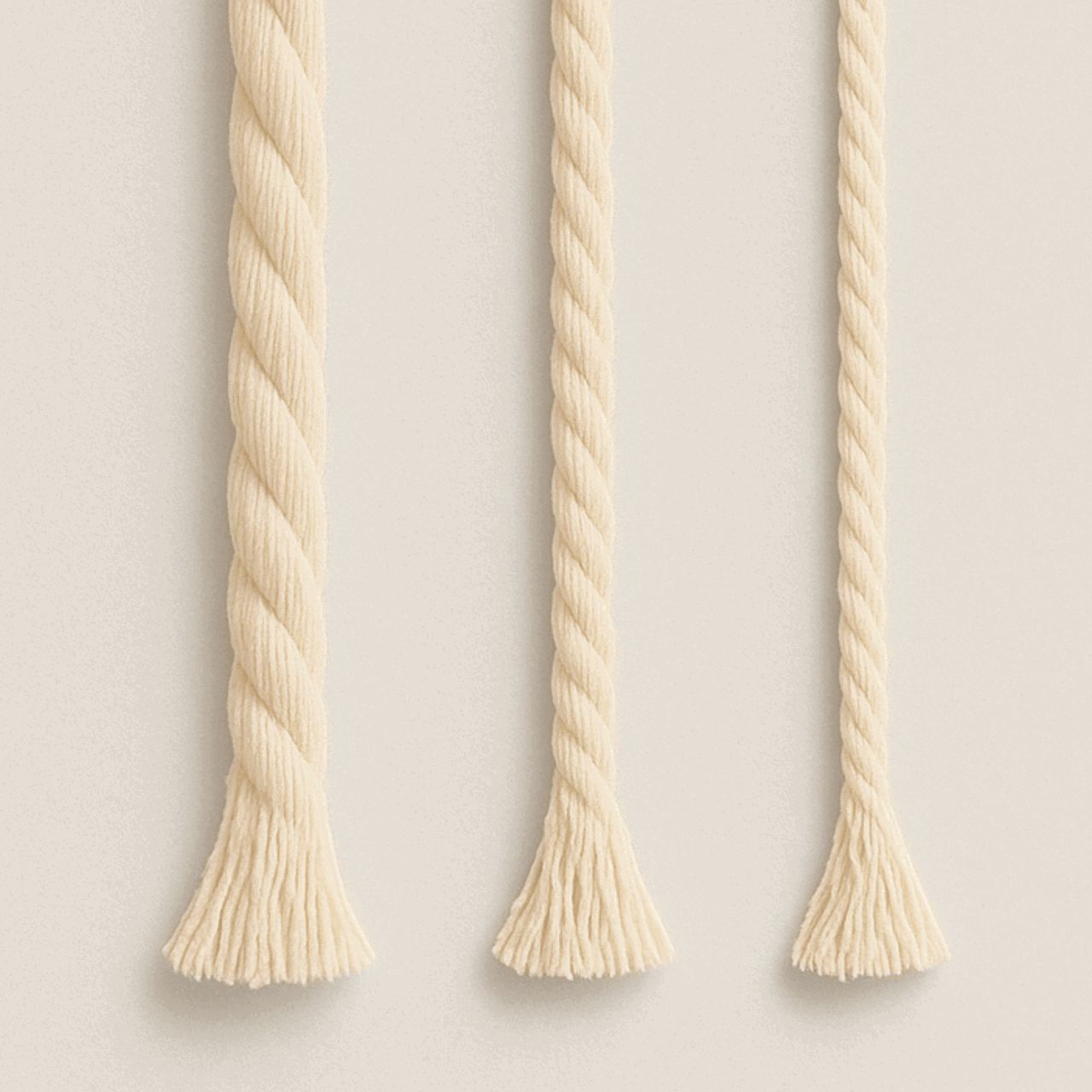
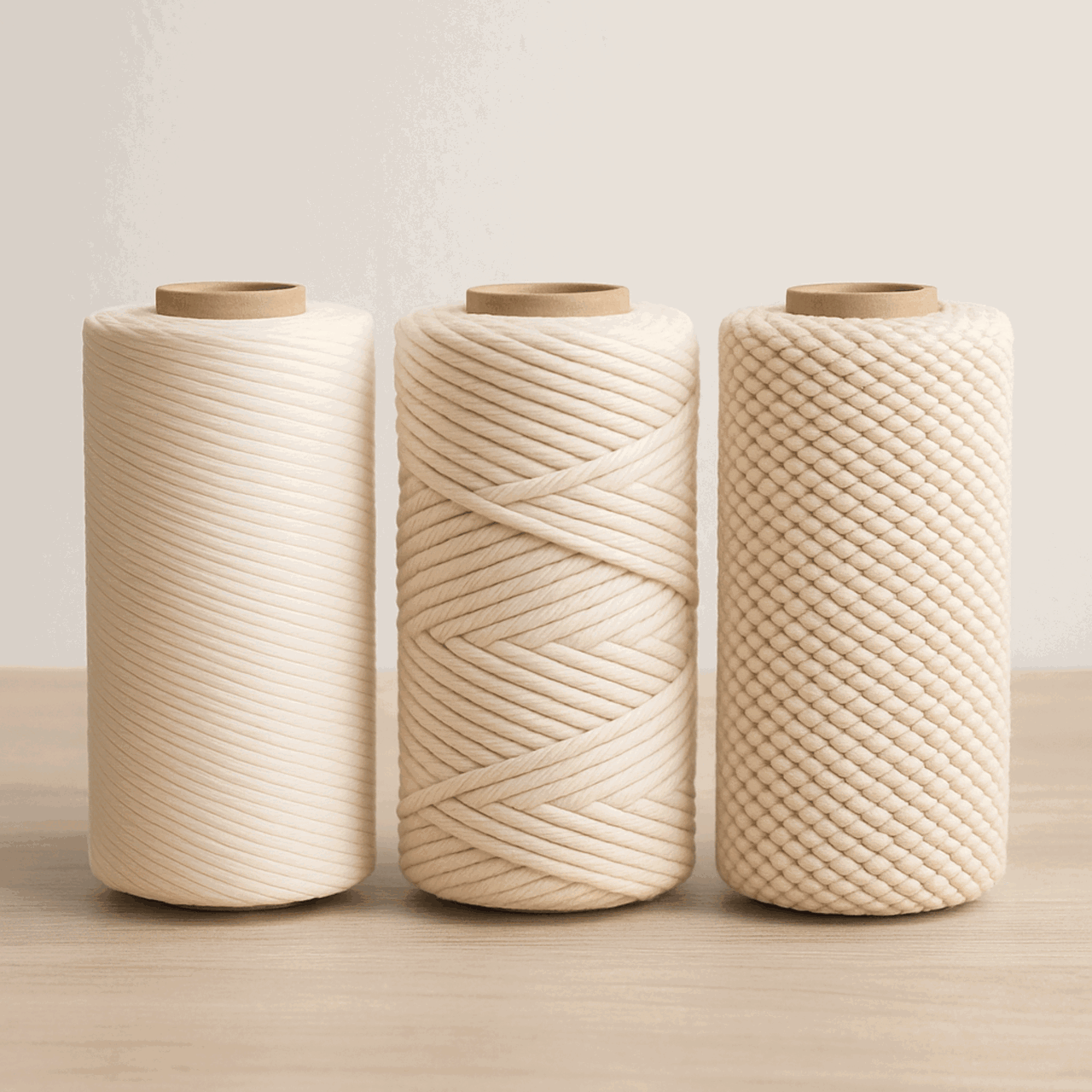
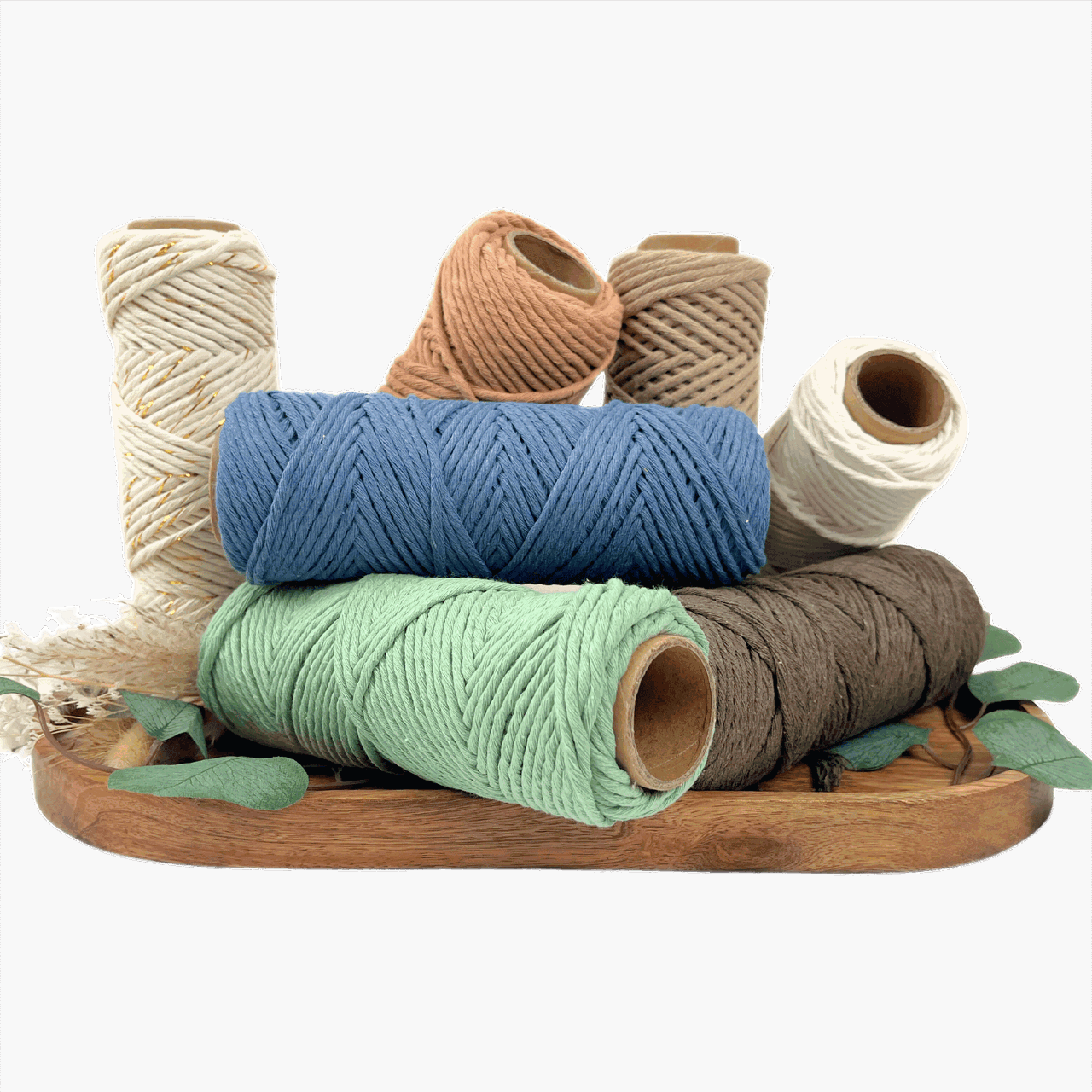
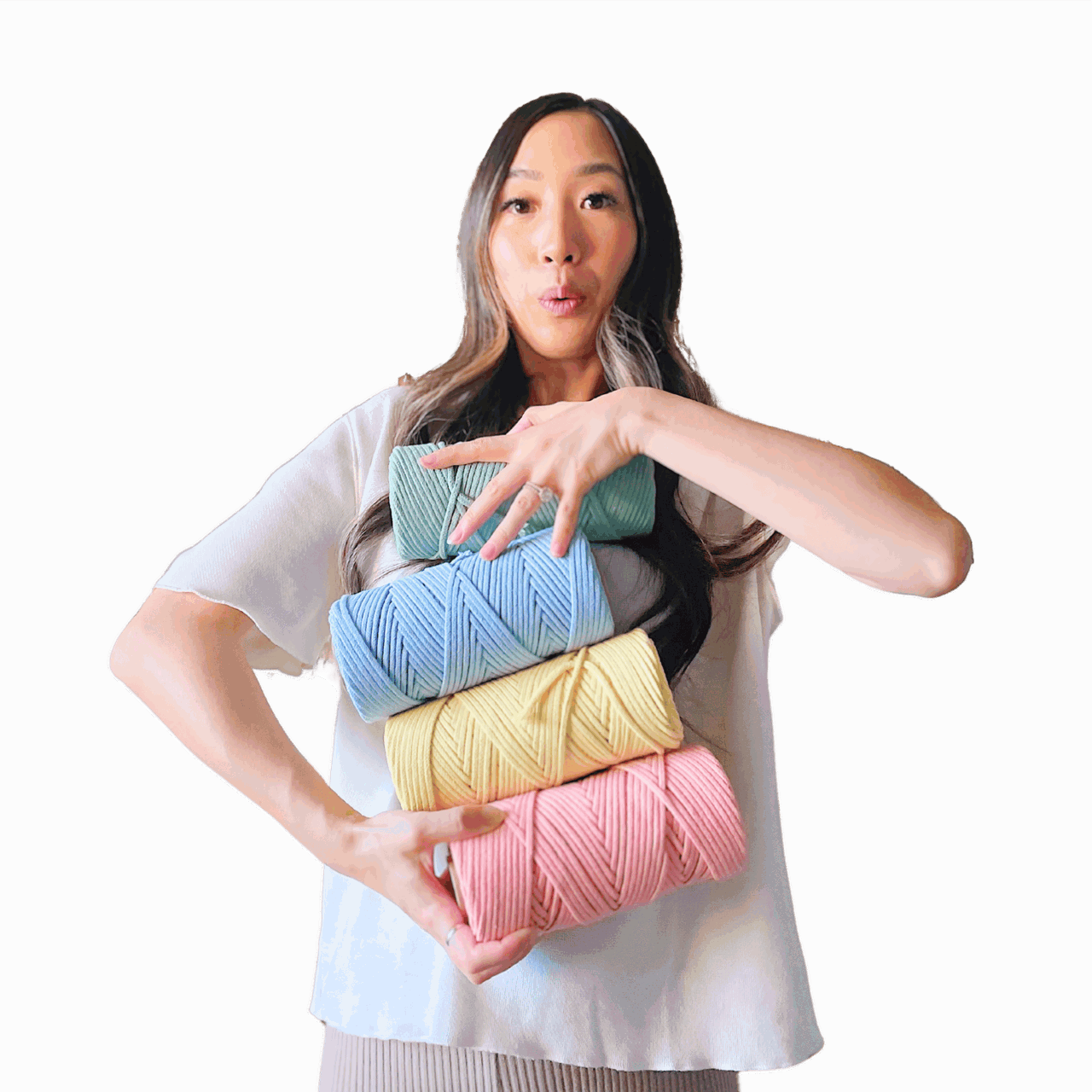
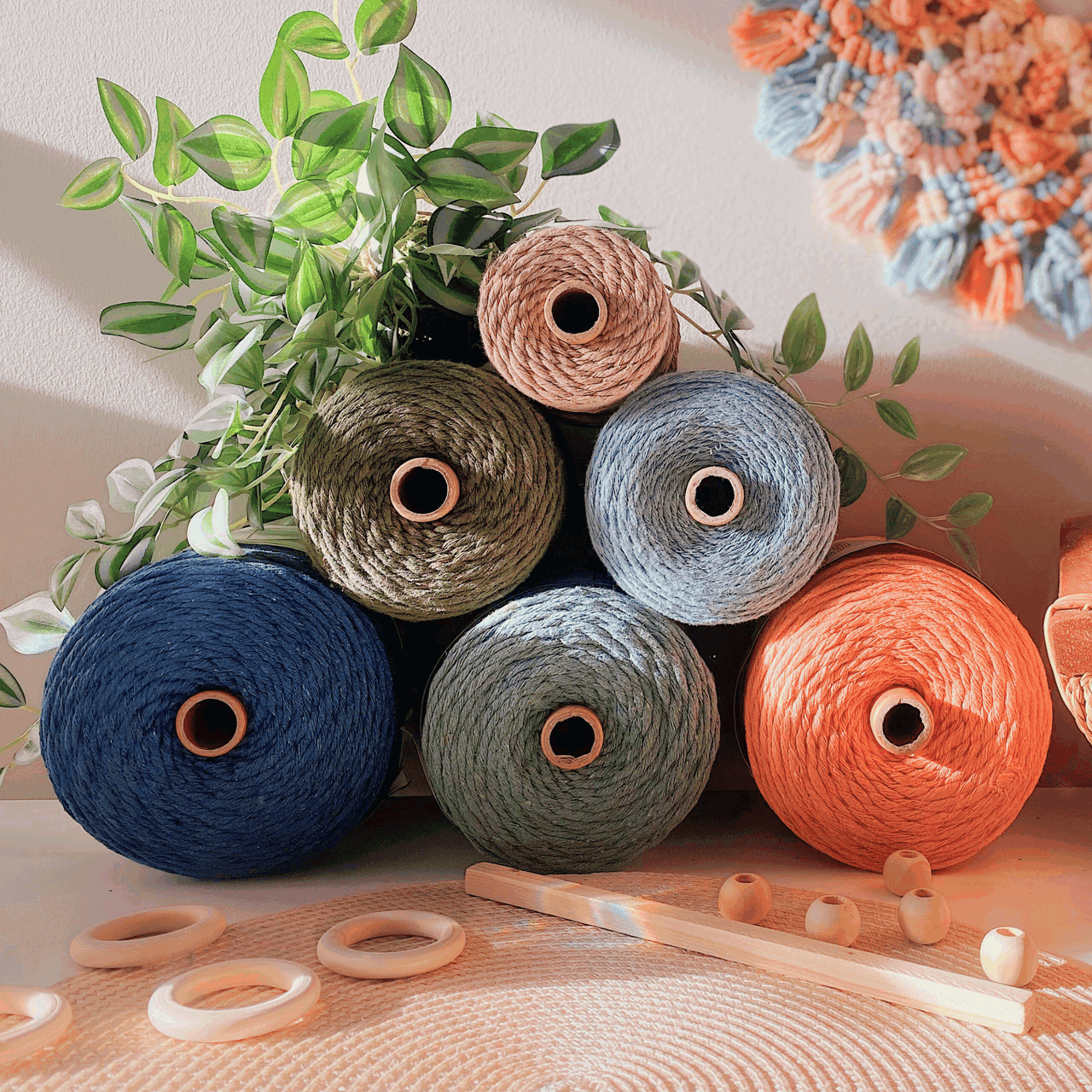
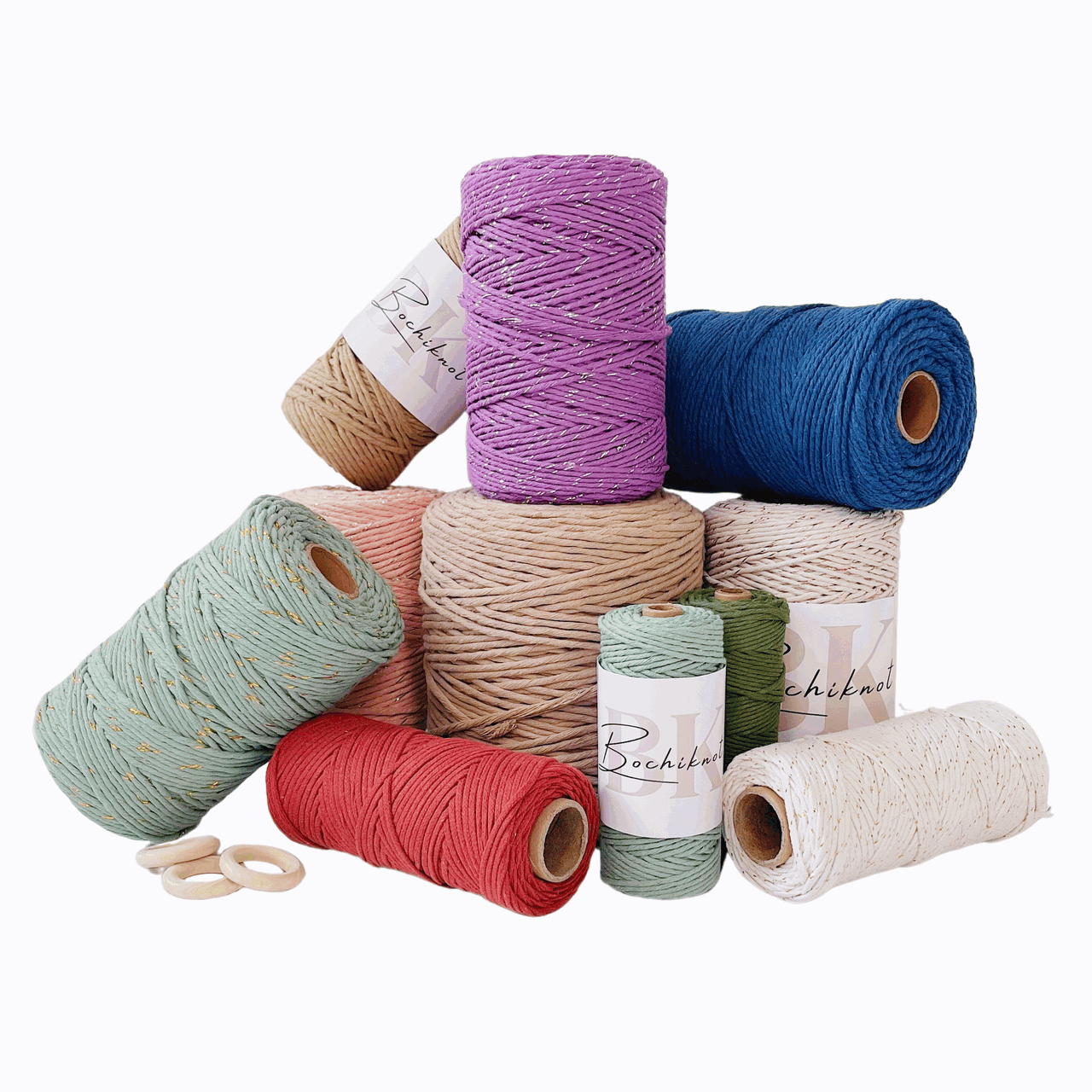
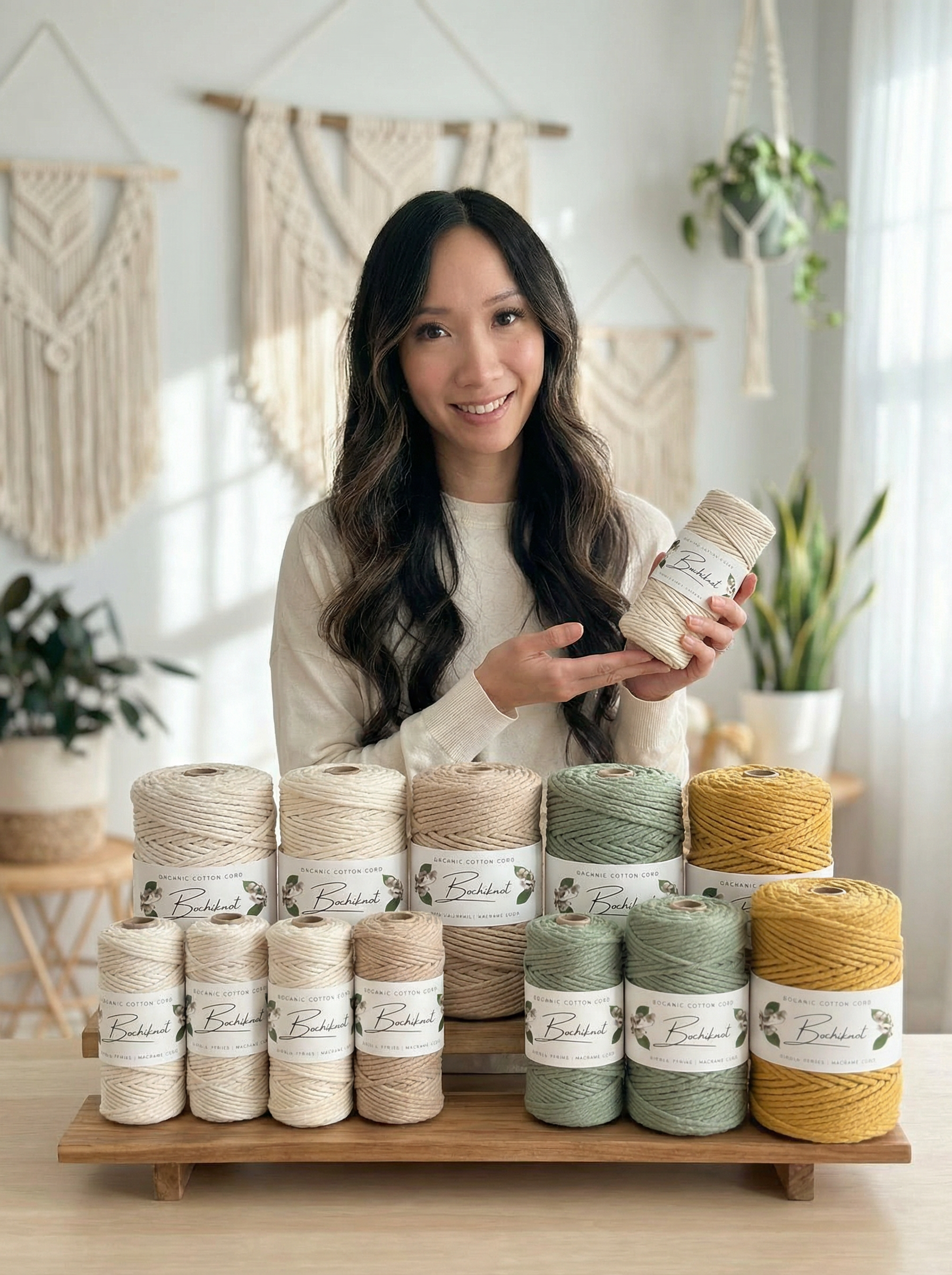
3 mm or 4 mm Braided Macramé Cord
Hollow braided structure holds shape beautifully — 3 mm makes a delicate coaster; 4 mm makes a chunkier version
Shop 3 mm cord4 mm Braided Macramé Cord (Chunkier Version)
Same hollow braided structure in 4 mm — chunkier finished look, same cut lengths
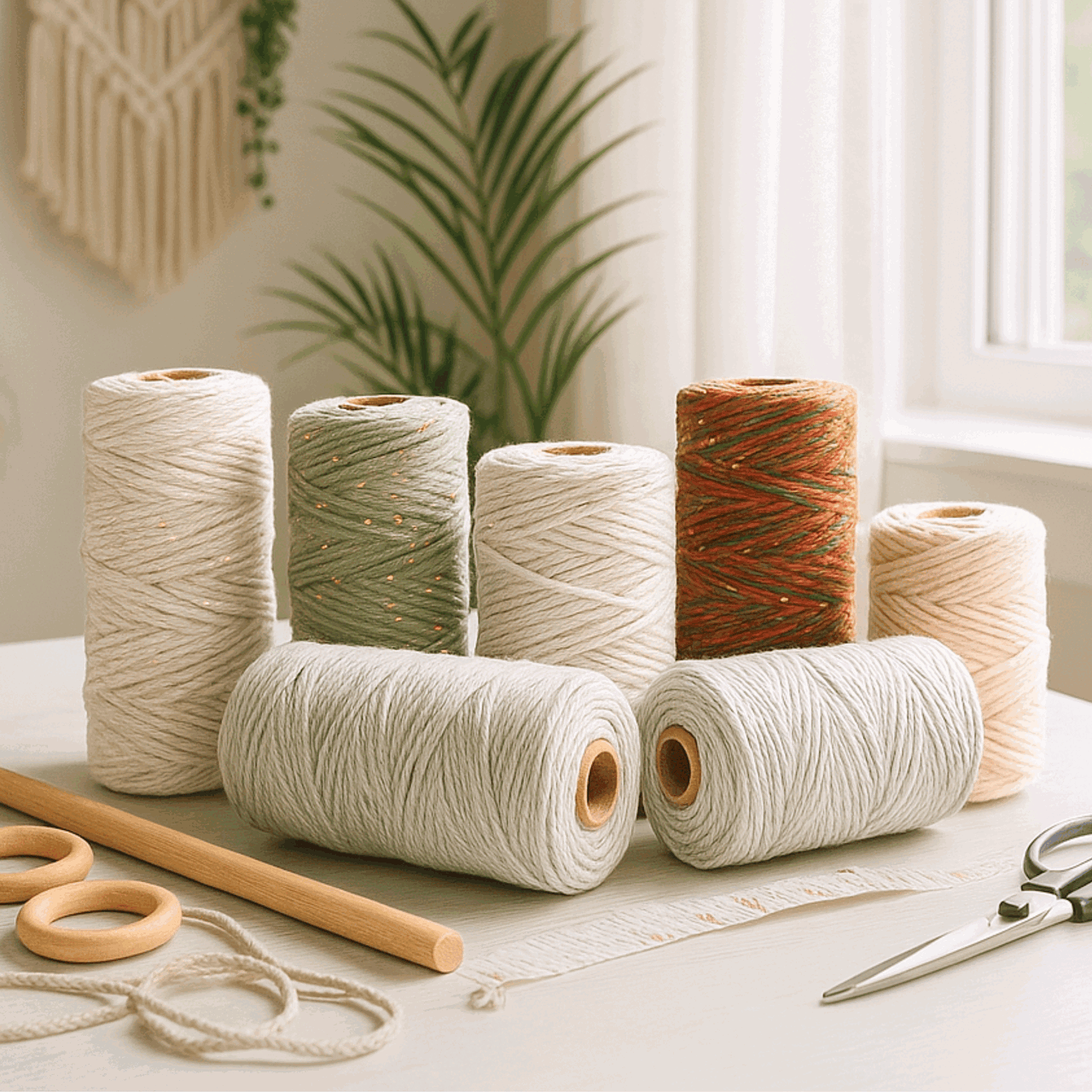
Shop 4 mm cordContrast Color Cord (Inner Ears)
2 small pieces × 25 cm — used for the contrast inner-ear detail
Shop colorsEssential Macramé Tools

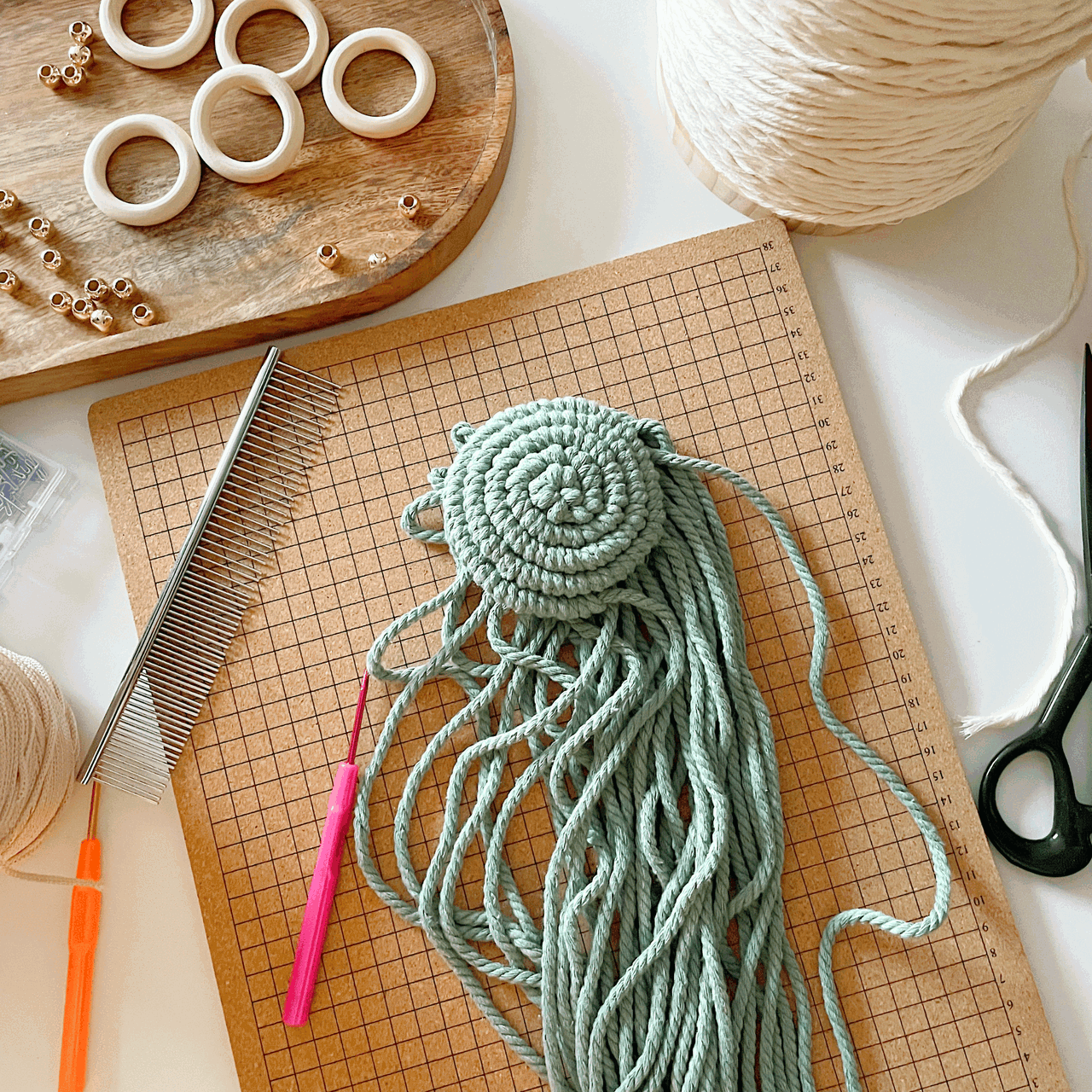
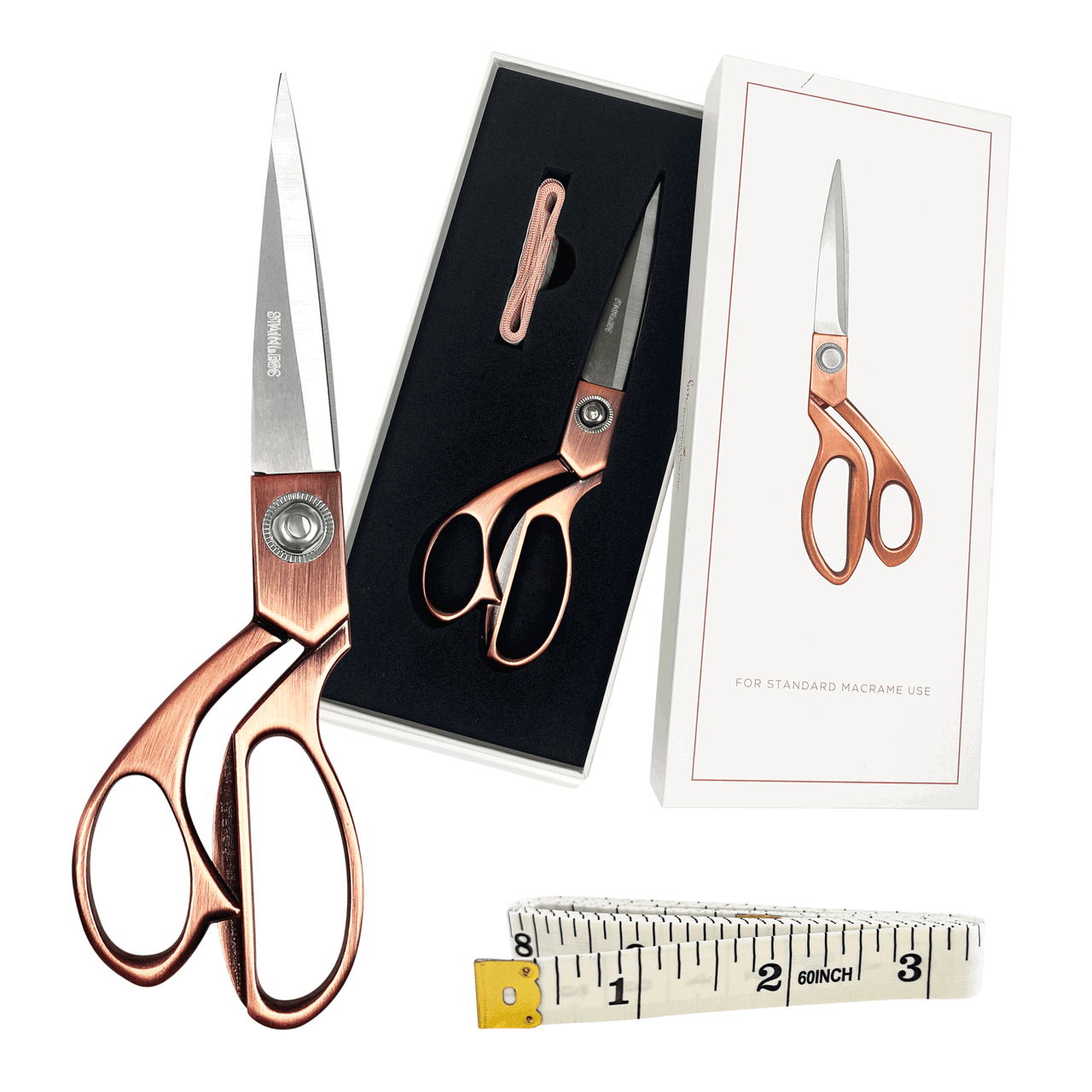
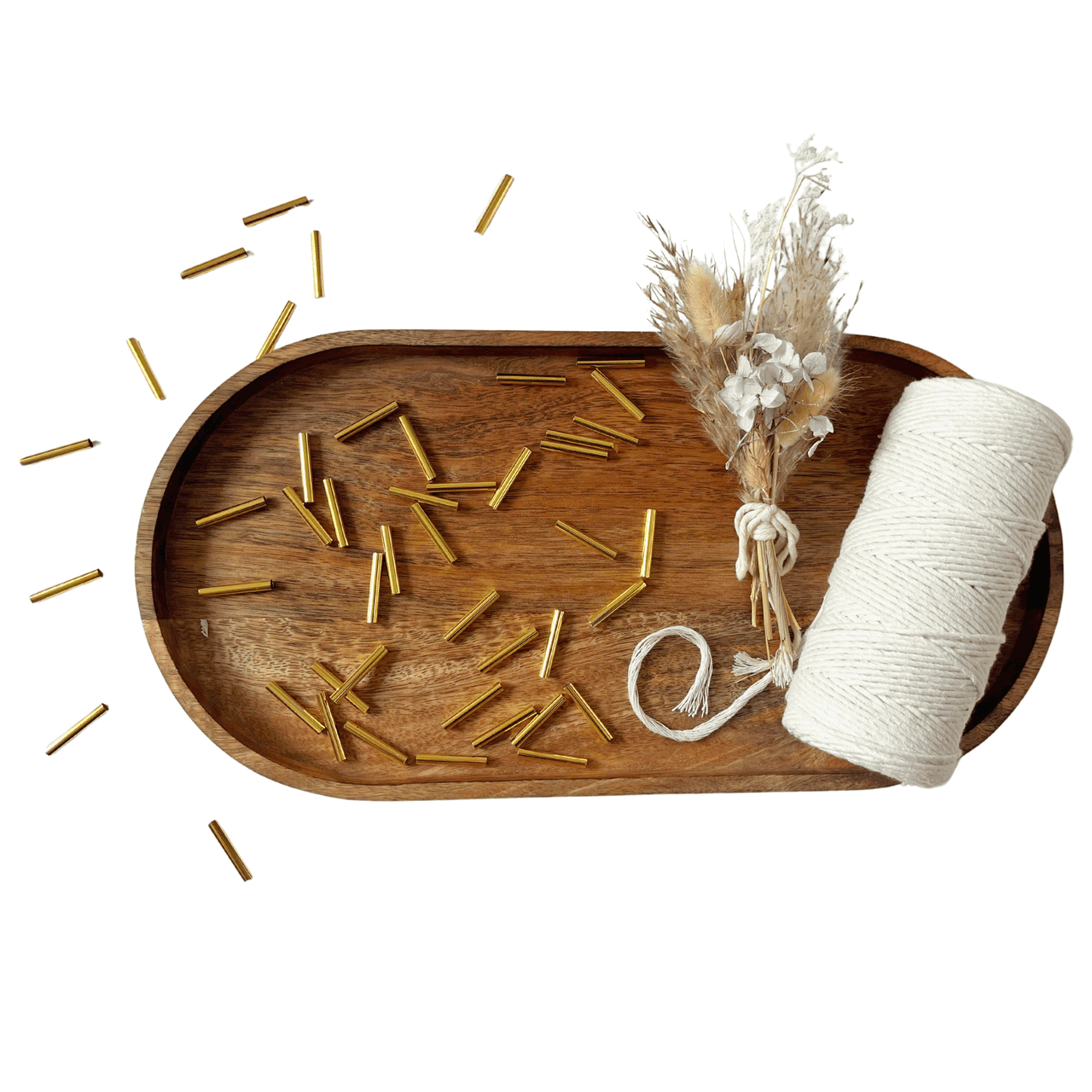
- Gold precision scissors — for clean cord ends and trimming closing-edge tails
- Macramé measuring tape — for cutting accurate cord lengths
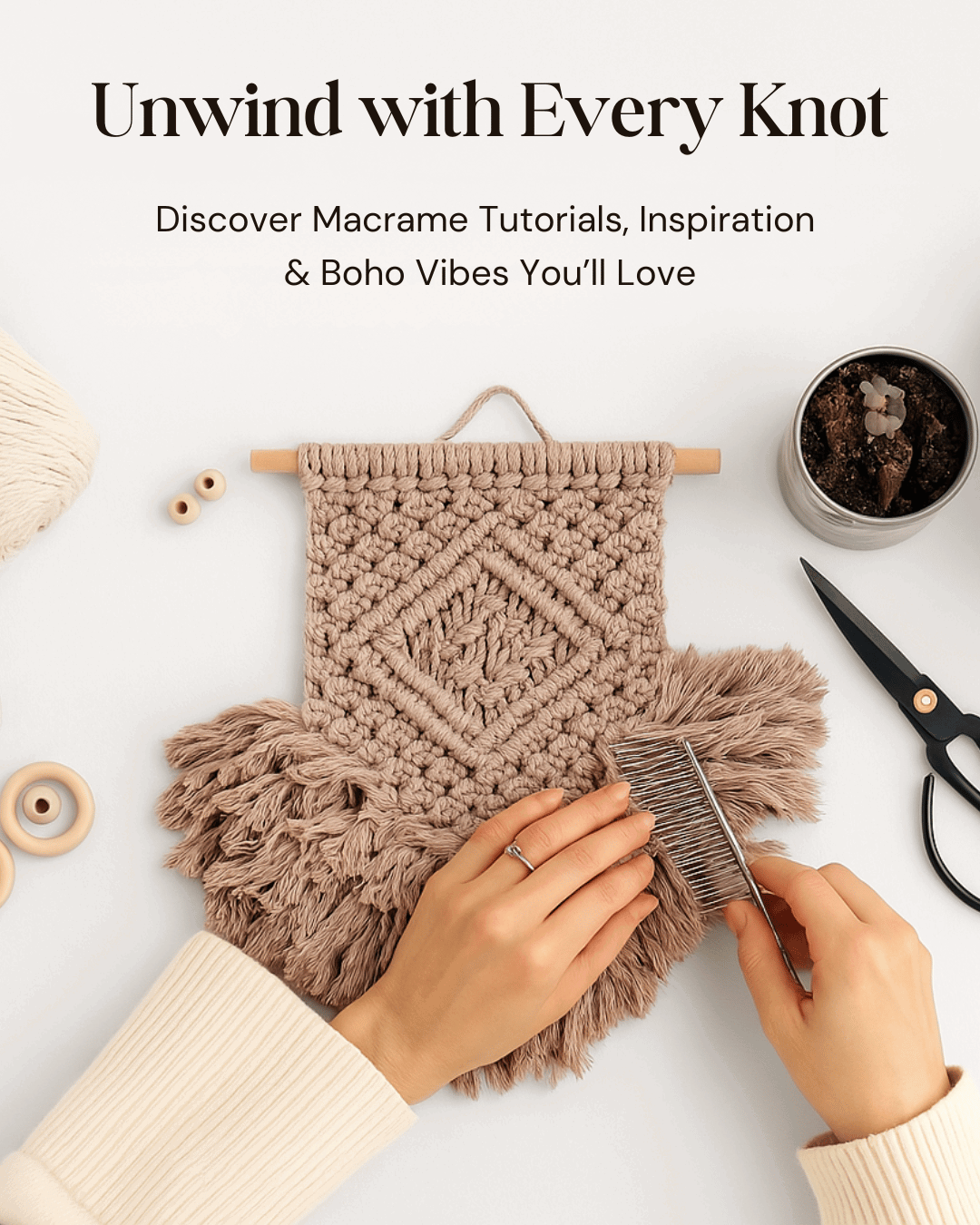
- Metal comb — for tidying any frizz at the closing edge
- Optional: small crochet hook or weaving needle — essential for tucking cord ends into the back in Step 8
Cord Lengths to Cut
| Cord set | Quantity | Length (cm) | Length (inches) | Purpose |
|---|---|---|---|---|
| Color 1 (main) | 1 cord | 150 cm | 59" | Anchor cord — forms the center loop |
| Color 1 (main) | 5 cords | 90 cm | 35" | First round attachment cords |
| Color 1 (main) | 4 cords | 70 cm | 28" | Second-round expansion cords |
| Color 1 (main) | 5 cords | 50 cm | 20" | Third-round expansion cords |
| Color 1 (main) | 8 cords | 30 cm | 12" | Edge fill and ear cords |
| Color 2 (contrast) | 2 cords | 25 cm | 10" | Inner ear contrast detail (one per ear) |
How to Make a Macramé Bear Coaster (Step-by-Step)
Follow the 8 steps below. Each has a photo and clear bullet instructions. If you get stuck on any step, the video at the top of the page walks through every step in real time.
Step 1: Build the Center Loop and First Round
- Start by forming a small loop with the 150 cm cord, leaving about a 1-inch tail. Attach five 90 cm cords onto the loop using reverse lark's head knots, then pull the long end of the original cord to tighten the loop into a neat circle. Retighten the attached knots so the center looks snug and rounded.
- Use the long anchor cord to make a full round of double half hitch knots around the circle. As you go, gently pull the anchor cord every few knots to help shift the cords closer together and keep the shape even.
- Focus on keeping the knots snug rather than overly tight. Pulling too aggressively will cause the coaster to curve instead of lying flat.


Step 2: Expand the Circle Without Creating Warp
- This is the key shaping step. If you continue the next round without adding cords, the coaster will begin to curve upward instead of staying flat.
- Add 4 cords at 70 cm using reverse lark's head knots, spacing them between sections of double half hitch knots where gaps naturally appear.
- One simple sequence is: add 1 cord, make 3 knots, add 1 cord, make 2 knots, add 1 cord, make 2 knots, add 1 cord, then finish with 3 knots. Adjust the spacing slightly if needed based on your tension.

Step 3: Alternate Between Full Rows and Added-Cord Rows
- After adding the 70 cm cords, make one full row of double half hitch knots without adding any new cords.
- For the next expansion round, add 5 cords at 50 cm between sections of 3 or 4 knots. A simple pattern is: add 1 cord and make 3 knots twice, then add 1 cord and make 4 knots three times.
- Finish with one more full row without cord additions. By this stage, the coaster should have five rows total and lie fairly flat. Alternating between expansion rows and regular rows helps prevent curling.

Step 4: Separate the Ear Cords
- Before finishing the edge, separate the cords that will become the bear ears.
- Position the coaster so the end of the working row is on the right side. You should see 2 cords in the center, 4 longer cords on each side for the ears, and 2 cords between the ear sections.
- Tie the two ear groups into temporary overhand knots so they stay separate and do not get trimmed during the closing row.


Step 5: Create the Clean No-Fringe Edge
- This finishing step creates the clean edge around the coaster instead of leaving loose fringe exposed.
- Make the first double half hitch knot normally. For the next knot, fold the previous working cord into the anchor group, tighten the knot, then trim the newly added short anchor tail.
- Repeat this process across the side until you reach the first ear.


Step 6: Shape the Bottom, Ears, and Right Side Closure
- At the ear sections, switch from the closing-edge method back to regular double half hitch knots. Untie the ear bundle and make 3 knots across the 4 ear cords.
- Between the ears, return to the clean-edge closing method on the 2 center cords, trimming the short anchor tails as before.
- Repeat for the second ear, then continue closing the right side. Leave the final anchor ends untrimmed so they can be woven into the back later.


Step 7: Make the Bear Ears With the Contrast Color
- To form the inner ear detail, cross the middle two cords of one ear section over each other.
- Take a 25 cm contrast cord and attach it over the crossed cords using a reverse lark's head plus half hitch knot.
- This creates the small contrasting inner ear shape that gives the coaster its bear look.


Step 8: Tuck in the Ends at the Back
- Use a crochet hook or weaving needle to tuck the remaining loose ends through knot loops on the back of the coaster.
- Avoid weaving into the outer edge loops, since those knots were trimmed during the clean-edge finish and can loosen if disturbed. Start weaving from about the second row inward instead.
- Some ear loops may need to hold two cords, which is completely fine. Once all ends are secure, trim away the excess cord.


How Long Does a Macramé Bear Coaster Take to Make?
A macramé bear coaster takes 1 to 2 hours from start to finish. First attempts usually take closer to 2 hours; with practice you can complete one in about 1 hour. The slowest sections are the expansion rows (where you're adding cords mid-knotting) and the closing-edge finish around the ears.
| Phase | Time (first try) | Time (with practice) |
|---|---|---|
| Phase 1 — Center + first 3 rounds (Steps 1–3) | ~45 min | ~25 min |
| Phase 2 — Separate ear cords (Step 4) | ~5 min | ~3 min |
| Phase 3 — Closing edge (Steps 5–6) | ~40 min | ~20 min |
| Phase 4 — Inner ears + back weaving (Steps 7–8) | ~20 min | ~10 min |
| Total time | ~110 min (1 h 50 min) | ~58 min |
How Much Does a Macramé Bear Coaster Cost to Make?
Total materials cost is approximately $2 to $4 USD per coaster. Buying cord in bulk significantly lowers the per-coaster cost — a single 100 m spool of 3 mm cord makes roughly 20 bear coasters.
| Material | Used per coaster | Bulk pack price | Cost per coaster |
|---|---|---|---|
| 3 mm braided macramé cord (main color) | ~5 m | 100 m spool | ~$2.50 |
| 3 mm braided cord (contrast color, inner ears) | 50 cm | From scrap or any spool | ~$0.25 |
| Total materials per coaster | ~$2.75 |
Pro Tips for a Flat, Professional Coaster
- Don't over-tighten the knots. The #1 cause of a warped (curving up) coaster is pulling each double half hitch too tight. Aim for snug, not strained.
- Add cords on every other round. The pattern alternates "add cord" rows with "no add cord" rows. If you add too often, the coaster goes wavy. If you add too rarely, it curves.
- Press the coaster flat as you work. Every few knots, lay the coaster flat on the table and check that it's not starting to cone. If it is, your last row was too tight — loosen it slightly.
- Trim each closing-edge tail short. When you fold the previous working cord into the anchor group, trim the tail to about 0.5 cm. Leaving it too long causes bulges on the edge.
- Steam the finished coaster. A 5-second hover with a fabric steamer (don't touch the cord) relaxes any fraying and gives the finished coaster a polished, store-bought look.
- Iron under a damp cloth. For a truly flat finish, place a damp cloth over the coaster and iron on low for 10 seconds. Cotton cord responds beautifully to this trick.
Common Mistakes & How to Fix Them
| Mistake | What happens | How to fix it |
|---|---|---|
| Coaster curves up like a bowl | Knots too tight or not enough expansion cords added | Loosen tension on next row; add 1 more expansion cord than the pattern shows |
| Coaster goes wavy / ruffled | Too many cords added or expansion rows in a row | Stick to the alternation: 1 expansion row, 1 plain row, 1 expansion row, 1 plain row |
| Center loop won't tighten neatly | You released the anchor cord too early | Pull the long end of the original 150 cm cord firmly after attaching all 5 reverse lark's heads |
| Ears are uneven sizes | You separated different numbers of cords on each side in Step 4 | Count carefully — exactly 4 cords per ear, 2 cords between them, 2 cords on each outside |
| Closing edge looks lumpy | Closing-edge tails not trimmed short enough | Trim each tail to 0.5 cm — almost flush with the knot |
| Inner ear contrast cord falls off | Reverse lark's head + half hitch not tied tightly | Pull both ends of the contrast cord firmly after tying; trim ends short and tuck |
| Back of coaster looks messy | Cord ends not woven through enough back loops | Weave each end through at least 3 different loops on the back; avoid the outer edge loops |
Macramé Bear Coaster Variations & Color Ideas

Once you've made one bear coaster, the design is endlessly customizable:
Classic Brown Bear
Brown 3 mm cord with a cream contrast inner ear — the most "bear-like" version
Polar Bear
Pure white cord with pale gray inner ears for a winter / Christmas variant
Panda Bear
White body with black inner ears — instant panda; great for nursery decor
Pink Teddy Bear
Soft pink body with cream inner ears — perfect for baby shower gift sets
Cat Coaster
Same construction; just shape the ears more pointed and skip the round-belly finish
Plain Round Coaster (No Ears)
Skip Step 4 entirely and close the full circle for a classic round coaster
Ways to Use Your Finished Bear Coaster
- Drink coaster — the original design, perfect for mugs, glasses, and wine glasses
- Plant pot saucer — small succulents and air plants sit nicely on a bear coaster
- Trinket dish — for jewelry, keys, or small everyday items
- Wall art — sew a small loop on the back and hang for nursery or kid's room decor
- Gift set — make 4 in matching colors and gift as a coaster set
- Baby shower favors — small, cute, handmade — perfect for guests
- Christmas ornaments — add a loop and hang on the tree
- Craft fair product — sells for $8 to $15 each in person; $12 to $25 as a 4-pack on Etsy
Macramé Bear Coaster FAQ
What size is the finished macramé bear coaster?
The finished coaster is approximately 4 inches wide and 5 inches long (including the ears). The body portion alone is about 4 inches in diameter, sized to fit standard drinkware.
What type of cord works best for this project?
4 mm braided macramé cord is the original pattern's cord, and 3 mm braided cord works with the same cut lengths if you want a finer finish. For a chunkier finished look, use 4 mm cord. For a finer, more detailed coaster, use 3 mm.
Why does a round macramé coaster start to warp?
Warping usually happens when the circle is not expanded enough as it grows, or when the knots are pulled too tightly. This pattern prevents that by alternating rows with added cords and rows without added cords, and by maintaining snug-but-not-strained tension throughout.
How do you finish a macramé bear coaster without fringe?
The outer edge is finished with a closing-row double half hitch technique. Each working cord is folded into the anchor group for the next knot, then the newly added short anchor end is trimmed. This creates a clean, structured edge instead of loose fringe.
Do the ears need to lay perfectly flat?
No. The coaster body should lay flat for use, but it's fine if the ears stick up slightly or angle outward. That actually adds to the bear shape and gives the coaster character.
What tool should I use to tuck in the ends?
A crochet hook or weaving needle both work well for pulling the cord ends through the loops on the back of the coaster. The crochet hook is faster; the weaving needle is gentler on the cord.
How long does it take to make a macramé bear coaster?
Beginners should expect 1 to 2 hours from start to finish for their first coaster. With practice, you can complete one in about 1 hour. The slowest sections are the expansion rows and the closing-edge finish.
How much does a macramé bear coaster cost to make?
Total materials cost is approximately $2 to $4 USD per coaster — about $2.50 for the main cord and $0.25 for the contrast color. A 100 m spool of 3 mm cord makes roughly 20 coasters.
Can I sell macramé bear coasters I make from this tutorial?
Yes. The finished coasters you make are yours to sell. You may not copy or republish the tutorial itself, but products you make from your knowledge are completely yours. Bear coasters typically sell for $8 to $15 each in person at craft fairs and $12 to $25 as a 4-pack set on Etsy.
What knot do I need to know before making this coaster?
The only required knot is the double half hitch knot (also called the clove hitch). You'll also use the reverse lark's head knot for attaching cords. Both are foundational beginner knots covered in our basic knot pillar series.
Can I make a macramé coaster without the bear ears?
Yes. Skip Step 4 (separating the ear cords) and continue the closing-edge finish around the full circle. The result is a clean round coaster — same construction, no ears. Many makers use this simpler version as a baseline before attempting the bear variation.
What's the easiest macramé coaster pattern for beginners?
A plain round coaster (no ears, no contrast color) is the easiest beginner coaster — just expanding rounds of double half hitch knots with a clean closing edge. The bear coaster in this tutorial is one step up because of the ear separation and contrast color details. If you're brand new to macramé, master the double half hitch tutorial first.

Your Next Macramé Project

Master the Double Half Hitch
Deepen the foundation knot that builds the entire coaster
Learn the knot

Keep Learning with Bochiknot
Patreon Membership
Exclusive patterns, video tutorials, and a private macramé community
Join PatreonAbout Nicole Woo
Nicole is the founder of Bochiknot Macramé and has been teaching macramé for over 5 years. She's helped thousands of beginners take their first knot through her tutorials, YouTube channel, Patreon community, and best-selling DIY patterns on Etsy. When she's not knotting, she's photographing every step so you don't have to guess.

Leave a comment