




How to Tie a Gathering Knot in Macramé (Step-by-Step)

Basic Knot Tutorial · Updated May 23, 2026 · 14 min read · Phase 1
The gathering knot — also called the wrap knot — is how almost every macramé project ends. It's the finishing knot that binds a bundle of cords together at the top of a plant hanger, the bottom of a tassel, the base of a keychain, or anywhere else you need to neatly close off a section of cord.

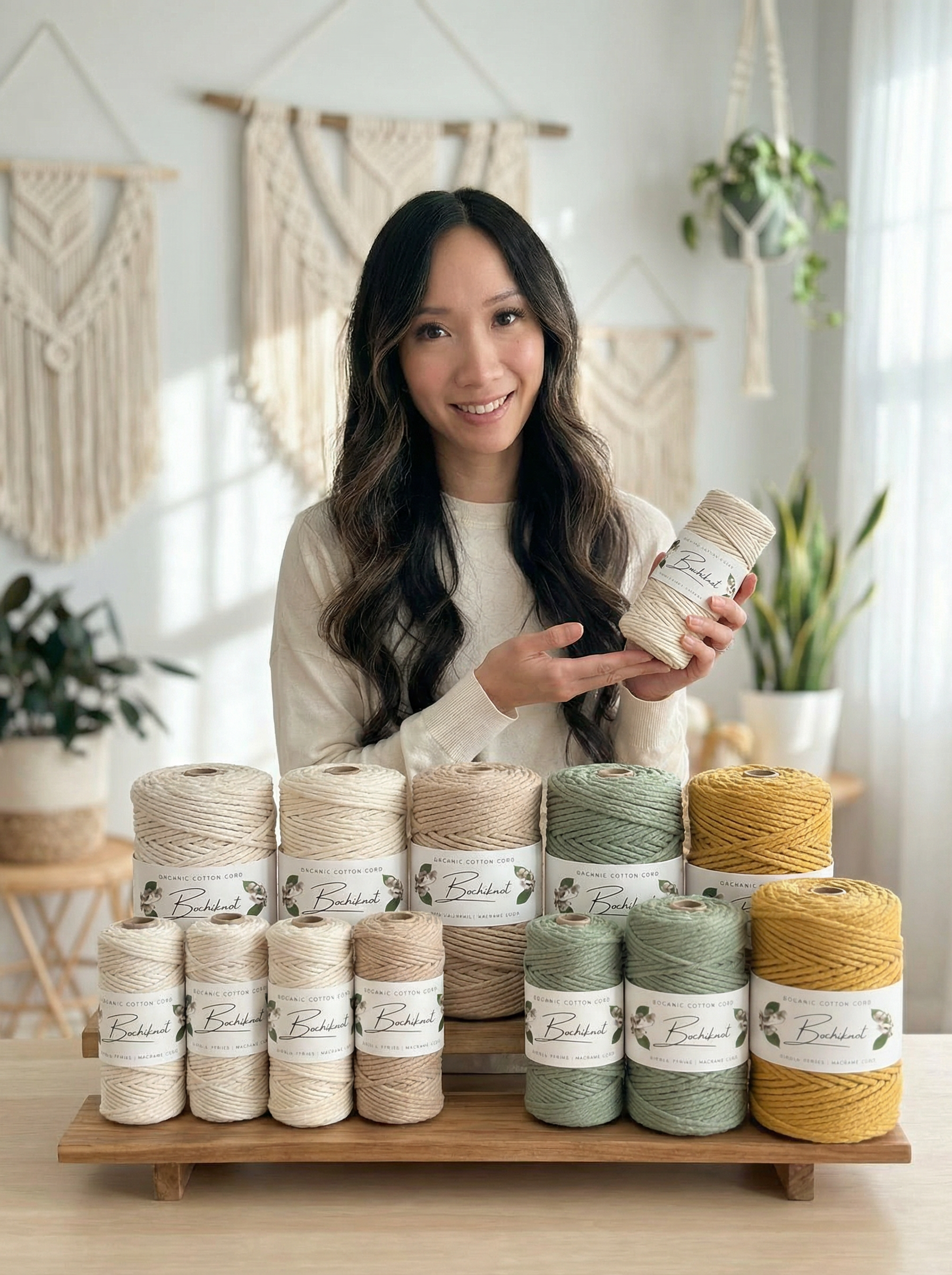
Written by Nicole Woo
Founder of Bochiknot · Teaching macramé since 2018
This is the fourth and final basic knot I teach in beginner classes — and it's the one that takes a piece from "I made this" to "this looks finished." Before learning the gathering knot, my students' plant hangers end with messy clumps of cord at the top. After learning it, they end with that clean, polished, cylindrical wrap you see on every store-bought hanger.
Below is the complete walkthrough: what the gathering knot is, why it's also called the wrap knot, the cord setup, the 6-step technique (with diagram), all the places you'll use it, common mistakes I see in classes, troubleshooting, and a 12-question FAQ.
In this tutorial:
- What is the gathering knot?
- Also known as: wrap knot, binding knot, whipping knot
- When and where to use it
- Anatomy: the working cord and the bundle
- What you'll need
- How to tie a gathering knot (step-by-step)
- Variations: contrasting cord, beads, multi-wrap
- How many wraps should it have?
- Common mistakes
- Troubleshooting
- Projects that use the gathering knot
- FAQ
- Your next macramé knot
The gathering knot (also called a wrap knot, binding knot, or whipping knot) is a finishing knot used to bind a bundle of cords together with a series of tight wraps in macramé projects like plant hangers, tassels, and wall-hanging ends. It works by wrapping a separate working cord around the bundle and locking it through a hidden loop, and is considered beginner-friendly.
What Is the Gathering Knot?
The gathering knot is a finishing knot that binds a bundle of cords together using a separate working cord. The working cord wraps tightly around the bundle and locks in place using a hidden loop pulled up inside the wraps. The finished knot looks like a clean cylinder of wrapped cord — like a small rope sleeve.
It's the knot you use to:
- Finish the top of a plant hanger — where all the cords meet to form the hanging loop
- Bind the bottom of a tassel — holding the fringe together at the top of the tassel
- Clean up the base of a keychain — where the cord ends meet the key ring
- Close off any section of cord — anywhere in a piece where you need a clean transition
Unlike the other three basic knots (lark's head, square knot, double half hitch), the gathering knot doesn't decorate the body of a piece. It's purely a structural finishing knot — the period at the end of the sentence.
Also Known As: Wrap Knot, Binding Knot, Whipping Knot
The gathering knot has a few different names depending on what you're reading. They all refer to the same technique.
| Name | Used by | Notes |
|---|---|---|
| Gathering knot | Modern macramé makers | The most common name in 2026 craft tutorials |
| Wrap knot | Macramé makers (interchangeably) | Used as often as "gathering knot" — same knot |
| Binding knot | Older craft texts | Generic term for any knot that binds a bundle |
| Whipping knot | Sailors, climbers, paracord makers | The traditional functional name; same technique |
For the rest of this tutorial I'll use "gathering knot" since that's the most common modern macramé name — but everything I show you applies identically if you're following a sailing or scout knot guide that calls it whipping.
When and Where to Use the Gathering Knot
The gathering knot shows up at the end of more macramé projects than any other knot. Here's where you'll see it:
| Project type | Where the gathering knot goes | Wraps |
|---|---|---|
| Plant hangers | Top of the piece, just below the hanging loop | 8-12 |
| Tassels | Top of the tassel, binding the folded fringe | 6-8 |
| Keychains | Base, just below the key ring | 5-8 |
| Light pulls / handle pulls | Top and/or bottom of the pull | 6-10 |
| Feather wall hangings | The "spine" where the feather is bound | 6-8 |
| Macramé bags | Strap connections, decorative section transitions | 5-8 |
| Curtain tie-backs | Both ends to close off the cords | 6-10 |
| Dreamcatchers | Where the hanging cords meet the ring | 5-8 |
If your piece ends in a bundle of cord that needs to look finished, the gathering knot is what does it.
Anatomy: The Working Cord and the Bundle
The gathering knot uses a slightly different setup than the other basic knots. Two main components:
- The bundle: All the cords from your piece that you want to bind together. For a plant hanger, this is typically 8-16 cords. For a tassel, it's the folded fringe. For a keychain, it's just 2-4 cords.
- The working cord: A separate length of cord, typically 20-24 inches long, that you'll wrap around the bundle. This is the cord that does all the work.
The working cord is folded into a U-shape, laid along the bundle, then wrapped around both the bundle and the U-shape underneath. When the wrapping is done, you feed the end of the working cord through the bottom of the U-loop and pull the top tail upward — which pulls the loop and your wrapping cord end up through the wraps, locking everything in place.
What You'll Need
✅ The setup
- A bundle of cords to bind — could be the top of a plant hanger, a folded tassel, or any group of cord ends.
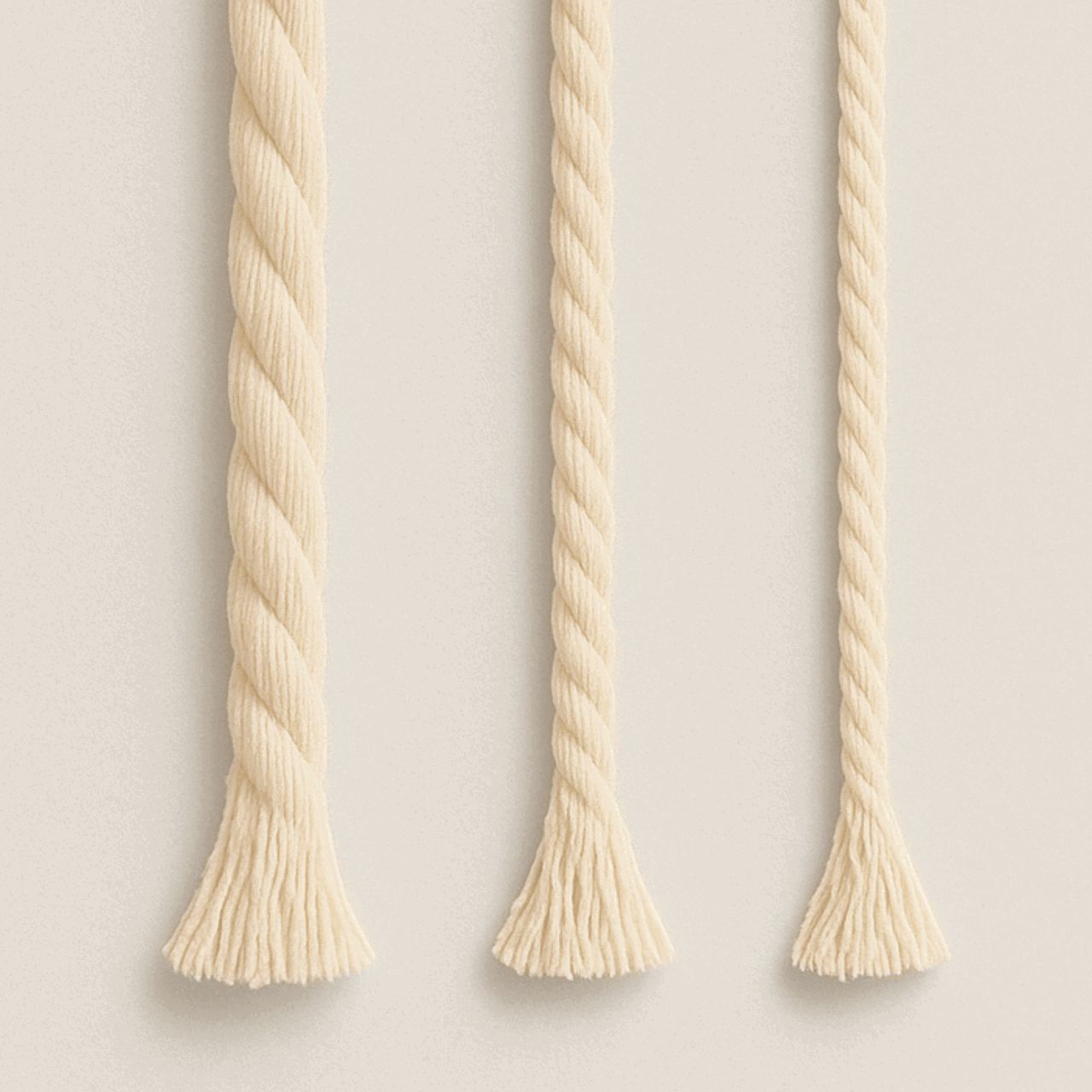
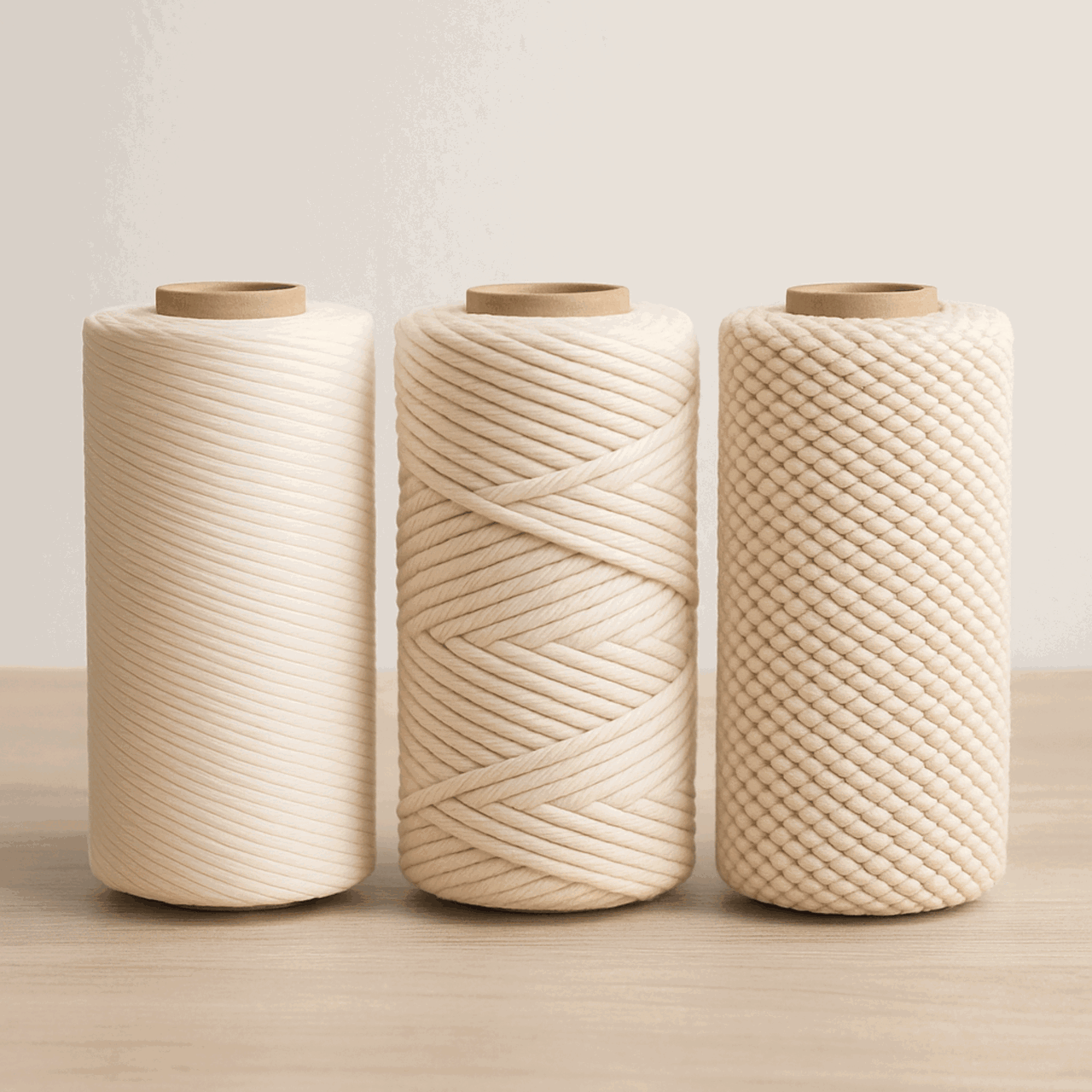
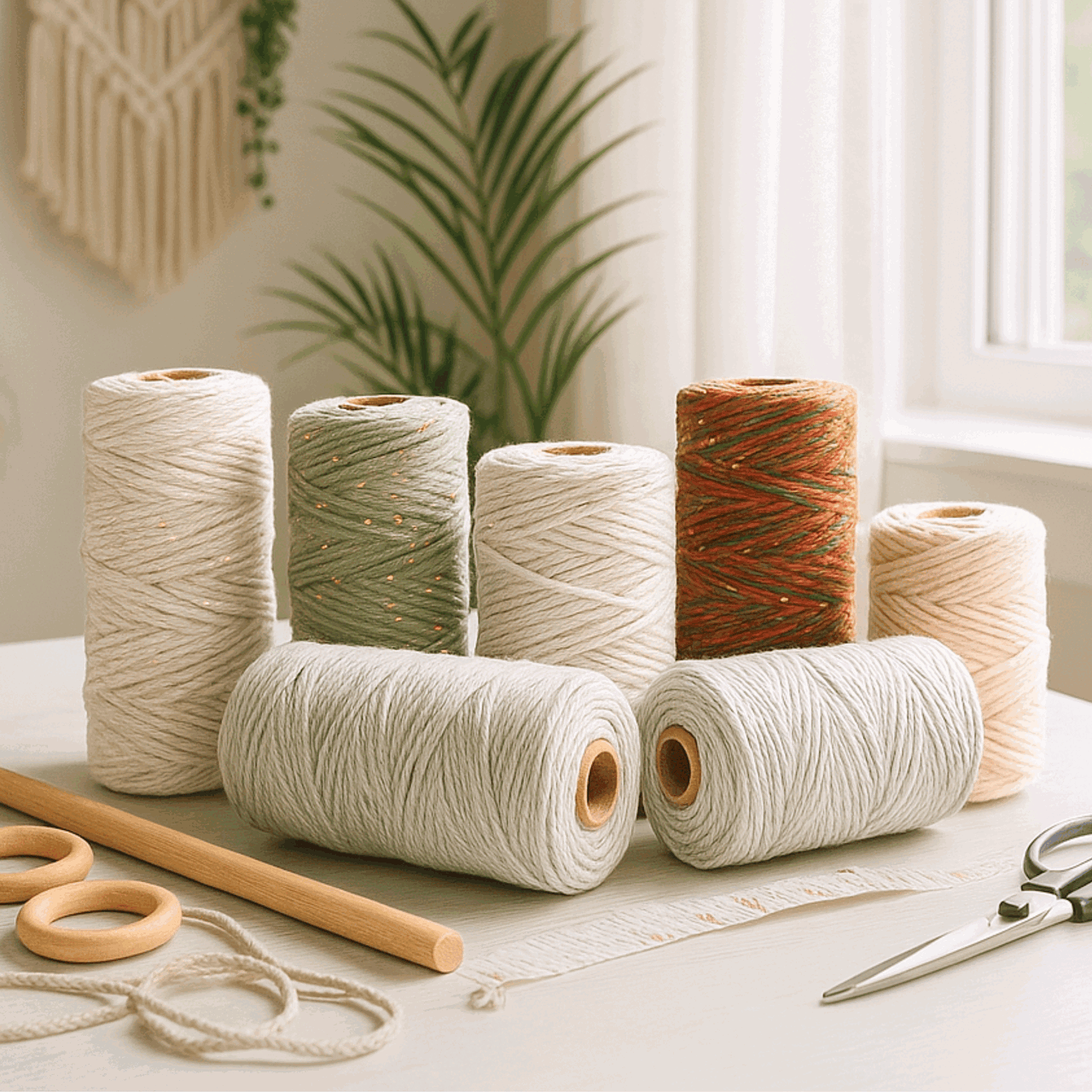
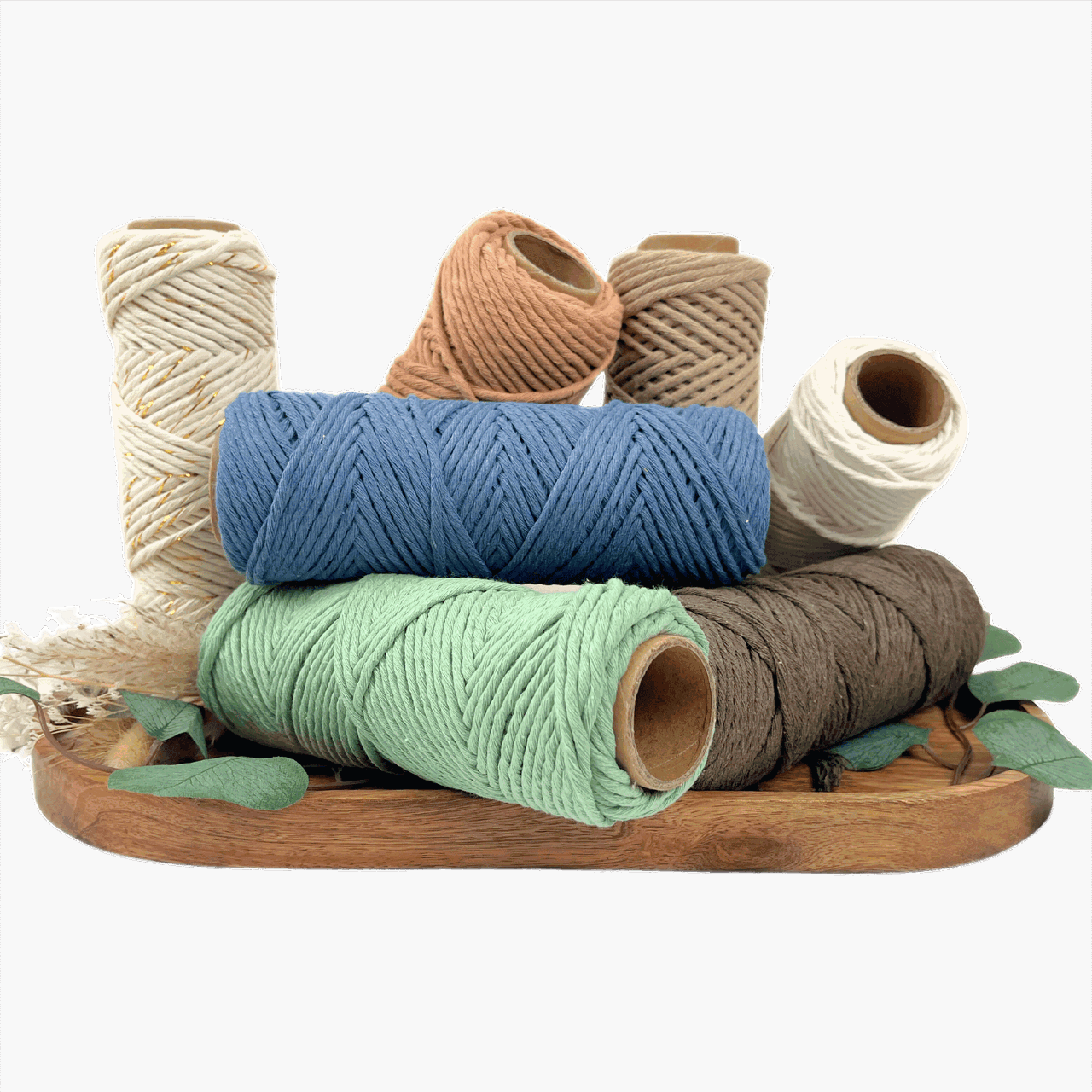
- One separate working cord — about 20-24 inches long, 3mm or 5mm cotton. Same cord as your piece works best. Shop single-strand cord →
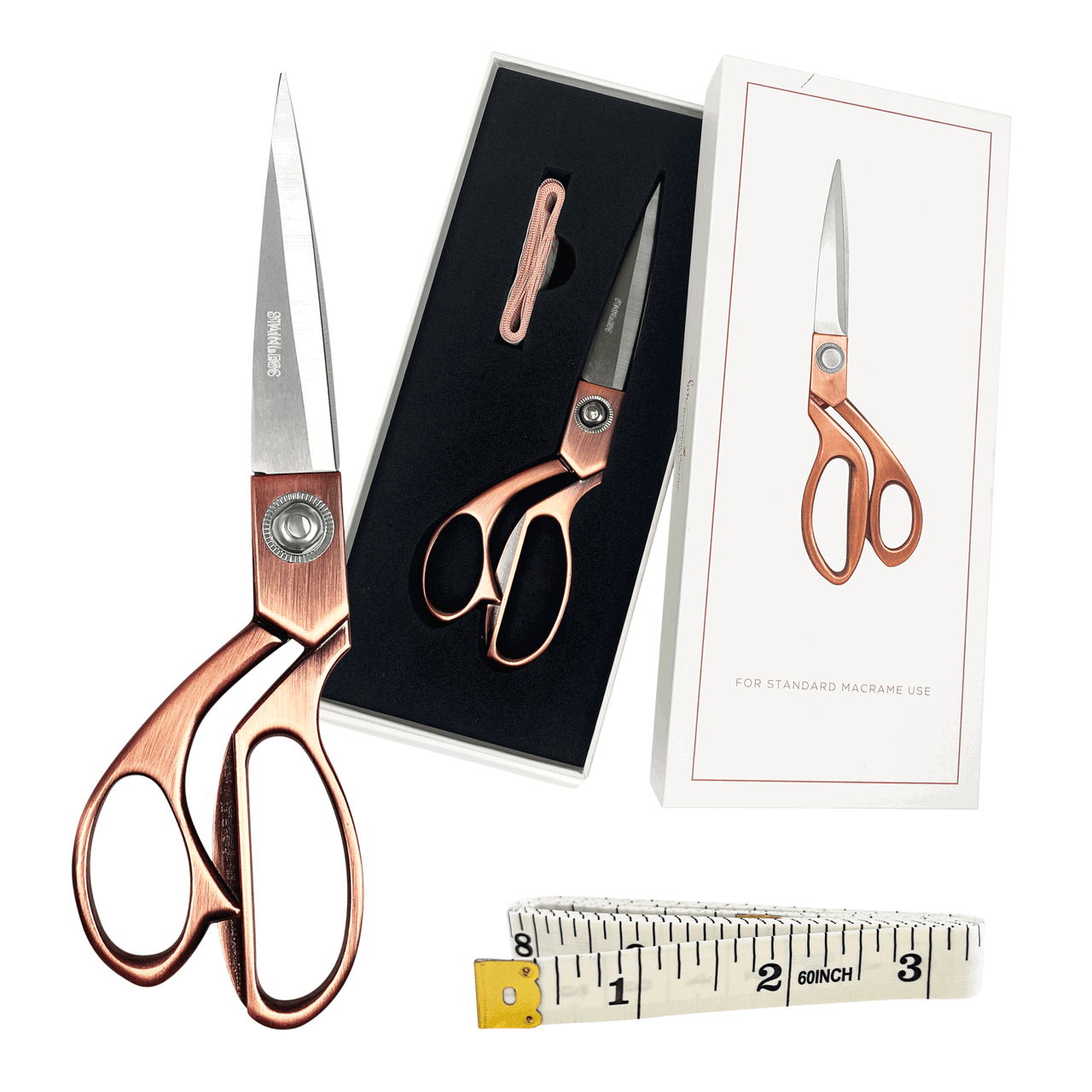
- Sharp scissors — for trimming the cord tails at the end. Shop scissors →
- A flat surface or hanging spot — wherever your project is already set up.
How to Tie a Gathering Knot (Step-by-Step)
This is the trickiest of the four basic knots to describe in writing, but the mechanic is simple. The walkthrough below covers the 6-step technique.

1Make a U-shaped loop with the working cord
Take your 20-24 inch working cord. Fold it into a long, narrow U-shape — like a hairpin. Lay the U along the side of your bundle so the closed end of the U (the bottom of the loop) hangs slightly past where you want the gathering knot to end. The two tails of the working cord should stick up past the top of the bundle.
2Wrap the working cord around the bundle
Take the longer of the two working cord tails. Starting at the top of where you want the knot, begin wrapping it tightly around the bundle (which includes the U-shape underneath). Wrap downward toward the closed end of the U-loop. Each wrap should sit snug against the previous one with no visible gaps.
3Continue wrapping to your desired length
Keep wrapping. A typical gathering knot has 6-10 wraps, but you can do more for a chunkier look. The wraps should cover most of the U-shape, leaving just the bottom of the U poking out below the last wrap.
4Feed the working cord through the loop
When you've finished wrapping, take the end of the wrapping cord and thread it through the U-loop sticking out at the bottom of your wraps. Just push the end through the loop — it doesn't need to go all the way through, just enough to grip.
5Pull the top tail to lock the knot
Now grab the top tail of the working cord (the end that's still sticking up above the wraps). Pull it firmly upward. This pulls the U-loop — with your wrapping cord end threaded through it — up inside the wraps until it disappears. Both the top tail and the threaded end are now locked inside the knot.
6Trim the excess cord ends
Take sharp scissors and trim both tails (top and bottom) flush with the wraps. The cut ends will disappear inside the wrapped section. You're left with a clean cylindrical knot with no visible cord ends.
That's it. The finished gathering knot looks like a small rope sleeve wrapped around your bundle, with no visible start or end.
Variations: Contrasting Cord, Beads, Multi-Wrap
The basic gathering knot is plain — just wrapped cord. Three variations add visual interest.
1. Contrasting cord
Use a working cord in a different color from your main piece. The gathering knot becomes a visual accent — like a brass band wrapped around the top of a plant hanger. Common combinations: cream main piece with a tan or brown wrap knot, or natural cord with a dyed accent.
2. With a bead or charm
Thread a wooden bead, metal ring, or small charm onto the working cord before you fold it into the U-shape. The bead sits inside the wrap or just above it for a decorative detail. Common in boho-style plant hangers and feather wall hangings.
3. Multi-section wrap (rain knots)
Tie multiple small gathering knots stacked vertically down a section of cord, with small gaps between each one. This creates a "rain knot" effect — repeating bands of wrapped cord that look like droplets cascading down. Common at the bottom of contemporary wall hangings.
4. Extra-long wrap
Instead of 6-10 wraps, do 15-25. The result is a long cylindrical wrapped section that becomes a design feature in itself. Best on chunky pieces and statement plant hangers where the wrap should draw the eye.
How Many Wraps Should a Gathering Knot Have?
The number of wraps determines how the knot looks and how firmly it holds. Here's the rule of thumb:
| Wrap count | Look | Best for |
|---|---|---|
| 4-5 wraps | Minimal, narrow band | Small projects only (light keychains, tiny tassels); may slip on thicker bundles |
| 6-8 wraps | Balanced, classic look | Most plant hangers, tassels, keychains, feather wall hangings |
| 9-12 wraps | Bold, decorative | Statement plant hangers, large wall hangings, chunky cord projects |
| 15-25 wraps | Long cylindrical band | Design feature on large pieces; intentional visual element |
The standard "default" is 8 wraps for most projects. Go higher only when you want the gathering knot to be a visible design element; go lower only on very small pieces where a chunky knot would look disproportionate.
Common Gathering Knot Mistakes
Five mistakes I see in beginner classes:
- Wraps that are too loose. If you can see gaps between the wraps, the knot will slip over time. Fix: each wrap should sit snug against the previous one. Pull the working cord firmly with each new wrap.
- Forgetting to pull the top tail hard at step 5. If you under-pull, the U-loop doesn't fully disappear inside the wraps, and the knot can come undone. Fix: pull until you feel firm resistance — the loop should fully vanish inside the wraps.
- Working cord too short. Beginners often cut their working cord to 12-15 inches, then run out partway through wrapping. Fix: always cut working cord to at least 20-24 inches. Better to have extra to trim than to run short.
- U-loop not long enough. If the U-loop doesn't extend below where the wraps end, you can't thread the end through at step 4. Fix: make the U-shape generous — the loop end should hang at least 1-2 inches below your final wrap.
- Wraps slipping sideways over time. Caused by under-tight wrapping plus a slippery cord. Fix: tighter wraps, more of them, and consider a small dab of clear fabric glue inside the wraps before final trimming for permanent hold.
Troubleshooting
"My gathering knot is loose / can be pushed up and down the bundle"
The wraps aren't tight enough, or you didn't pull the top tail firmly at step 5. Untie and redo with tighter wrapping. If it still slips, add more wraps (try 10-12 instead of 6-8).
"The wraps look uneven — bunched in the middle and gappy at the edges"
You varied your tension as you wrapped. Each wrap should be the same firmness as the others. Untie and redo, focusing on consistent pull on every single wrap.
"The U-loop doesn't have enough cord sticking out at the bottom to feed through"
You made your U-shape too short, or you wrapped too far down. Untie a few wraps from the bottom to expose more of the loop, then re-thread and pull tight.
"I can see the cord tails sticking out after trimming"
Trim them flush with the wraps using sharp scissors. If they still poke out, the wraps weren't tight enough to hide them — redo with tighter wrapping. For a permanent hidden finish, add a small dab of clear fabric glue before trimming.
"My gathering knot is bulky and looks disproportionate"
Too many wraps for the size of the bundle. Try fewer wraps (6 instead of 12), or use thinner cord for the working cord. Match the working cord thickness to the project: 3mm for delicate pieces, 5mm for medium, 7mm+ for chunky statement pieces.
Projects That Use the Gathering Knot

- Plant hanger (top wrap) — The most common use. The gathering knot binds all the cords at the top, just below the hanging loop. → See my 5 ways to start a plant hanger guide.
- Macramé tassel — Fold a bundle of cords in half, then tie a gathering knot just below the fold to bind the fringe together. Trim the bottom flush for a finished tassel.
- Keychain — Loop your cords through a key ring, then tie a gathering knot at the base to close off the bundle below the ring.
- Feather wall hanging — The gathering knot forms the "spine" where the feather is bound, with cord ends extending out as the feather plumes.
- Multi-tier plant hanger — A gathering knot at the top plus an optional second one mid-piece where the upper section transitions to the pot-holding section.
- Decorative pull / handle pull — Top and bottom gathering knots close off both ends of a pull cord, with a sennit or twisted cord in between.
Gathering Knot FAQ
What is a macramé gathering knot?
A finishing knot that binds a bundle of cords together using a separate working cord. The working cord wraps tightly around the bundle and locks in place using a hidden loop pulled up inside the wraps. The result is a clean cylindrical knot — most commonly used at the top of plant hangers.
Is a gathering knot the same as a wrap knot?
Yes — exactly the same knot. Macramé makers use both names interchangeably. You'll also see it called a binding knot or whipping knot.
What is the gathering knot used for?
Top of plant hangers, bottom of tassels, base of keychains, spine of feather wall hangings, decorative pulls, and any project that ends in a bundle of cord that needs a clean finish.
How much cord do I need for a gathering knot?
About 20-24 inches of separate working cord per knot. Thicker bundles or longer wraps need slightly more.
How many wraps should a gathering knot have?
Typically 6-10 wraps. Fewer looks loose; more looks bulky. The standard default is 8 wraps for most projects.
Where is the gathering knot used on a plant hanger?
At the very top, just below the hanging loop. It binds all the cords together cleanly at the transition point between the loop and the strap section.
Why is my gathering knot loose?
Three likely causes: wraps not tight enough, top tail not pulled hard enough at step 5, or too few wraps. Add more wraps and pull each one firmly.
Can I tie a gathering knot with the same cord I'm using for the piece?
It's much harder. A separate working cord is the recommended approach — 20-24 inches cut specifically for the gathering knot.
How do I hide the cord tails after tying?
Trim them flush with the wraps using sharp scissors. The cut ends disappear inside the wraps when trimmed close. A small dab of clear fabric glue can permanently secure them if needed.
Can beginners tie a gathering knot?
Yes — it's usually the 4th and final basic knot beginners learn. Most beginners get a clean knot on their second or third attempt.
What's the difference between a gathering knot and a square knot?
Completely different purposes. Square knot = decorative body knot tied with 4 cords. Gathering knot = finishing knot that wraps a separate cord around a bundle.
What projects use a gathering knot?
Plant hangers (most common), tassels, keychains, feather wall hangings, light pulls, curtain tie-backs, and dreamcatchers — anywhere you end with a bundle of cord.
Your Next Macramé Knot
You've now learned all four basic macramé knots. Combined, they cover roughly 95% of every pattern you'll ever attempt.
- The lark's head knot · The mounting knot at the start of every project
- The square knot · The workhorse — plus spiral, alternating, and sennit variations
- The double half hitch · For diagonal lines, V-shapes, and diamond patterns
- The reverse lark's head + half hitch · The decorative mounting variation
- The berry knot — for 3D texture · Stacked square knots that form raised decorative bumps
- The endless falls knot — two-color decorative knot with a braided front and ladder-pattern back, perfect for plant hangers and bag straps.
Or take everything you've learned and start your first piece with the complete beginner's guide to macramé.
🎯 Want all 4 basic knots in one box?
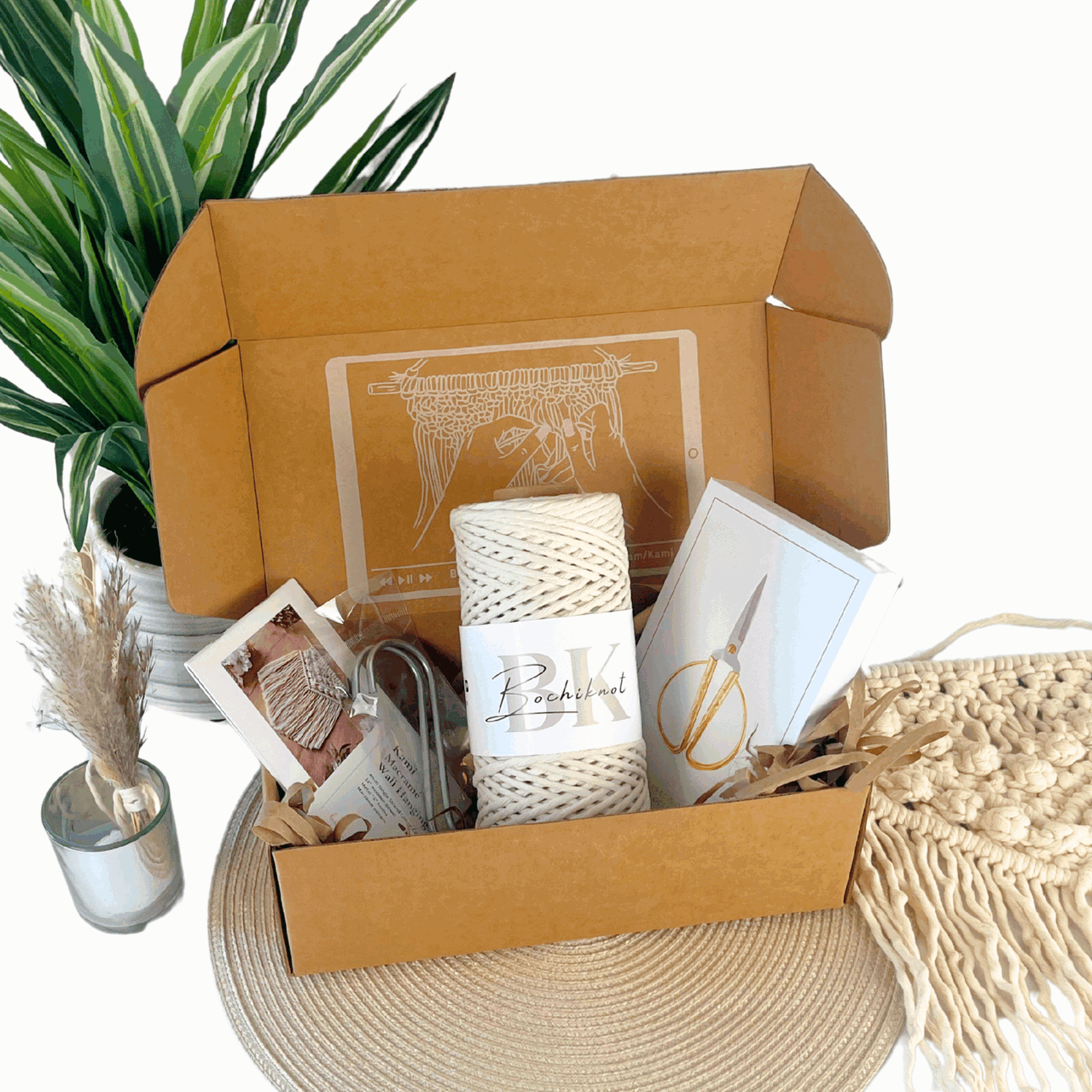
The Macramé Welcome Kit walks you through the lark's head, square knot, double half hitch, and gathering knot — with everything you need (cord, dowel, step-by-step pattern) in one box.
Get the Welcome Kit →Join the Bochiknot Patreon Community
Monthly exclusive patterns, early video access, and 1-on-1 knot feedback.
Become a patron →The gathering knot is the period at the end of every macramé sentence. Once you can tie a clean one, your finished pieces stop looking like beginner work and start looking like the polished projects you've been pinning on Pinterest.
When you finish your first piece with a clean gathering knot, tag @bochiknot on Instagram. Happy knotting. 🌾
Nicole Woo — Founder, Bochiknot
Macramé educator & designer · Teaching since 2018
Nicole is a self-taught macramé artist who left a career in accounting to teach the craft full-time. Through Bochiknot, she's helped thousands of beginners take their first knot — sharing step-by-step tutorials on YouTube, premium cotton cord in the shop, and beginner-friendly kits.
You might also like
Basic knot · Tutorial
How to Tie a Lark's Head Knot
The mounting knot at the start of every project.
Basic knot · Tutorial
How to Tie a Square Knot
The workhorse — plus spiral, alternating, and sennit variations.
Phase 1 · Pillar
Macramé for Beginners: The Complete Guide
The full pillar — 4 knots, supplies, your first project, and more.


Leave a comment